Daily Chore Chart for Kids (Free Printable Bedtime Routine)
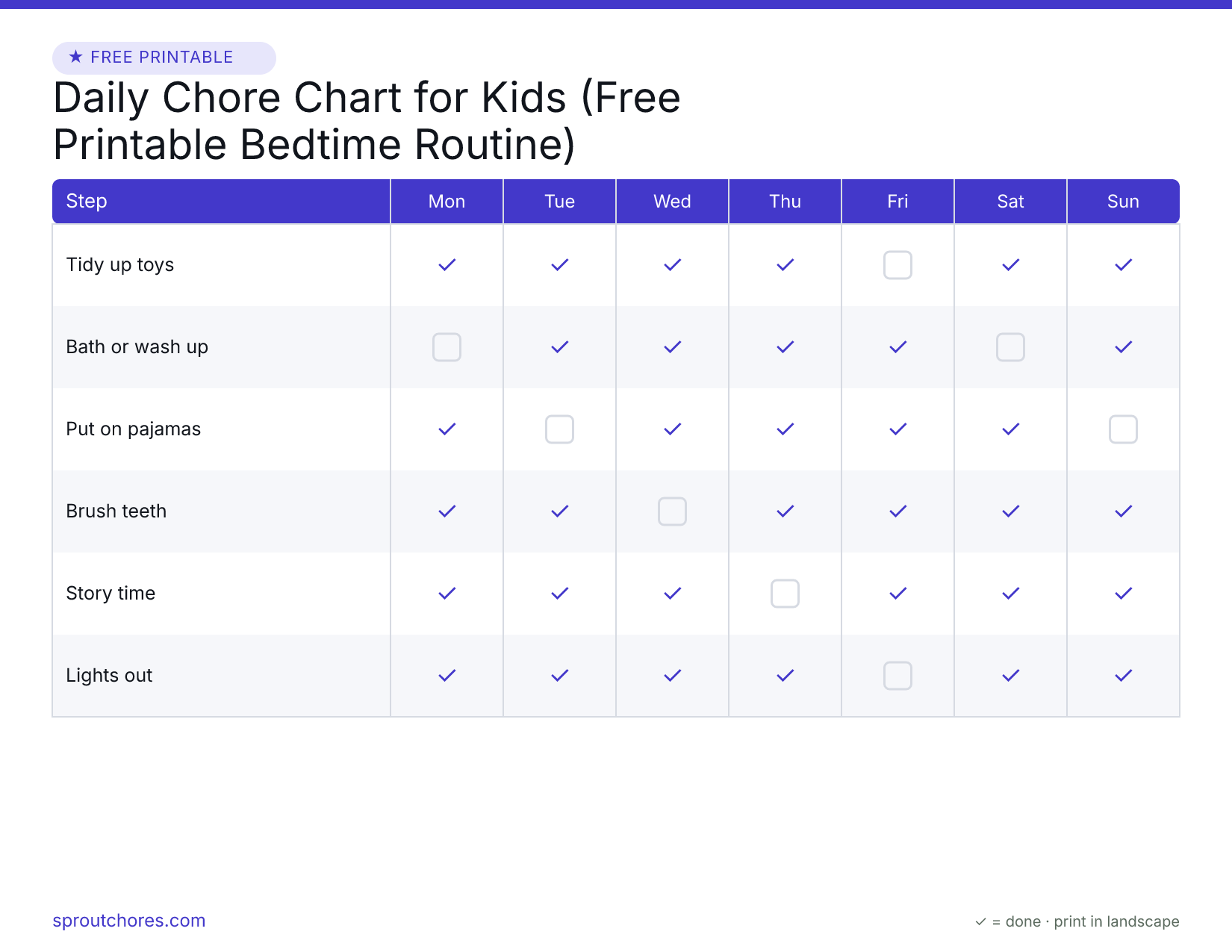
If your evenings tend to fall apart somewhere between dinner and lights-out, you're in good company. This daily chore chart for kids is built for the part of the day that resets the same way every night: the wind-down to sleep. You'll set your own short sequence of steps in the editable maker above, attach a simple picture to each one so even a child who can't read yet can follow it, and print the whole thing for free. I'm Andrew. There are four kids in our house, ages 9 to 18, and over the years we've also opened our home to younger children through foster care. After all of that, the single change that did the most to take the struggle out of bedtime wasn't a clever incentive or a special chart design. It was just letting a child see the same handful of steps happen in the same order, night after night, until the path to bed stopped being a surprise and started being something they already knew by heart.
| Step | Mon | Tue | Wed | Thu | Fri | Sat | Sun | Remove |
|---|---|---|---|---|---|---|---|---|
| Tidy up toys | ||||||||
| Bath or wash up | ||||||||
| Put on pajamas | ||||||||
| Brush teeth | ||||||||
| Story time | ||||||||
| Lights out |
Tip: choose Landscape in the print dialog for the best fit.
Print in landscape for the best fit. A few reminders from our family to yours: do it together the first few times, keep the chart somewhere everyone can see it, and reward steady effort over a perfect job. — The SproutChores family
Why a daily routine, not a weekly one, calms bedtime down
Plenty of chore charts spread tasks across a seven-day grid, and for daytime jobs that works fine. But sleep is different. It happens every single evening, in the same shape, and that sameness is the entire point. A child who can predict what comes next has almost nothing to fight against. The evening stops feeling like something adults spring on them and starts feeling like the last familiar stop on a road they've walked hundreds of times. A printed daily chart holds that order steady for you, which matters most on the nights you're exhausted and would otherwise wing it.
We learned just how much weight predictability carries during our season as foster parents. Two of the little ones who came to us had arrived with barely any rhythm to their days; they'd nod off wherever they happened to be, with no real sense of what followed what. As you'd guess, getting them to sleep was a nightly skirmish. So we gave the whole evening a dependable shape and simply kept it, night after night, even when it was hard. The pushback didn't disappear in a day. But once they could feel each step coming, the standoff softened into something far gentler. What we took from that has shaped how we handle every kid in the house: a lot of what looks like a child refusing bed is really a child who doesn't feel settled, and a routine they can count on is one of the kindest ways to settle them. The body has to calm before any cooperation shows up, and an evening that never changes its order is one of the simplest ways to get a wound-up little one there.
How we actually use the chart at home
Build your steps in the maker above and keep the list short. For a young child, four or five steps is usually plenty; a crowded chart just gets ignored. Once it's printed, think hard about where it goes. A sheet stuck on the side of the fridge is easy to stroll right past. The version that earns its place is the one your child's eyes genuinely land on at the moment each step needs to happen.
With our youngest, one printed page was only the beginning. We'd cut the steps apart into separate little picture cards and post each one right in the spot where that part of the night takes place, so the reminder is waiting for the child exactly where they need it rather than back in the kitchen. One card stays near the bath, another near the bed. The child glances over, sees what's next, and keeps moving without a parent narrating every step. If your kid is a bit older and reading, the printed daily chart on its own is usually enough — they can run a finger down the list and pace themselves.
One more thing that has spared us countless meltdowns, and it's free: give warning before a transition. Announcing "bedtime, right now" to a child deep in play almost guarantees a fight. We hand them a runway instead — a heads-up an hour out, another around fifteen minutes, one last nudge at five — so moving into the routine never lands as an ambush. And I'd quietly reframe what this chart is for. In our home it isn't a scoreboard the kids play against; it's more a check for us, a way to glance back and notice whether the evenings are holding together or coming undone. The willingness to wind down doesn't come from a sticker waiting at the finish. It comes from this simply being how our nights go.
What a calm wind-down looks like, toddler through grade-schooler
We've never trusted a single rigid script for every child. The principle holds firm — same steps, same order, every night — but how you run it bends to the kid standing in front of you.
Toddlers, roughly 2 to 3: keep it tiny and do it together. At this age the steps are basically self-care wearing a costume — into pajamas, a quick wash, teeth — and a toddler learns by imitating, so working through it shoulder to shoulder beats issuing instructions from the doorway. The picture cards do most of the lifting here, since the written words mean nothing yet.
Three to four: a child this age can start working down the sequence with a little more independence, though don't expect it to run clean. They'll stall on one step or skip another entirely, and that's fine; you're laying a habit, not grading a performance. This is a good stretch to let them point at or tick off each step as they finish it, which makes the progress feel like their own.
Four and up: most kids can carry the routine with you nearby rather than hovering, and the printed daily chart really starts to shine, since they can recognize the steps and keep their own pace through wash, teeth, and a story. One honest, bedtime-specific fix worth sharing: with one of our daughters, screens late in the evening were quietly wrecking the entire wind-down. Once we drew a firm line and cut the screens off in the late afternoon, bedtime more or less sorted itself out. If your evenings keep collapsing no matter how good the chart looks, the screen is the first place I'd go looking.
Frequently asked questions
- What's the difference between a daily chore chart and a weekly one?
- A weekly chart spreads tasks across a seven-day grid, which suits daytime jobs that rotate or only happen some days. A daily chore chart for kids does the opposite: it shows the same short sequence that repeats every single day. That's exactly why it fits a bedtime routine — sleep happens every night in the same shape, and the repetition is what makes it predictable. A child who already knows the order has far less to push back against.
- My toddler can't read yet — does a printable chart still help?
- That's precisely where the pictures earn their keep. A clear little drawing of a bath or a bed tells a pre-reader what comes next without a single word. We took it further with our youngest by snipping the steps into separate picture cards and posting each one in the room where it actually happens, so the cue meets the child right where they need it instead of sitting on a distant wall. The visual order quietly becomes a hands-off reminder of what to do and when.
- Should I reward my child for finishing the bedtime routine?
- In our house we keep bedtime clear of rewards. The chart isn't a prize machine; it's there to make the shape of the night visible and to help us, as parents, notice whether the evenings are holding steady. Cooperation grows out of the plain fact that this is simply how our nights run, not from a treat waiting at the end. Dangling a reward right before sleep tends to turn winding down into one more thing to negotiate, which is the last thing anyone wants at that hour.
- How do I get a free printable daily chore chart for kids?
- Use the editable maker on this page: set your own wind-down steps, add a simple picture to each so a young child can follow along, and print it at home. There's no signup and nothing to pay. Keep it to four or five steps for a little one so it feels doable rather than long, and hold the order the same night after night — that steadiness is what actually makes bedtime easier.

About the author
More free printables
Get the free Age-by-Age Chore Chart Pack
Six printable charts (ages 4–10) plus reward and routine sheets, in one tidy PDF. We'll also send new printables and the occasional real parenting tip. The charts on this site are always free — no sign-up needed.
We email you new printables now and then — unsubscribe anytime. Privacy.
Something went wrong — please try again in a moment.
✓ Almost there — check your inbox!
We just emailed you a confirmation link. Click it to confirm, and your free Age-by-Age Chore Chart Pack lands in your inbox moments later.