Chore Chart for a 16-Year-Old: A Free Printable That Works Like an Agreement
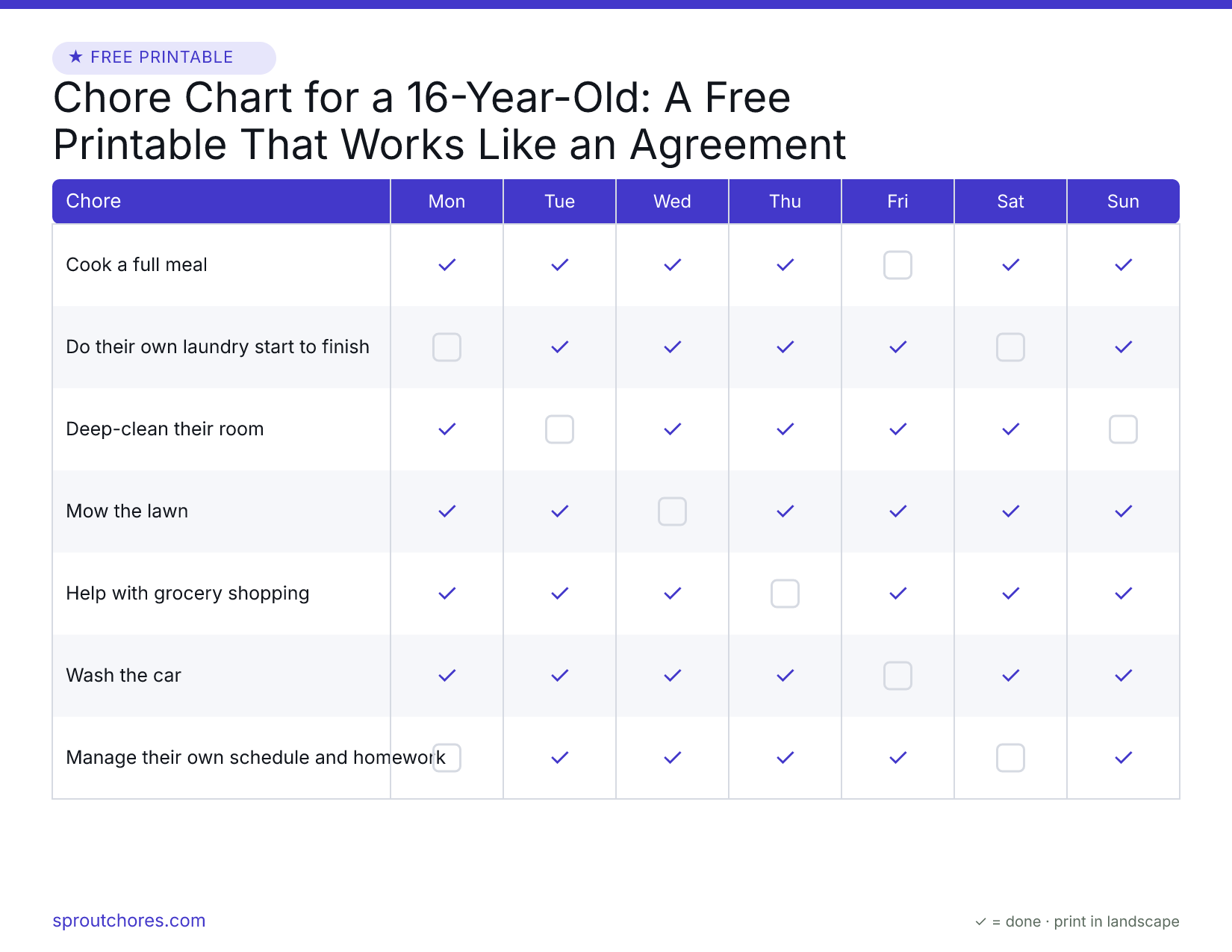
By the time you're printing a chore chart for a 16-year-old, you're not really managing a child's tasks anymore — you're working things out with someone who is a year or two from moving out, might have a first job, and may be learning to drive. That changes what a chart is even for. I'm Andrew; my wife and I are the SproutChores family, raising four kids from nine to eighteen with a season of foster parenting in the mix. We've now walked two of ours through the middle-teen years, and one thing we learned is that around sixteen the old wall grid — the one you check off day by day — quietly outlives its usefulness. What replaces it isn't nothing. It's closer to a standing agreement: a short, plainly worded document that spells out what your teen owns, what you can call on them for, and how the money works, judged across a month rather than a day. The editable printable below is built to be exactly that. You can run it as a simple task grid if your sixteen-year-old still wants that structure, or switch it into agreement mode, which is where most families land by this age. Before you print, hold onto one idea that colors the rest of this page: a chart at sixteen is a way for you to keep an eye on how the responsibility is being carried, not a device for manufacturing the will to carry it. That part has to come from somewhere the paper can't reach.

| Chore | Mon | Tue | Wed | Thu | Fri | Sat | Sun | Remove |
|---|---|---|---|---|---|---|---|---|
| Cook a full meal | ||||||||
| Do their own laundry start to finish | ||||||||
| Deep-clean their room | ||||||||
| Mow the lawn | ||||||||
| Help with grocery shopping | ||||||||
| Wash the car | ||||||||
| Manage their own schedule and homework |
Tip: choose Landscape in the print dialog for the best fit.
Print in landscape for the best fit. A few reminders from our family to yours: do it together the first few times, keep the chart somewhere everyone can see it, and reward steady effort over a perfect job. — The SproutChores family
Want every age in one file? Get the free Age-by-Age Pack
Six printable charts (ages 4–10) plus reward and routine sheets, in one tidy PDF — free, straight to your inbox.
We email you new printables now and then — unsubscribe anytime. Privacy.
Something went wrong — please try again in a moment.
✓ Almost there — check your inbox!
We just emailed you a confirmation link. Click it to confirm, and your free Age-by-Age Chore Chart Pack lands in your inbox moments later.
Age-appropriate chores for a 16-Year-Old: A Free Printable That Works Like an Agreement
Every chore below is pre-loaded in the generator above and is something a child in this age range can realistically manage with a little initial guidance:
- Cook a full meal
- Do their own laundry start to finish
- Deep-clean their room
- Mow the lawn
- Help with grocery shopping
- Wash the car
- Manage their own schedule and homework
What a 16-Year-Old Can Really Own — Around a Job and a License
At sixteen, the question of whether your teen can do a thing is settled — they can cook, clean a bathroom to a real standard, run laundry from hamper to drawer, mind a younger sibling, handle a car's worth of errands. Skill stopped being the bottleneck years ago. What sixteen actually tests is reliability when life is pulling in five directions at once: a work shift, driving practice, homework, and a social calendar that suddenly feels more urgent than any of it. So the useful move at this age isn't loading more chores onto a list. It's handing over entire areas of the household and asking your teen to keep them running without you tracking each step.
That shift is the whole game. "Wipe the counters tonight" is still you doing the thinking. "The kitchen is yours to keep livable, on whatever rhythm works around your schedule" asks them to own an outcome and manage themselves toward it — around a job and everything else. That second version is the one that builds a functioning adult, and by sixteen it's barely a rehearsal anymore. A teen this age with a part-time job is already answering to a boss, clocking in on time, and being judged on whether the work got done. The responsibilities you hand them at home are the same lesson in a lower-stakes room.
Somewhere along the way I stopped seeing chores as a means to a clean house. The tidy kitchen is a nice side effect; what I'm really after is a person who can run a life without someone standing behind them. I think of the jobs on the chart as reps for the adult life they're about to step into on their own — and at sixteen, some of those reps are already happening for real, on someone else's payroll.
Why the Wall Chart Retires at Sixteen (and What Replaces It)
Here's the move that surprised me as a parent: with our older teens, we more or less retired the daily chore chart. Tracking a sixteen-year-old box by box is a losing battle — they aren't home on a predictable schedule anymore, and honestly, a checkbox grid is a tool for someone who still needs to be shown the shape of a day. By the middle teens, what worked far better was a standing arrangement, which is why this printable has an agreement mode. Instead of ticking off tasks each morning, you write down the handful of things your teen owns, add that you may ask them ahead of time for specific jobs — covering a sibling for an evening, a proper clean before company, cooking a night that week — and then you look at the whole picture across the month rather than the day.
Why monthly? Because that's how the adult world actually judges people. No decent boss trails you around checking off each small task; they hand you a role and weigh whether you carried it over a stretch of time. Doing it that way at home also kills the nagging, which at sixteen is poison — nothing turns a near-adult against you faster than being managed like a ten-year-old. The way we handle the inevitable dropped ball is closer to how a good manager operates than a hovering parent. We lay out plainly what's theirs to handle, make sure they have what they need to do it, then step back and let real results land when they don't follow through, instead of rushing in to patch it. If catching them every time becomes the pattern, the only thing they learn is that letting it slide summons a rescue. A consequence shaped like the real world — the way missing something at a job costs you the shift, the trust, or the money — is what actually teaches at this age.
Two habits keep the peace inside all of this. One is giving a heads-up before you need something rather than springing it on a teen mid-focus; an hour's notice turns a standoff into a shrug. The other is building the whole thing to be easy to restart. A busy stretch — exams, a run of long work shifts, a family trip — will knock the arrangement over, and most people read that collapse as proof the system failed. It didn't; it just met an ordinary week. Set it up so you can stand it back up in five minutes when things settle, because you'll be doing that more than once, and that's normal rather than defeat.
Money at Sixteen: A Monthly Deal, Not a Per-Chore Tab
A lot of parents arrive on this page wanting to know how to pay a sixteen-year-old, so here's exactly what we do and what we refuse to do. We don't attach a price to individual chores. Put a dollar figure on each task and a sharp sixteen-year-old will do the math in about four seconds, then cheerfully skip whatever isn't worth their time. That isn't laziness — it's a rational response to a system you accidentally built.
What we use instead looks a lot more like employment than an allowance. Our teenagers get a set amount each month — for us it's landed around seventy-five dollars, though the number is yours to set — and it's strictly for wants: the coffee runs, the concert ticket, the thing they've been quietly saving glances at. Every real need is covered no matter what, which is the point; because the money only touches the fun stuff, watching it shrink actually registers. The amount isn't tied to a tally of boxes. It rides on the full month — whether the work they owned held up, whether they stayed dependable without being chased, and the attitude they brought to it. Slip on the follow-through and the figure comes down when the month closes. Let it truly fall apart and the money pauses entirely until they string together a couple of steady weeks and earn it back.
Two things stay well away from this money. Screens and behavior live in their own lane — we don't make our kids buy screen time with chores, and we don't shave the monthly amount because an unrelated mood went sideways. When there's a genuine behavior problem, losing screen time is the separate lever we reach for. Let those wires cross and a clever sixteen-year-old turns every request in the house into a negotiation, which is exhausting with someone this good at arguing. And if your teen has landed their own job now, don't scrap the family arrangement — it teaches a different muscle. Their paycheck rewards showing up for a shift; the home deal rewards being a dependable member of a household nobody's paying them to care about. Both matter, and the second one is the one they'll lean on for the rest of their life.
Frequently asked questions
- What chores should a 16-year-old be responsible for?
- By sixteen, capability isn't the limit — a teen this age can cook real meals, run their own laundry, keep a bathroom and shared spaces genuinely clean, handle trash and recycling, look after younger siblings, and take on bigger jobs indoors and out. So rather than a longer list, we hand over whole areas to own and manage without supervision, which mirrors how adult responsibility actually works. In this printable's agreement mode you write down the domains your sixteen-year-old owns plus the standing jobs you can call on, and you judge it over the month instead of task by task.
- Should a 16-year-old with a job still have to do chores at home?
- Yes, and here's why we don't let a job buy them out of it. A paycheck teaches one thing — show up for your shift and get paid — but contributing at home teaches a different and, honestly, more important thing: being a dependable part of a household that isn't paying you to care. We keep the home responsibilities lighter and more flexible once a teen is working real hours, and we move to a monthly agreement rather than a daily grid so it bends around their schedule. But we don't drop it. The point was never the labor; it's the habit of pulling your weight for the people you live with.
- How much should I pay a 16-year-old for chores?
- We don't price chores individually, because a sixteen-year-old will just skip whatever task pays the least. What's worked for us is a set monthly amount — around seventy-five dollars in our house, though you set your own number — that's strictly for wants while we cover every need. It isn't attached to checkboxes; it rides on how the whole month went, meaning whether the work held up, whether they stayed reliable without reminders, and the attitude behind it. If the follow-through slips, the amount comes down at month-end; if it collapses, it pauses until they rebuild a couple of steady weeks. Treat it as a read on the month, not a bill you owe per chore.
- How do I get my 16-year-old to do chores without constant nagging?
- Stop managing them by the task and start handing over whole responsibilities, then let real consequences do the teaching. A sixteen-year-old tunes out a lecture the same way you tuned out your own parents, but a result that mirrors the real world — the way flaking at a job costs you something — actually lands. Give a heads-up before you need something instead of demanding it on the spot, resist the urge to rescue them every time they drop the ball, and lean on the plain expectation that everyone in the family pitches in rather than on the chart itself. The chart's real job is to let you see who's keeping up, not to supply the motivation.

About the author
More free printables
Get the free Age-by-Age Chore Chart Pack
Six printable charts (ages 4–10) plus reward and routine sheets, in one tidy PDF. We'll also send new printables and the occasional real parenting tip. The charts on this site are always free — no sign-up needed.
We email you new printables now and then — unsubscribe anytime. Privacy.
Something went wrong — please try again in a moment.
✓ Almost there — check your inbox!
We just emailed you a confirmation link. Click it to confirm, and your free Age-by-Age Chore Chart Pack lands in your inbox moments later.