Sticker Chart for Kids (Free Printable Sticker Reward Chart)
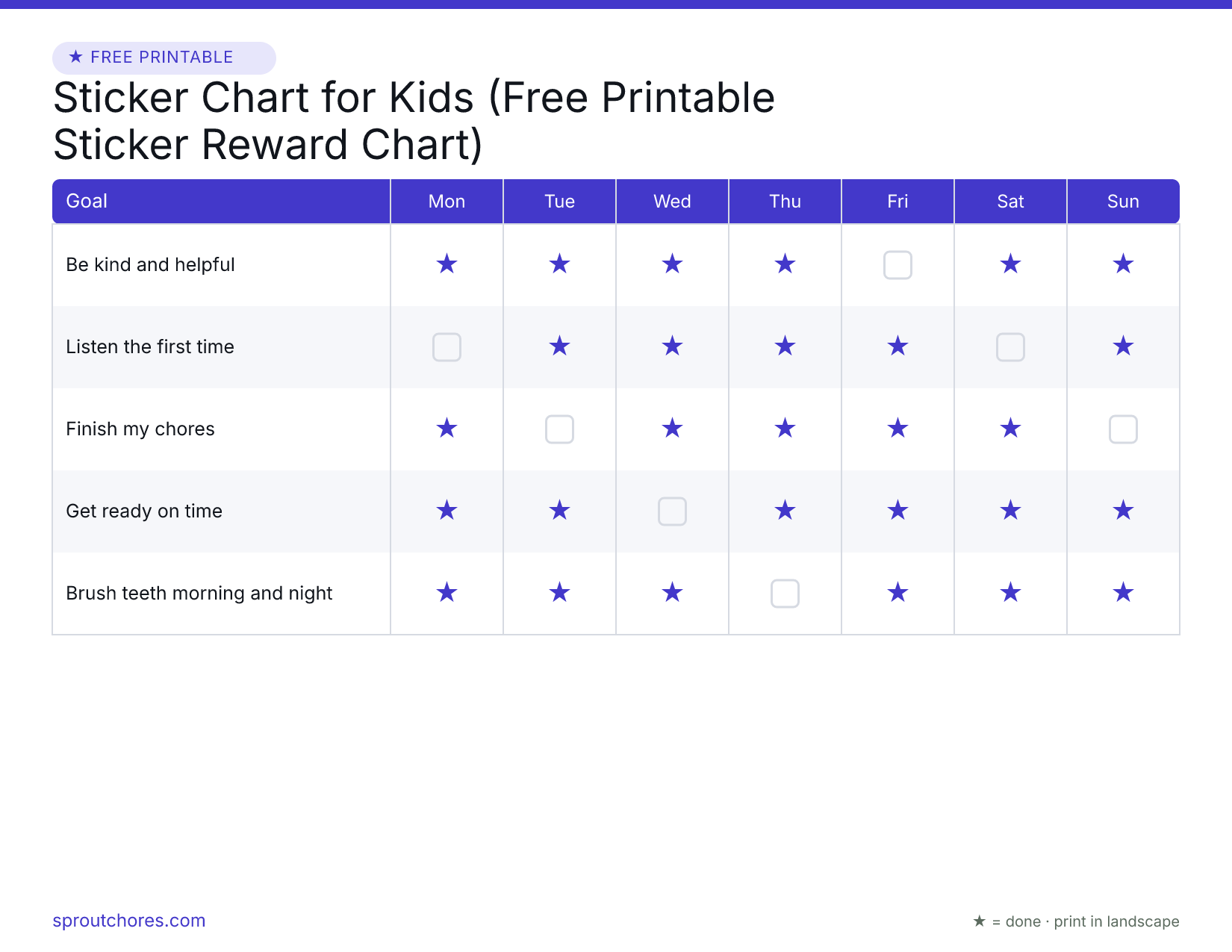
A sticker chart is the most low-tech motivation tool there is, and for a lot of young kids it simply works: a grid on the wall, one square to fill each day, and the small, satisfying ritual of peeling a sticker and pressing it down. The maker on this page builds that grid for you — type in the habit you're working on, keep the days of the week running across the top, and print it free for the fridge or a bedroom door, no account required. Our one strong suggestion before you start: point it at a single habit and make one sticker a day the whole game, because a chart crowded with demands is the fastest way to get everyone to stop looking at it. A quick word on who's giving the advice. I'm Andrew, and with my wife I'm raising four kids from nine to eighteen; we've also fostered younger ones for months at a time, so we've filled in a lot of these squares. The most useful thing we've learned is that a sticker chart earns its keep as a way for you to see how a new habit is landing across the week — not as a device for buying good behavior out of a child. Kids lean into a home where they're genuinely part of things; the sticker is just a little momentum while a habit is still finding its legs. Build yours below, then read on for how we keep one working.
| Goal | Mon | Tue | Wed | Thu | Fri | Sat | Sun | Remove |
|---|---|---|---|---|---|---|---|---|
| Be kind and helpful | ||||||||
| Listen the first time | ||||||||
| Finish my chores | ||||||||
| Get ready on time | ||||||||
| Brush teeth morning and night |
Tip: choose Landscape in the print dialog for the best fit.
Print in landscape for the best fit. A few reminders from our family to yours: do it together the first few times, keep the chart somewhere everyone can see it, and reward steady effort over a perfect job. — The SproutChores family
Want every age in one file? Get the free Age-by-Age Pack
Six printable charts (ages 4–10) plus reward and routine sheets, in one tidy PDF — free, straight to your inbox.
We email you new printables now and then — unsubscribe anytime. Privacy.
Something went wrong — please try again in a moment.
✓ Almost there — check your inbox!
We just emailed you a confirmation link. Click it to confirm, and your free Age-by-Age Chore Chart Pack lands in your inbox moments later.
Start with one habit, not a wish list
The strong pull with a blank sticker chart is to fill it with every behavior you wish you saw more of. Resist that, especially at the start. Pick one habit and make a single daily sticker the entire goal — climbing into bed and staying there, getting dressed without a standoff, using gentle hands with a sibling. A young child can hold exactly one target in their head; a whole row of them just becomes something the family learns to tune out.
Placement decides as much as content. Hang it low, at your child's eye level, right where the habit happens — a chart tucked somewhere only grown-ups glance never earns a single sticker. Then phrase the goal so plainly there's nothing to argue about. "Teeth brushed before your story" is a finish line a four-year-old can see; "be good at bedtime" is an open invitation to negotiate that you'll lose most nights.
Two small moves of our own have spared us more friction than any reward. One is a bit of warning before a transition — letting a child know a few minutes ahead that brushing or clean-up is coming, rather than announcing it out of nowhere, defuses most of the pushback. The other is a line we never cross: once a sticker is on the chart, it stays. The moment stickers can be taken away, the whole thing starts to feel like a losing game, and kids stop buying in. Keep the wins up on the wall, and deal with the rough afternoons face to face instead of docking the board.
Using a sticker chart for behavior, potty training, and different ages
"Kids" spans a huge range, and a sticker chart means something a little different at each end of it. For twos and threes, treat it as a rhythm-builder more than a motivator: self-care steps like getting dressed, tidying their own mess, or brushing. Don't expect it done well — you'll be redoing a fair bit yourself, and that's not the chart failing. At this age the sticker just marks that the routine happened, and the repetition is the whole point. By five through eight, the same chart shifts toward follow-through — doing the thing without being asked — and kids this age take real pride in a full, unbroken week.
If you're reaching for a sticker chart for behavior rather than a task, the one-habit rule matters even more. Trying to overhaul everything at once overwhelms a young child; naming a single behavior — speaking kindly when frustrated, staying at the table through dinner, using words instead of yelling — gives them something specific and reachable to aim at. A potty-training chart is really the same idea narrowed to one skill: a sticker for each success while a brand-new ability takes root. Whatever the goal, remember what the chart can and can't do. It carries a habit through its shaky early stretch; it doesn't do the teaching. A child's body, their readiness, and plain repetition are what actually get them there.
Rewards that stay a treat, not a paycheck
Treat a reward as a bit of shine at the end of a good run, not as pay and not as the reason your child cooperates. With young kids, the sticker is frequently prize enough on its own — for a lot of them the peeling and the pressing is the payoff — and a warm, genuine "look at you!" in the moment usually outperforms anything from a store. So lead with that. When a longer stretch of effort deserves a little more, the cheapest thing worked best for us: a shoebox of dollar-store trinkets a child could dig into every so often. Nothing in it was worth arguing over, so handing one out never turned into a negotiation, and it still landed as a real treat.
Where we draw firm lines is around what the chart is allowed to touch. Screens and regular fun stay off it — once a kid has to earn those through good behavior, normal life at home starts to feel transactional, and that mindset is tough to unwind later. We also keep sticker charts separate from the ordinary jobs a child does just because they're part of the household. Those aren't something we pay out for; they're one of the ways kids rehearse the skills adult life will ask of them, and they're a shared responsibility, not a service rendered. That separation is the whole reason a sticker chart belongs on a fresh habit and not on the chores we already expect — it stops a temporary boost from quietly turning everyday contribution into something a child expects to be paid for. If money enters at all, it shows up later as an allowance, and we tie that to the big picture — whether a child is dependable, puts in honest effort, and brings a decent attitude — rather than to any individual sticker.
What the chart is really for, and when to take it down
Here's the piece most sticker-chart advice skips: the chart isn't mainly there to motivate your child. It's there to inform you. A glance down a week of filled and empty squares tells you which habit is taking hold and which one keeps slipping, so you can lean in or ease off without a single nag. Treat it as a read on how the week is going, not a scoreboard your child is running up.
That same read tells you when you're finished. Once a habit runs on its own — the child does it without the sticker even crossing their mind — you can retire that goal quietly, no big ceremony, and aim a fresh sticker at whatever's still wobbly if you like. Expect some backsliding when they're tired or a week goes sideways; that's not the system breaking. The routines that survive aren't the perfect ones; they're the ones simple enough to restart after a chaotic week has knocked them sideways.
And don't try to judge progress day by day, because change in a young child is nearly impossible to see up close — you only catch it looking back. The step that took three reminders last spring just happens on its own now, and that shift never shows up in one triumphant week of stickers; it grows out of months of the same calm expectation. We saw the quiet power of that predictability most clearly while fostering. The children who spent time with us had rarely known a dependable day, and what actually helped them settle wasn't a reward hanging on a wall — it was being able to count on what came next; a rhythm they could trust did what no prize ever could. It's also worth knowing that a chart which captivates one child can be completely invisible to the next, even within the same family. One of ours loved building her own version and following it to the letter; another hardly noticed it and did far better with a steady routine and a nudge in the moment. Neither was doing it wrong — if a sticker chart clicks for your child, wonderful, and if it doesn't, that's useful to know too.
Frequently asked questions
- How does a sticker chart work?
- At its simplest, a sticker chart is a grid where your child earns one sticker each time they do the habit you're working on — usually once a day — and the row fills up as the days go by. The filling-up is the point: a young child can see progress they can't yet feel, and the small ritual of choosing a sticker and pressing it on is often more motivating than whatever's waiting at the end. For it to actually work, keep it to a single habit, put the sticker on right when the good thing happens so a toddler connects the two, and let the chart only ever move forward — no taking stickers back. Used that way, it carries a new habit through its wobbly first weeks while giving you a clear read on how it's going.
- Do sticker charts actually work for kids?
- They can, but not quite the way the packaging implies. In our experience the sticker doesn't manufacture motivation — it gives a brand-new habit a little cheer while it forms and hands you a week-at-a-glance picture of how things are landing. As a short, upbeat nudge it earns its place; as a long-term payment plan it tends to fall apart. Lasting drive comes from a child feeling capable and feeling genuinely needed at home, not from a prize. So lean on it as a tool for you and a bit of fun for your child, keep it clear of the everyday jobs everyone pitches in on, and don't be discouraged when the stickers eventually lose their pull — that usually means the habit has stuck.
- What age is a sticker chart best for?
- Sticker charts tend to land best from about age two through eight. With toddlers, think of the chart as a routine cue rather than a motivator — it marks that a step happened, and you'll still be doing much of the work alongside them, which is completely normal at that age. From roughly five to eight, kids get more out of it: they can follow a whole week, take real pride in an unbroken row, and need fewer reminders. Past eight or nine, most kids outgrow stickers, and a plainer checklist or an allowance tied to their overall follow-through usually fits better. And remember that some kids love a chart while others barely notice one — both are normal, so don't force it if it clearly isn't landing.
- How do I make a free printable sticker chart?
- Use the editable maker on this page: type in the one habit you're focusing on, keep the days of the week across the top, and print it at home for the fridge or a bedroom door. There's no signup and nothing to pay, and you can start fresh any time you want to switch habits. If you'd rather begin from a blank template and hand-write the goal yourself, that works just as well — the only rules that really matter are keeping it to a single habit and hanging it somewhere your child will actually see it.

About the author
More free printables
Get the free Age-by-Age Chore Chart Pack
Six printable charts (ages 4–10) plus reward and routine sheets, in one tidy PDF. We'll also send new printables and the occasional real parenting tip. The charts on this site are always free — no sign-up needed.
We email you new printables now and then — unsubscribe anytime. Privacy.
Something went wrong — please try again in a moment.
✓ Almost there — check your inbox!
We just emailed you a confirmation link. Click it to confirm, and your free Age-by-Age Chore Chart Pack lands in your inbox moments later.