Chore Chart for a Family of 3: A Column for Each Person
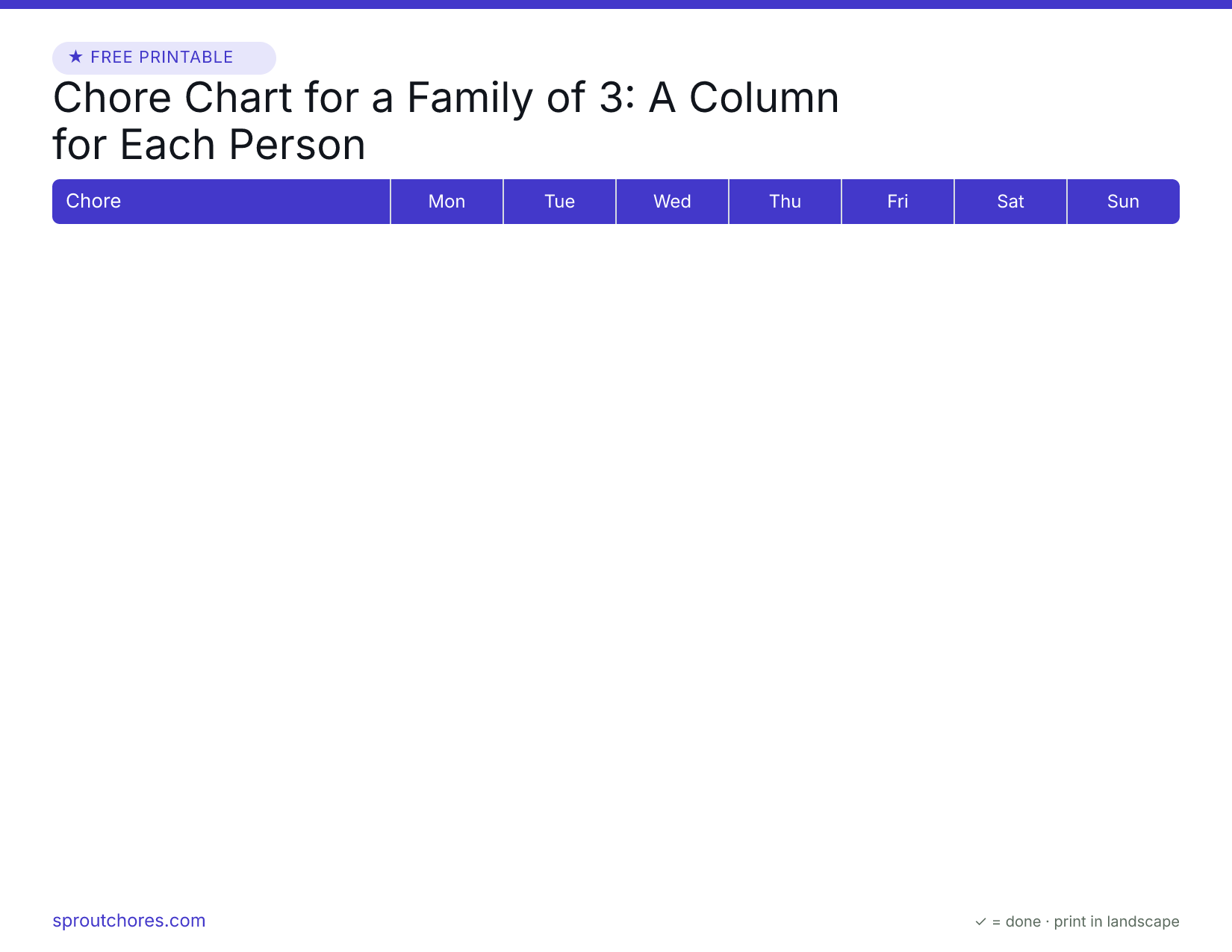
A family of three sits in an odd blind spot. Most printable charts are drawn for a big pile of kids, and the ones that aren't usually assume a neat two-parents-and-two-kids setup — so a household of three ends up with columns it doesn't need or a template that never quite fits. The generator on this page starts from your actual house instead. Give it three people, name them, type in the jobs your week really produces, and it lays out a clean weekly grid with a column for each person that you can edit, print, and post on the fridge. I'm Andrew, and my wife and I are the family behind SproutChores. Our own house runs louder than three — four kids between nine and eighteen, plus the children we've fostered over the years — but a chore chart for a family of 3 is one of the setups people ask us about most, partly because three comes in two very different shapes. One thing worth saying before you build: in our experience a chart like this earns its keep as a tracking tool for the grown-ups, not as a sticker gimmick to talk a kid into pitching in. Add your three people and lay out the chart your home actually runs on.
| Chore | Mon | Tue | Wed | Thu | Fri | Sat | Sun | Remove |
|---|
Tip: choose Landscape in the print dialog for the best fit.
Print in landscape for the best fit. A few reminders from our family to yours: do it together the first few times, keep the chart somewhere everyone can see it, and reward steady effort over a perfect job. — The SproutChores family
Want every age in one file? Get the free Age-by-Age Pack
Six printable charts (ages 4–10) plus reward and routine sheets, in one tidy PDF — free, straight to your inbox.
We email you new printables now and then — unsubscribe anytime. Privacy.
Something went wrong — please try again in a moment.
✓ Almost there — check your inbox!
We just emailed you a confirmation link. Click it to confirm, and your free Age-by-Age Chore Chart Pack lands in your inbox moments later.
Who Goes on a Family-of-3 Chart
A three-person household almost always shows up as one of two shapes. The first is two parents and a single child — the only-kid home. The second is one parent raising two kids. There are other versions too: a parent living with a grandparent and one child, or a single mom or dad with a teen and a preteen. The generator doesn't care which one you are. It hands you three columns and lets you fill them with whoever actually lives under your roof.
The part I'd insist on either way: put every adult in the house on the chart. It's tempting to treat the grid as the kids' section and leave the grown-ups off it, but a chart that only lists children quietly announces that housework is a kid problem the adults have opted out of — and kids read that fast. When your name sits in a column right beside theirs, carrying real jobs and not token ones, the whole sheet turns into an honest picture of how three people keep a home running together.
There's also a plain practical upside to exactly three: it's the roomiest a per-person chart ever gets. Three columns lay out big and legible on a single page, so you can write real task descriptions in each box instead of cramming abbreviations into a crowded grid. A chart people can actually read from across the kitchen is a chart that gets used, not one that fades into fridge decoration.
When It's Two Parents and One Child
With an only child, the daily fairness fight most families know — "how come I have to and she doesn't" — simply never happens; there's no sibling to compare against. But a quieter problem slips in to take its place. It is genuinely faster for two capable adults to just handle everything themselves, and an only child can drift into being a kind of guest in their own home, waited on without ever noticing the work that keeps the place going.
The chart is the correction. It carves out a real, visible share for the one kid and sets it right next to two adult columns, so the idea that everybody here carries some of the load becomes something your child reads off the wall instead of something you have to keep repeating. For the handful of jobs nobody enjoys, run a three-way rotation that includes the two of you — a kid takes the grim week far more gracefully when the grid shows plainly that the same task lands on Mom or Dad next time around.
And here's a reframe we come back to often, especially for an only child: they'll never split a household with a sibling someday. When they move out, the whole thing is theirs — every load of laundry, every sink of dishes, every bill and repair. So the real point of their column was never getting tonight's dishes done. It's the quiet accumulation of reps that turns, years down the line, into an adult who can actually run a home without being walked through it.
When It's One Parent and Two Kids
A single parent with two kids is carrying an entire adult's share of the house alone, and this is exactly where a chart stops being optional. Its first job here is honest accounting: one glance tells you who's really doing what, so you can hand genuine work to the kids instead of silently absorbing all of it and grinding yourself down. Give them real jobs, not busywork designed to look like helping.
Because there are only two children, fairness runs one-to-one and loud — every comparison is direct. The instinct is to make their two columns match exactly. Resist it. A seven-year-old and a twelve-year-old can't shoulder the same load, and forcing an even split mostly teaches the older, more able one that being good at things just earns you more work — a lesson that sours quickly. Match each kid to what they can genuinely handle right now and let it grow as they do. What stays identical across both columns isn't the task list; it's the expectation that each of them contributes something that matters. Kids take an uneven split better than adults expect, as long as they can see the lighter load reflects age and not favoritism.
The two of them will probably be wired differently, too. One of our girls took to charts instantly — she likes designing her own and coloring in the boxes. Another of our kids barely registers that a chart exists; for him a grid on the wall does nothing, and what actually moves him is being told the next task in the moment. Same parents, same kitchen, completely different operating systems. Don't assume one chart style lands for both children. Put the dreaded jobs on a rotation that swaps between the two of them week to week, keep the expectation steady, and meet each kid where they actually are rather than where you wish they were.
The Chart Is Your Tracking Tool — Build It to Survive a Bad Week
It's worth being clear about what this chart is for, because it's easy to turn it into the wrong thing. In our house its real job is to give the adults a fast read on how each person is doing, so we know where to lean in and where to ease off. It's an instrument for seeing the household clearly, not a machine for making kids perform.
That's why we keep a few things deliberately off it. Rewards and screen time don't live on the chart — we don't make our kids buy their fun with chores, and we don't price jobs out one at a time. The moment a task comes with a dollar figure, you've taught a kid to ask what a chore pays before deciding it's worth doing, which is the opposite of the point. Allowance does exist for our younger two, but it tracks the bigger picture — whether they showed up reliably, did the work properly, and brought a decent attitude over weeks — rather than getting billed chore by chore.
Progress here is nearly invisible in the moment; you only see it looking back. Our youngest once needed a reminder for every single step, and now he gathers all the household trash on his own without anyone asking — but that shift arrived after years of quiet consistency, not from any clever chart. Which brings me to the biggest mistake I see: a family engineers a flawless system, then a vacation or a stomach bug or one genuinely chaotic stretch knocks it over, and they decide the whole idea failed. It didn't — the plan just wasn't built to bend. The version that lasts is the one you can pick back up without ceremony, and that matters double when one adult is running the show. We learned how much a dependable rhythm steadies kids while fostering children who came to us from homes with no structure at all: what settled them wasn't a prize sitting on top of the routine, it was trusting that the rhythm wouldn't change on them overnight. A three-person chart you can count on to stay put beats a clever one that shatters the first time real life gets in the way.
Frequently asked questions
- What chores go on a chore chart for a family of 3?
- There's no fixed list, and that's deliberate — the chart above is blank so you fill it with the jobs your household actually generates rather than a generic set half of which won't apply to you. The approach we use: give each of the three people a column, adults included, and match each person's jobs to what they can genuinely handle. A young child might own one or two small daily tasks, an older kid can take a whole zone like the kitchen or the trash, and the grown-ups carry the heavier or less visible load. Put the jobs nobody likes on a rotation so they move between people over the week. If you're hunting for chore chart ideas for a family of 3, start there — the one standard that stays constant for everyone is simply that they contribute something real.
- Should both parents be on a family-of-3 chore chart?
- Both, every time — and with an only child it matters even more. A chart that lists just the kid tells them, without a word, that housework is a child's job the adults have exempted themselves from, and an only kid especially can slide into being served rather than sharing the work. When your responsibilities sit in the grid beside theirs, chores stop reading as a punishment handed down and start looking like what all three of you do to keep the place running. If you're a single parent with two kids, the same logic holds: your column, carrying real work, is the clearest signal that this is a shared load and not something dumped on the children.
- How do I make a weekly chore chart for a family of 3?
- Use the generator on this page: set it to three people, add each person's name — both adults included — and type in the chores your week actually requires. It lays out a single weekly grid with a column per person and a row per job, which you can edit, print, and post somewhere everyone passes. A few things that make a family of 3 chore chart printable stick: match each person's jobs to their age and ability rather than forcing an identical split, rotate the unpopular tasks so they shift week to week, and keep the sheet somewhere visible so it does the reminding instead of you. If your household grows or shrinks, just add or remove a column and reprint.

About the author
More free printables
Get the free Age-by-Age Chore Chart Pack
Six printable charts (ages 4–10) plus reward and routine sheets, in one tidy PDF. We'll also send new printables and the occasional real parenting tip. The charts on this site are always free — no sign-up needed.
We email you new printables now and then — unsubscribe anytime. Privacy.
Something went wrong — please try again in a moment.
✓ Almost there — check your inbox!
We just emailed you a confirmation link. Click it to confirm, and your free Age-by-Age Chore Chart Pack lands in your inbox moments later.