Chore Chart for a Family of 5: Two Parents, Three Kids, One Grid
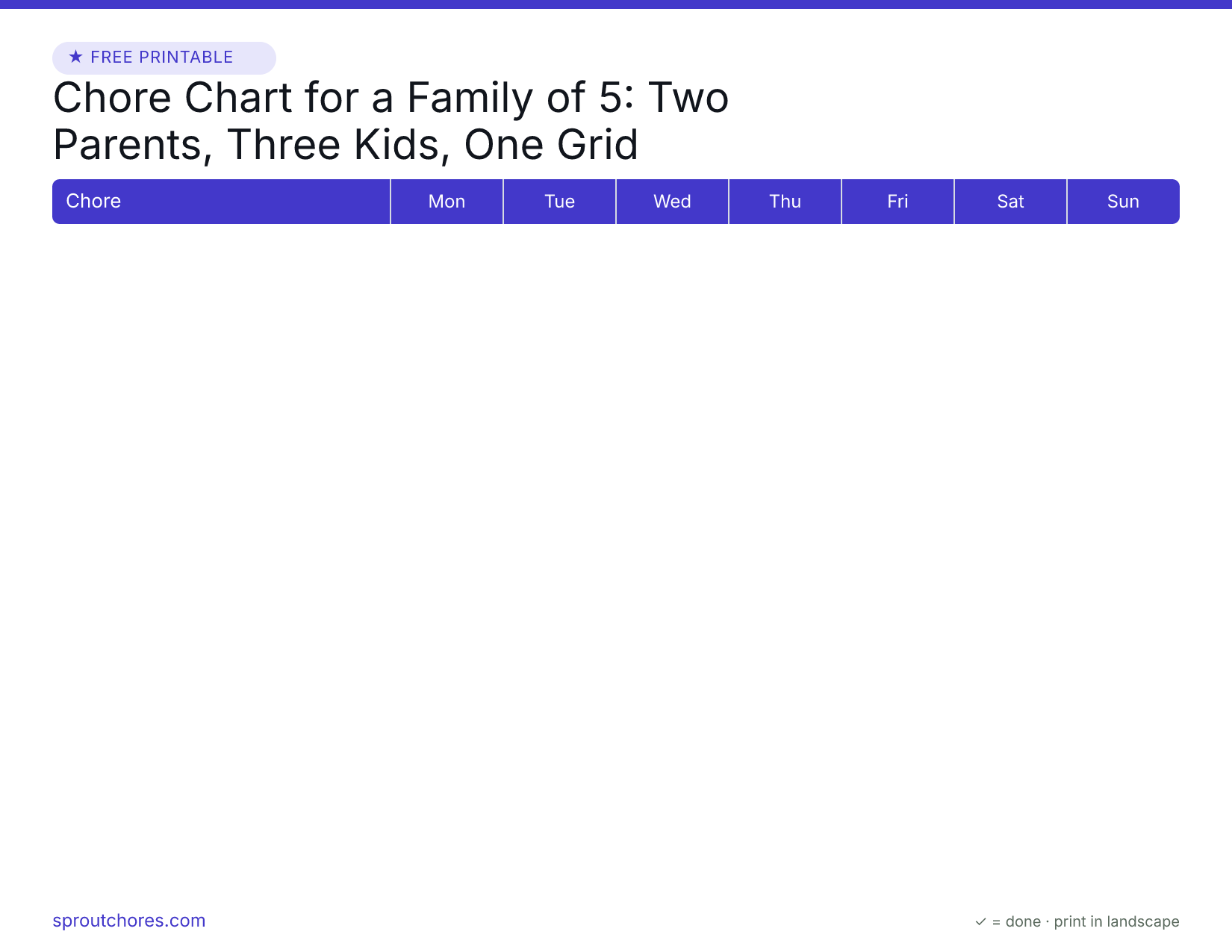
If your household is five people, the odds are good it's two grown-ups and three kids spread across a few different ages — and that middle size is oddly under-served. Most printables are built either for a tidy family of four or a sprawling family of six, and neither quite fits when you've got three children at three different stages plus two adults who belong on the chart too. The generator below builds the version you actually need: name everyone who lives with you, give each of the five a column, type in the jobs your week really involves, and it lays out a clean weekly grid you can edit, print, and stick on the fridge. I'm Andrew, and my wife and I are the SproutChores family. Our own house runs bigger — four kids from nine to eighteen, plus the foster children we've cared for over the years — but a five-person, three-kid home sits right in the range we live in every day, and the way we share a load carries straight over to it. One thing I'll flag up front, because it colors everything below: a chart like this earns its keep as a tracking tool, not as a carrot for the kids. Its job is to give the two of us a clear, week-to-week read on how each person is doing, so effort doesn't go unnoticed and the load stays honest. Add your five people and build the chart your home actually runs on.
| Chore | Mon | Tue | Wed | Thu | Fri | Sat | Sun | Remove |
|---|
Tip: choose Landscape in the print dialog for the best fit.
Print in landscape for the best fit. A few reminders from our family to yours: do it together the first few times, keep the chart somewhere everyone can see it, and reward steady effort over a perfect job. — The SproutChores family
Want every age in one file? Get the free Age-by-Age Pack
Six printable charts (ages 4–10) plus reward and routine sheets, in one tidy PDF — free, straight to your inbox.
We email you new printables now and then — unsubscribe anytime. Privacy.
Something went wrong — please try again in a moment.
✓ Almost there — check your inbox!
We just emailed you a confirmation link. Click it to confirm, and your free Age-by-Age Chore Chart Pack lands in your inbox moments later.
Who Belongs on a Family-of-Five Chart
The typical family of five is two parents and three kids, often with real gaps between them — a teenager, a middle child in grade school, and a little one still learning to dress himself. But five-person homes come in other shapes too: one parent with four kids, two adults raising three children, a household with a grandparent in the mix. The generator doesn't need to know which; it hands you five columns and lets you drop in whoever lives under your roof.
The part I'd argue hardest for is putting both adults into two of those columns. With three sets of kid eyes on the wall instead of one or two, a chart that lists only the children broadcasts a message louder than you'd like — that keeping the house going is a kid's job while the grown-ups sit it out. Children clock that fast, and it breeds the exact resentment you're trying to head off. When your name and your partner's sit in the grid with real jobs beside them, the whole thing reads for what it is: a picture of how five people keep one home running. In our house the through-line is plain — if you live here, you have a hand in running the place — and nothing makes that land like kids seeing the adults' names carrying weight too.
One practical heads-up for exactly five: this is the size where the grid starts to feel snug. Four columns sprawl comfortably on a page; five is the point where you'll want to keep task labels short, print it a notch larger, or flip the page to landscape so every box stays readable. A chart people can take in at a glance is a chart people actually use.
Three Kids, Three Stages: Match the Load, Don't Split It Evenly
The thing that really defines a family-of-five chart is the three kids. An odd number changes the math on fairness: there's always a middle, and every comparison runs three ways instead of head-to-head, so "why does he get the easy one" has two other columns to point at. The instinct is to make all three kids' columns look identical. Don't. If your three span, say, six to sixteen, an even split either crushes the youngest or coasts the oldest — and matching loads mostly teaches your most capable kid that being good at things just earns more work, a lesson that curdles quickly.
We assign by what each kid can genuinely handle at this point and let the load climb as they grow into it. None of it is really about getting the house spotless tonight, either — we treat chores as rehearsal for running a home of their own someday, which is exactly why we can shrug off a shaky first attempt and let the skill build over years. What stays identical across the three columns isn't the tasks; it's the plain expectation that each of them owns something that genuinely matters. Kids take "different but fair" better than parents fear, as long as they can see that the lighter load on the little one's column is about age, not favoritism. The middle child especially watches for that — give them a job that's clearly theirs and clearly a step up from the youngest's, and a lot of the jockeying settles.
Three kids will also show you how differently children can be built under one roof. One of ours took to charts on sight; she likes making her own, coloring the boxes, the whole ritual. Another barely registers that a grid exists — for him the wall does nothing, and what moves him is being told the next task in the moment. Same parents, same kitchen, opposite wiring. So don't expect one chart style to click for all three. The standard holds steady — everyone here pitches in — but how you walk each kid to it will look different from child to child, and that's the actual work of it, not a sign the system is broken.
Rotate the Jobs Nobody Wants — Three Kids Make a Clean Cycle
Every house has the handful of jobs no one volunteers for: the bathroom, the trash, the after-dinner kitchen. In a family of five, those are exactly the ones to drop onto a rotation — and three kids happen to make a tidy one. This week's bad draw becomes the next kid's next week and the third kid's the week after, then loops back around. When a child can see that cycle laid out on the grid, most of the "it's not fair" argument evaporates before it starts, because the unfairness is visibly temporary.
The rotation also guards against a trap that's easy to fall into with three kids of different ages: the strongest worker in the house slowly turning into its unofficial supervisor. The capable one can actually do the hard jobs well, so the hard jobs keep drifting their way — and they notice. A rotation keeps the worst work moving instead of quietly settling on whoever's best at it.
Keep a couple of things fixed alongside the pool, though. Your youngest still needs anchor jobs that fit where they are — a five-year-old isn't cycling into anything with a mop — so the rotation should move only among the kids who can genuinely handle those jobs. And once a kid crosses into the teen years, we've found the shared family chart mostly stops working for them; at that stage we move them off the grid to something closer to a paid arrangement, with tasks we ask for in advance, rather than a row beside their grade-school siblings. It's completely normal to run a family of five with a little one on in-the-moment prompts, a middle kid happily managing their own column, and a teen on the job model — all on the same fridge, all at once.
The Chart Is Your Dashboard — and Build It to Survive a Real Week
Here's the stance underneath everything we build: the chart is mostly for the adults. Five people is more than anyone can hold in their head, so the chart's real job is to let you glance at the week and see who's keeping up and who's slipping — think of it as an instrument panel for the parents, not a scoreboard the kids are meant to run up. We're not trying to get children to perform for a grid; we're trying to see the household clearly enough to know where to step in.
That's why a few things stay deliberately off the chart. Screen time and treats live in their own lane — our kids don't have to earn their fun by doing chores. And we don't price work out job by job; the moment a chore comes with a dollar figure, you've taught a kid to ask what it pays before deciding whether it's worth doing. Allowance does exist for the younger ones, but it tracks the whole pattern — whether they showed up, did the work properly, and brought a workable attitude over time — rather than getting billed per task. One small, free move also prevents an astonishing number of blowups in a busy five-person house: a heads-up before a job instead of a command in the middle of something. "We'll tackle the kitchen after this show ends" lands nothing like "go do the kitchen now," because it gives a kid time to shift gears rather than being yanked out of whatever they were in.
The last piece is durability. Five people generate a lot of ordinary chaos — a kid home sick, a weekend away, a stretch where the whole week just unravels. The usual way a chore system dies isn't that the idea was wrong; it's that a family builds something intricate and perfect, one rough week topples it, and everyone quietly concludes the whole thing failed. It didn't fail — it just had no give in it. So leave slack in the design: a chart you can abandon for a week and pick back up without ceremony will outlast a beautiful one you're afraid to disturb. We saw how much that steady structure matters most clearly with the foster children we've had — kids who arrived with no dependable rhythm at all. What settled them wasn't a reward stuck on top of the routine; it was the plain predictability of knowing what came next and trusting it wouldn't change on them overnight. A chart your family can count on to stay put does far more than any incentive pinned to the front of it. Aim for steady progress, not a flawless grid.
Frequently asked questions
- What chores should each person do in a family of 5?
- There's no fixed list here, and that's deliberate — the chart above is blank so you fill it with the jobs your own house actually produces, not a generic set half of which won't apply to you. The approach we use: give all five people a column, adults included, and match each person's jobs to what they can genuinely handle right now. The youngest might own one or two small daily tasks; a middle child can take a defined zone like the table or the trash; an older kid can carry a whole area like the kitchen; and the grown-ups hold the heavier or less visible load. Drop the jobs nobody enjoys into a rotation so they move among the kids over the week. The single rule that applies to everyone, top to bottom, is that each person is responsible for something that genuinely matters.
- How do I divide chores fairly between three kids?
- Fairness with three kids isn't three identical columns — it's an age-appropriate load for each one plus an even share of the jobs everyone hates. Match each kid's tasks to their stage so the youngest isn't set up to fail and the oldest isn't bored into resentment. Then rotate the miserable jobs — the bathroom, the trash, the after-dinner kitchen — among the kids who can handle them, so your most capable child doesn't silently inherit them just for being good at them. Three kids rotate cleanly, since the bad draw moves to the next kid and then the third before coming back around. And remember the middle child watches fairness most closely: a job that's clearly a step up from the youngest's and clearly their own settles a lot of the friction.
- How do I make a chore chart for a family of 5?
- Use the generator on this page: set it to five people, add each name — both adults included — and type in the chores your week actually calls for. It lays out a single weekly grid with a column per person and a row per job, which you can edit, print, and post somewhere everyone walks past. A few things make it stick: match each person's jobs to their age and ability instead of forcing an identical split, rotate the unpopular tasks so they move between the kids, and keep the sheet visible so it does the reminding instead of you. Because five columns run a little tight on a page, keep task labels short or print it a size larger. If your family grows or shrinks, just add or drop a column and reprint.

About the author
More free printables
Get the free Age-by-Age Chore Chart Pack
Six printable charts (ages 4–10) plus reward and routine sheets, in one tidy PDF. We'll also send new printables and the occasional real parenting tip. The charts on this site are always free — no sign-up needed.
We email you new printables now and then — unsubscribe anytime. Privacy.
Something went wrong — please try again in a moment.
✓ Almost there — check your inbox!
We just emailed you a confirmation link. Click it to confirm, and your free Age-by-Age Chore Chart Pack lands in your inbox moments later.