Back-to-School Routine Chart (Free Printable Weekday Schedule for Kids)
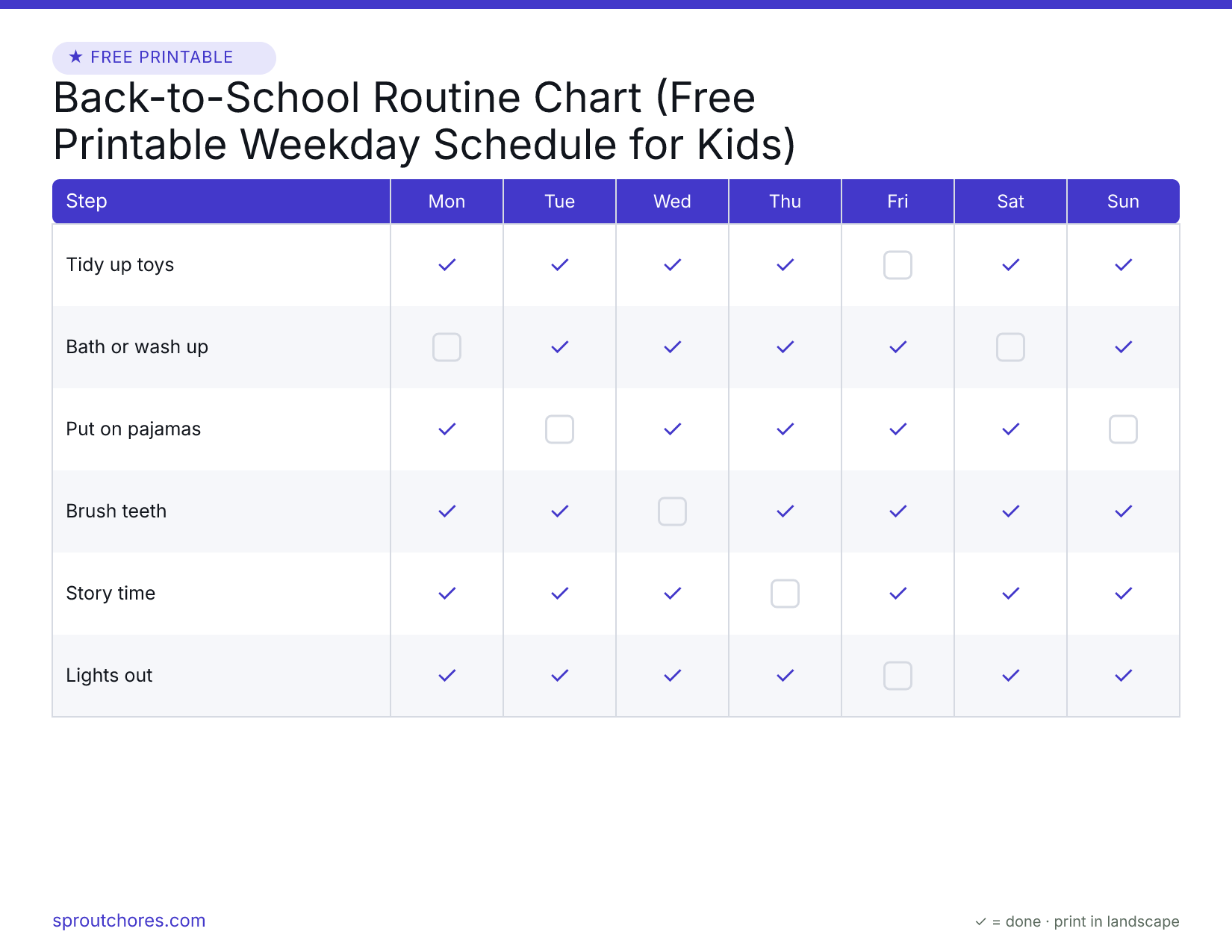
The first couple of weeks back at school are their own special kind of turbulence. Summer let the days go loose — late wake-ups, no real order to the afternoon, bedtime whenever — and now everyone's suddenly expected to hit an alarm, get out the door on time, and land homework before dinner. The gap between those two speeds is where the nagging lives. The chart on this page is built to close it. In the maker above you shape a single dependable weekday — the arc from waking and getting ready and out the door, through the after-school landing, into homework, and down to a calm evening — add a simple picture beside each step so a kid who isn't reading yet can still follow it, spread it across the week, and print it for free. I'm Andrew, dad to four kids from 9 to 18, and over the years my wife and I have also raised younger children through foster care. This is the seasonal hub that ties together the morning, after-school, and homework charts we built — one predictable shape for the whole school day rather than three disconnected fights. And the lesson underneath all of it is simple: when a child can see the same handful of steps land in the same order, day after day, the transition back stops being a battle and starts being a groove they slide into on their own.
| Step | Mon | Tue | Wed | Thu | Fri | Sat | Sun | Remove |
|---|---|---|---|---|---|---|---|---|
| Tidy up toys | ||||||||
| Bath or wash up | ||||||||
| Put on pajamas | ||||||||
| Brush teeth | ||||||||
| Story time | ||||||||
| Lights out |
Tip: choose Landscape in the print dialog for the best fit.
Print in landscape for the best fit. A few reminders from our family to yours: do it together the first few times, keep the chart somewhere everyone can see it, and reward steady effort over a perfect job. — The SproutChores family
Want every age in one file? Get the free Age-by-Age Pack
Six printable charts (ages 4–10) plus reward and routine sheets, in one tidy PDF — free, straight to your inbox.
We email you new printables now and then — unsubscribe anytime. Privacy.
Something went wrong — please try again in a moment.
✓ Almost there — check your inbox!
We just emailed you a confirmation link. Click it to confirm, and your free Age-by-Age Chore Chart Pack lands in your inbox moments later.
Why the first weeks back go smoother with one predictable shape
The hardest thing about September isn't any single task — it's that the whole rhythm of the day changed overnight. A kid who spent August free-forming their hours is now asked to run a tight sequence they haven't touched in months, and the resistance you're seeing usually isn't defiance. It's a nervous system that no longer knows what comes next. A back-to-school routine chart hands that structure back. When the weekday unfolds the same way every day — up and ready, out the door, home and landed, homework, then a wind-down toward bed — getting through it stops being a fresh argument at every turn and becomes a path the child already half-knows before you say a word.
We saw just how much a dependable rhythm can carry during our hardest and most rewarding stretch as a family, fostering young children. Some of them arrived with almost no shape to their days — meals, sleep, and activity happened whenever — and the single most steadying thing we did was give the day a fixed pattern and hold it, morning to night, until they could feel the next step coming before it arrived. The pushback faded not because we found a clever incentive, but because so much of what read as acting out was really uncertainty about what was about to happen to them. That reshaped how we approach every kid in the house, especially at a jolt like the start of school: a child who's dragging their feet is often one who's overwhelmed by a suddenly unfamiliar day, not one who's being difficult. A routine they can anticipate does quiet work on both the behavior and the worry behind it.
The pictures pull more weight than parents expect. A younger child who can't read a word still recognizes a little drawing of a backpack, a book, or a bed, and that image answers the running question every kid is silently asking through a busy day — okay, what now? — so you're not the one supplying the answer for the twentieth time before the second bell.
How to use the chart across the whole school day
Build your weekday in the maker above and keep each stretch lean. This chart works because it's a hub — one continuous shape rather than four separate systems a kid has to remember — so think in phases: the get-ready run from wake-up to out-the-door, the after-school landing, the homework block, and the evening slide toward sleep. If you want to dig deeper into any one phase, we've built dedicated makers for the morning, after-school, and homework pieces, and they all plug into this same overall shape. On a single sheet, though, four or five anchor steps per phase is plenty; a crowded chart just gets skipped.
Print it, then give real thought to where it lives, because a page taped somewhere a kid walks straight past does nothing. For our little ones, one sheet on the fridge was never the whole trick — we'd separate the steps into individual picture cards and put each one in the exact spot that part of the day happens: a get-dressed card near the dresser, a homework card at the table, a bath card in the bathroom. The reminder waits for the child right where the action is, so they look up, see the next move, and keep going without a grown-up steering every turn. If your kid is older and reading well, the printed weekly chart on its own usually carries it — they can run a finger down the column and set their own pace.
The lever that has spared us the most transition meltdowns costs nothing: flag every shift before it lands. Springing "time to leave, now" on a kid mid-cartoon is a fight waiting to happen; a little advance warning — a heads-up well ahead, then a shorter one closer in — lets them mentally arrive at the change instead of getting ambushed by it. This matters double in the first weeks back, when their internal clock is still on summer. And I'd gently reset what the chart is actually for. In our house it's far less a scoreboard for the kids and more a quiet read for us — a way to glance across the week and notice whether the new schedule is holding together or quietly coming apart, and where a particular kid might need a nudge. Nobody gets ready or gets to work because a sticker is waiting at the bottom of the row. They do it because school days have a rhythm, everyone has a part in keeping the household moving, and this is simply how ours goes.
What the school-year routine looks like, toddler through teen
We've never believed one rigid script fits every child — the principle stays put (same shape, same order, every school day), but how you run it bends to the kid in front of you, and we've seen the full spread under one roof.
Little ones, roughly preschool through early elementary: keep each phase tiny and move through it beside them rather than calling instructions from the hallway. At this age the 'steps' are mostly self-care wearing a school-day costume — getting dressed, a quick wash and teeth, sitting for a few bites of breakfast, unpacking the bag when they get home, a bath before bed — and a young child learns by copying you. The picture cards do nearly all the lifting here, since the words are just shapes to them. A back-to-school chart for kids this age works best as something they see, not something they read.
Middle of the pack, roughly 6 to 10: kids here can start running each phase with real independence, and the after-school and homework blocks become the heart of the day. Don't expect it to run clean — they'll stall on a step or wander off entirely, and that's fine; you're building a habit, not grading a performance. This is also a good age to let them tick off each step as they finish, and to fold in one real household job as part of the afternoon, tied to the overall pattern of showing up and doing it well rather than paid out per task. We've watched wildly different wiring at the very same age, too: one of ours got a genuine kick out of designing her own chart and following it, while another barely registered a chart existed and needed us to name the next step out loud in the moment. Same house, opposite kids — so if the chart alone isn't landing, that's information, not failure.
Teens: honesty time — the formal family chart mostly falls away here, and we don't fight it. What survives from the routine is the shape, not the sheet: they own their own mornings and homework, and the arrangement shifts toward something job-shaped, with agreed responsibilities and real-world consequences rather than a row of boxes to check. One school-year fix worth passing along at every age, because it wrecked a stretch of evenings for one of our daughters before we caught it: watch the screens. A show or a tablet late in the day quietly swallowed the clock and torched her focus and her bedtime. Once we drew a clean line and cut screens earlier, the rest of the evening settled almost on its own. If your school-year routine keeps unraveling no matter how good the chart looks, that's the first place I'd look, ahead of the chart itself.
Frequently asked questions
- How do I get my kids back into a routine after summer?
- Start before the first day, not on it. Pick the single weekday shape you want — up and ready, out the door, the after-school landing, homework, then a wind-down to bed — and start running a version of it a week or two early so the change isn't a cold shock. Build that sequence in the maker above, add a simple picture to each step for a pre-reader, and expect it to take a couple of weeks to actually register; in our experience the new rhythm always feels like it'll never take hold, right up until it does. Warning kids before each transition, rather than springing it on them, is what smooths those first bumpy days more than anything.
- What age is a back-to-school routine chart good for?
- It earns its keep from the preschool years up through grade school, and how you lean on it shifts with age. For a young child who can't read, the pictures carry the day — and separating the steps into individual cards posted where each one happens (a get-dressed card by the dresser, a homework card at the table) works even better — while you move through it alongside them. By the middle grade-school years kids can recognize the steps and pace themselves down the printed weekly chart with you nearby rather than directing every move. By the teen years the formal chart usually fades and a job-shaped arrangement takes its place, though the underlying shape of the day still helps.
- Should I reward my kids for following the back-to-school routine?
- We keep the routine clear of rewards, and we deliberately keep screen time out of it too. The chart isn't a prize machine — it's there to make the shape of the school day visible and to help us, as parents, see whether the new schedule is holding or slipping. Cooperation grows out of the plain expectation that this is how our school days run and that everyone has a part in keeping the house moving, not from a treat at the end of the row. Bolting a reward onto getting ready or doing homework tends to turn an ordinary school day into something to haggle over, which is the opposite of the calm you're after in those first weeks back.
- How do I get a free printable back-to-school routine chart?
- Use the editable maker on this page: set your weekday steps from wake-up through the evening wind-down, add a simple picture to each so a young child can follow it, lay them out across the week, and print at home. There's no signup and nothing to pay. Keep each phase to about four or five steps for a little one so the day feels doable, post it (or the individual picture cards) where the action actually happens, and hold the order the same day after day — that steadiness is what turns the back-to-school scramble into a routine your kids can run on their own.

About the author
More free printables
Get the free Age-by-Age Chore Chart Pack
Six printable charts (ages 4–10) plus reward and routine sheets, in one tidy PDF. We'll also send new printables and the occasional real parenting tip. The charts on this site are always free — no sign-up needed.
We email you new printables now and then — unsubscribe anytime. Privacy.
Something went wrong — please try again in a moment.
✓ Almost there — check your inbox!
We just emailed you a confirmation link. Click it to confirm, and your free Age-by-Age Chore Chart Pack lands in your inbox moments later.