School Morning Routine Chart (Free Printable to Get Kids Out the Door)
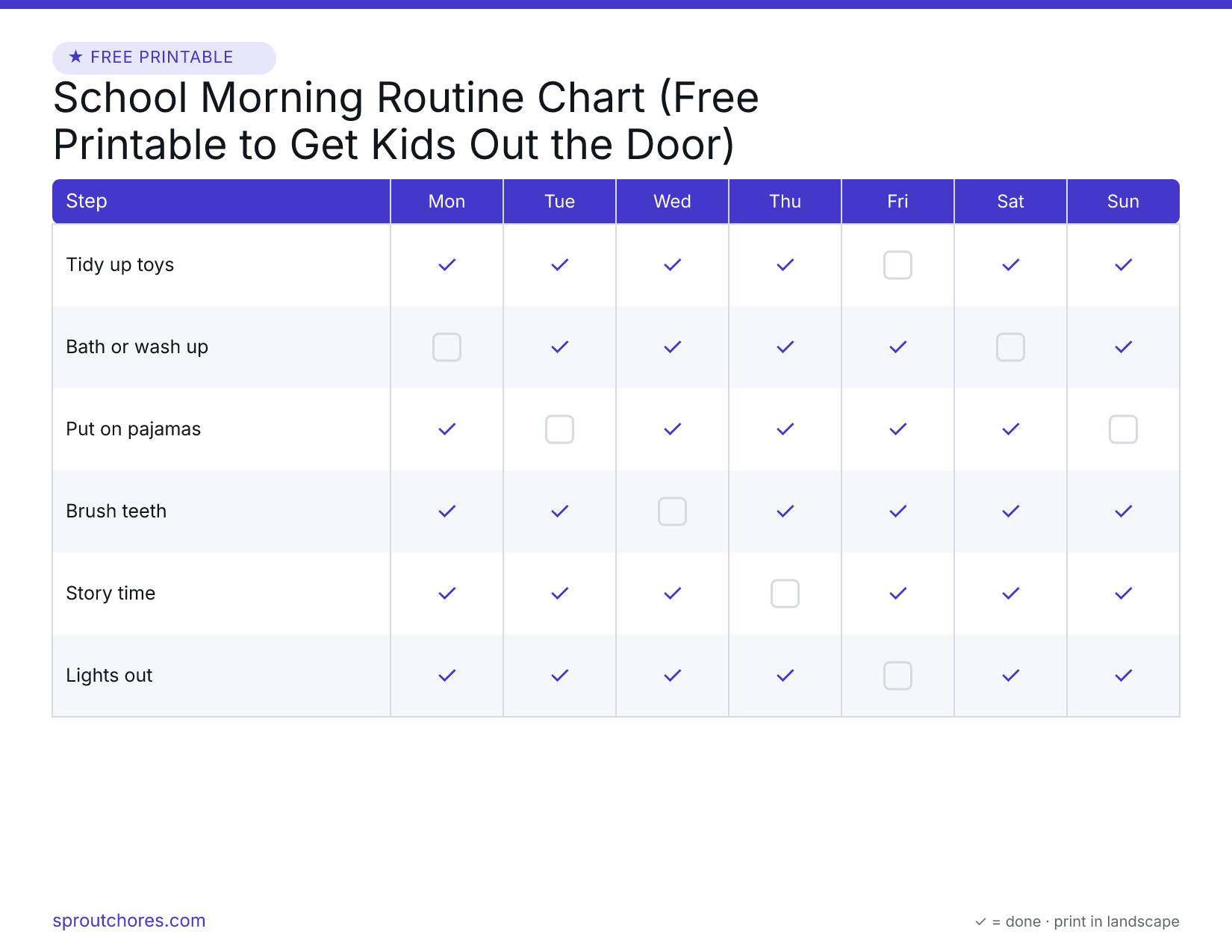
There's one stretch of the day that runs on a clock you don't get to negotiate with: the school morning. The bus arrives when it arrives, the bell rings whether or not both shoes have been found, and somewhere in the middle is a kid who woke up ten minutes ago and can't yet hold a plan in their head. The chart on this page is built for exactly that squeeze. In the maker above you lay out a short get-ready sequence, drop a simple picture beside each step so a child who isn't reading yet can still follow it, spread it across the school week, and print it for free. I'm Andrew — a dad of four, ages 9 to 18, and, with my wife, a foster parent to several little ones over the years. I head out for work around 7:30 most mornings, so I know the particular flavor of chaos a school departure can turn into. What finally settled ours wasn't a clever trick; it was letting a kid glance at the same handful of pictures, in the same order, every school day, so the walk from bed to the front door stopped hinging on me calling out the next move. Build yours below, then read on for how we actually get everyone out without the standoff.
| Step | Mon | Tue | Wed | Thu | Fri | Sat | Sun | Remove |
|---|---|---|---|---|---|---|---|---|
| Tidy up toys | ||||||||
| Bath or wash up | ||||||||
| Put on pajamas | ||||||||
| Brush teeth | ||||||||
| Story time | ||||||||
| Lights out |
Tip: choose Landscape in the print dialog for the best fit.
Print in landscape for the best fit. A few reminders from our family to yours: do it together the first few times, keep the chart somewhere everyone can see it, and reward steady effort over a perfect job. — The SproutChores family
Want every age in one file? Get the free Age-by-Age Pack
Six printable charts (ages 4–10) plus reward and routine sheets, in one tidy PDF — free, straight to your inbox.
We email you new printables now and then — unsubscribe anytime. Privacy.
Something went wrong — please try again in a moment.
✓ Almost there — check your inbox!
We just emailed you a confirmation link. Click it to confirm, and your free Age-by-Age Chore Chart Pack lands in your inbox moments later.
Why the school morning is the one that needs a routine most
Most parts of the day have some give in them — a slow breakfast on a Saturday costs you nothing. A school morning has a hard edge: a fixed time you have to be moving, and almost no room to drift. That's exactly why a visual sequence earns its keep here more than anywhere else. A young child genuinely can't juggle a five-part plan while still half-asleep, so without a chart that plan ends up living in your head, and you become the alarm that has to keep going off. Pinning the order to the wall hands that job to the paper instead of to you.
We got a close look at how much a predictable pattern matters during our years fostering. Some of the little ones who came to us had lived without much shape to their days at all, and mornings in particular were anyone's guess. What helped wasn't pushing harder — it was giving each day the same dependable outline and holding it there until they could feel what was coming before anyone said a word. One habit I kept was naming the day out loud first thing — whether it was a school day or a home day — so the morning had a frame before it even got going. It took a couple of weeks to sink in, and then it did. So much of what reads as a kid stalling on purpose is really a kid who isn't sure what happens next, and a school morning is precisely when that uncertainty costs you the most minutes. A printed chart is simply a way to protect that order on the mornings you're rushed and tempted to wing it.
How to use the chart when there's a bus to catch
Start from the end and work backward. Pick the moment you truly have to be in motion — the bus stop, the car, the walk to school — and build the steps back from there, so the chart reflects the real clock instead of a hopeful one. Keep it short: four or five steps is plenty for a little one, and a long chart just gets abandoned at step three while the minutes drain away.
Where you put it matters as much as what's on it. With our youngest we rarely leaned on a single sheet stuck to the fridge. We'd split the sequence into separate little picture cards and post each one right where that step happens, so the cue meets the child at the exact moment they need it. For a school morning the highest-value spot is the exit — a card by the front door for the backpack and shoes turns the classic last-second scramble, the missing coat and the one shoe hiding under the couch, into something the kid can see coming. Set up a small landing zone there the night before and the out-the-door pileup mostly dissolves on its own.
Two levers we lean on hard. First, give real warning before the leave-now moment rather than springing it. A kid yanked off a task with zero notice digs in; the same kid who's been told the departure is coming, and reminded again as it nears, tends to roll with it. Second, put slack into the clock on purpose. If the drive is ten minutes, don't leave with ten minutes to spare — head out earlier, so a spilled cereal bowl or a sudden bad mood doesn't sink the entire morning. That cushion is what keeps a small hiccup from turning into a late slip.
One reframe changed how we treat the chart altogether: in our house it isn't a scoreboard the kid is playing against, and it isn't a machine that dispenses prizes for getting dressed. It's mostly a tool for us — a way to glance across the week and see whether the mornings are holding together or quietly coming apart, so we know when to step in. The kids get ready because school happens and because everyone under our roof carries a piece of keeping the household moving, not because a sticker is waiting at the finish line. And build the whole thing to survive a rough week: the best routines aren't the perfectly polished ones, they're the ones you can pick straight back up after a sick day or a holiday without deciding the entire system failed.
What a calm school morning looks like, preschool through grade school
The principle stays put — same steps, same order, every school day — but how much a kid can run on their own shifts a lot with age, and we've watched the whole spread play out under one roof.
Preschool and kindergarten, roughly 4 to 5: the pictures do the heavy lifting here, because the words are still just shapes to them. Expect to move through most of it beside them rather than calling instructions from another room, and don't be thrown when they freeze halfway, hypnotized by a single sock. You're not scoring a test — you're wearing in a habit. Letting them tap or check off each picture as they finish makes the progress feel like their own.
Early grade school, about 6 to 9: most kids this age can work down a printed weekly chart with you nearby instead of hovering — they recognize the steps and can pace themselves through dressing, eating, and getting to the door. This is also where each kid's wiring shows. One of ours genuinely enjoyed making her own chart and following it; another barely registered that a chart existed and needed us to name the next thing out loud, in the moment, every single time. Same household, two completely different kids — so if the chart alone isn't landing, that's a clue about the child, not a verdict on the chart.
Older kids, roughly 10 and up: they can own the school morning start to finish, and the one place it reliably falls apart is the screen. A show or a game first thing devours the clock, and everything after it backs up. In our experience mornings smooth out fast when screens simply aren't on the table until the get-ready list is done and they're out the door. If your mornings keep collapsing no matter how clean the chart looks, that's the first thing I'd pull.
Frequently asked questions
- What time should a school morning routine start?
- Work backward from the moment you actually have to leave, not from wake-up. Add up how long your child really takes at each step — the honest time, not the rushed best case — then set the wake time so the whole sequence finishes a few minutes before the bus or the car. Then add a cushion on top: a morning with a spill or a sour mood needs slack, so we'd rather leave a touch early and wait than cut it to the exact minute and lose the whole thing to one hiccup. For most young kids that lands somewhere around 45 minutes to an hour before you need to be out the door.
- My child can't read yet — will a school morning chart still work?
- Yes, and that's the entire point of the pictures. A simple image of a shirt, a bowl, or a backpack tells a pre-reader what comes next without a single word. We took it a step further with our youngest by cutting the sequence into separate cards and posting each one where that step actually happens — including one by the front door for the bag and shoes. The picture shows up right where the child needs the reminder, which does far more than a chart parked somewhere they never think to look.
- How do I stop the morning battle before school?
- Three things moved the needle for us. Keep the order identical every school day so getting ready stops being a fresh argument and becomes a path the kid already knows by heart. Give warning before the leave-now moment instead of announcing it out of nowhere — a heads-up as the departure approaches heads off most of the pushback. And keep screens off until they're out the door; nothing eats a school morning faster than a show that started 'just for a minute.' The chart isn't there to bribe cooperation out of anyone — it makes the shape of the morning visible so the whole thing runs with less of you standing in the middle of it.

About the author
More free printables
Get the free Age-by-Age Chore Chart Pack
Six printable charts (ages 4–10) plus reward and routine sheets, in one tidy PDF. We'll also send new printables and the occasional real parenting tip. The charts on this site are always free — no sign-up needed.
We email you new printables now and then — unsubscribe anytime. Privacy.
Something went wrong — please try again in a moment.
✓ Almost there — check your inbox!
We just emailed you a confirmation link. Click it to confirm, and your free Age-by-Age Chore Chart Pack lands in your inbox moments later.