After-School Routine Chart (Free Printable Get-Home Checklist for Kids)
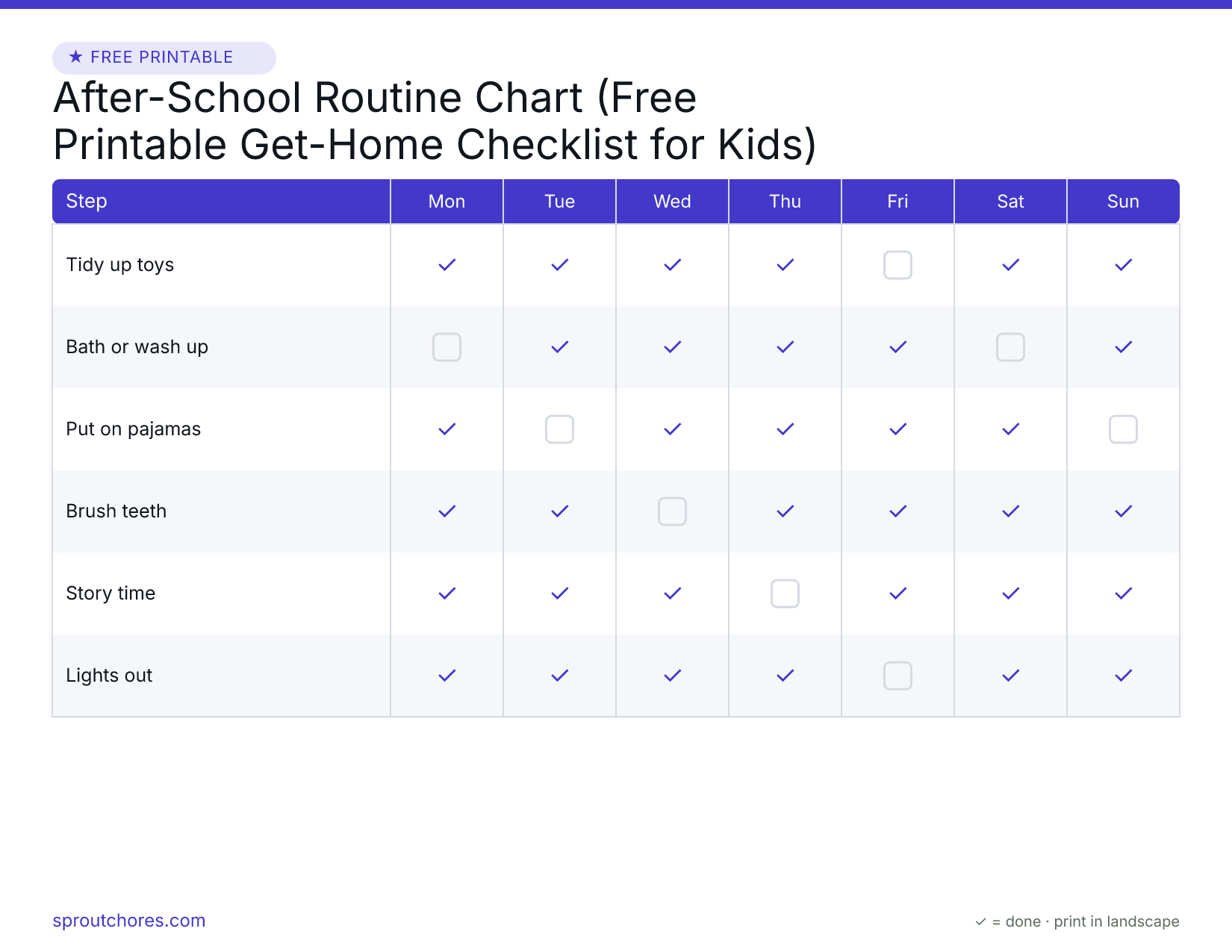
The stretch between the front door slamming open and dinner can be the loosest, loudest part of a kid's day — backpacks dropped wherever, a snack hunt, homework that somehow never starts, and the negotiation over screens that begins before shoes are off. The chart on this page is built to give that window a shape. In the maker above you set a short get-home sequence — think unpack the bag, grab a snack, homework, one job around the house, then free time — drop a simple picture beside each step so a child who isn't reading yet can still follow it, lay it out across the week, and print it for free. I'm Andrew, dad to four kids from 9 to 18, and over the years my wife and I have also welcomed younger children into our home through foster care. This is the after-school companion to the morning and bedtime charts we built — the third piece that closes out the whole day. And the thing I keep coming back to is plain: when a kid can see the same few steps land in the same order each afternoon, you stop being the human reminder app, and the 3-to-6 stretch finally starts running on its own.
| Step | Mon | Tue | Wed | Thu | Fri | Sat | Sun | Remove |
|---|---|---|---|---|---|---|---|---|
| Tidy up toys | ||||||||
| Bath or wash up | ||||||||
| Put on pajamas | ||||||||
| Brush teeth | ||||||||
| Story time | ||||||||
| Lights out |
Tip: choose Landscape in the print dialog for the best fit.
Print in landscape for the best fit. A few reminders from our family to yours: do it together the first few times, keep the chart somewhere everyone can see it, and reward steady effort over a perfect job. — The SproutChores family
Want every age in one file? Get the free Age-by-Age Pack
Six printable charts (ages 4–10) plus reward and routine sheets, in one tidy PDF — free, straight to your inbox.
We email you new printables now and then — unsubscribe anytime. Privacy.
Something went wrong — please try again in a moment.
✓ Almost there — check your inbox!
We just emailed you a confirmation link. Click it to confirm, and your free Age-by-Age Chore Chart Pack lands in your inbox moments later.
Why the after-school window needs its own routine
Mornings and bedtimes get all the attention, but the afternoon is where a lot of households quietly fall apart. A kid comes home wrung out from holding it together all day, and the temptation — for everyone — is to let the hours dissolve into a screen and a vague promise that homework will happen later. It rarely does. A predictable get-home sequence catches that drift before it starts. When the afternoon unfolds the same way each day, the question isn't whether homework gets done, it's just the next picture on the chart.
We learned how much steadiness matters during our hardest and most rewarding season, fostering young children. Some arrived with almost no rhythm to their days — meals, rest, and activity happened whenever, with little sense of what came next. What settled them wasn't a clever incentive; it was a dependable shape to the day they could lean on. Once the afternoon stopped being a guessing game, a lot of what had looked like resistance simply eased off. That reshaped how we think about every kid in the house: a child who melts down at the homework table is often a child who's depleted and unsure what's coming, not one who's being difficult. A routine they can anticipate does quiet work on both fronts.
The pictures matter more than parents expect, too. A younger child who can't read still recognizes a little drawing of a snack or a stack of books, and that image answers the running question every tired kid has — what now? — without you having to be the one who says it again.
How to use the chart so the afternoon runs itself
Build your steps in the maker above and keep the list short — five is plenty. A get-home sequence that works in most houses moves from unpacking the bag and clearing out today's papers, to a snack, then homework while there's still daylight focus left, then one job around the house, and finally open time that's genuinely theirs. Print it, then think hard about where it lives. Taped somewhere a kid walks straight past, a chart does nothing; the one that earns its place is the one their eyes actually land on at the moment it matters.
With our youngest, a single printed sheet was only the beginning. We'd cut the steps into separate picture tiles and post each one right where that part of the afternoon happens — a snack picture by the kitchen counter, a homework picture at the table, a tidy-up picture by the spot the backpack always lands. The cue waits for the child where the action is, instead of back on the kitchen wall, so they glance over, see what's next, and move along without anyone narrating it. If your kid is older and reading well, the printed weekly chart on its own usually does the trick — they can run a finger down the column and pace themselves.
One lever has saved us more afternoon standoffs than anything else, and it's free: give a heads-up before every shift. Cutting a kid off mid-game with "homework, now" almost guarantees a fight. We hand them a runway instead — a warning a while out, another a few minutes ahead — so moving into the next step never lands as an ambush. And I'd reframe what the chart is really for. In our home it's far less a scoreboard for the kids and more a quiet read for us — a way to glance back over the week and notice whether the afternoons are holding together or starting to slide, and where a kid might need a nudge. The willingness to do the work doesn't come from a sticker at the bottom of the page; it comes from this simply being how our afternoons go.
What "one chore" really teaches — and how it scales by age
Notice that the sequence has room for just one job, not a pile of them. That's deliberate. In our house chores aren't a way to extract free labor or earn a payout — they're rehearsal for the adult these kids are becoming, and the point of dropping a single job into the afternoon is the rep, the muscle memory of contributing because you're part of a family, not the spotless result. How big that one job gets is where you bend the routine to the kid in front of you.
For the youngest, roughly preschool age, the after-school 'chore' is really self-care and tidying — putting the backpack where it goes, clearing their own snack plate, picking up what they pulled out. Do it shoulder to shoulder and don't expect it clean; you're building the habit, not inspecting the work. The picture tiles carry most of the weight here since the words mean little yet.
Early grade-schoolers, around 6 to 10, can take on a real, repeatable job in that slot — feeding a pet, wiping a counter, gathering the trash. One of mine grew into hauling all the household trash on his own, start to finish, no supervision. That didn't appear one afternoon; it came from years of the same small expectation, the way real change in parenting works — invisible day to day, obvious when you compare now to where you started. This is also the age where a modest weekly allowance can enter the picture, tied to the overall pattern of showing up and doing the work well, never doled out for each task on the chart.
Teens are a different animal, and honestly the family chart tends to fall away here — it's near impossible to enforce, and we don't try. With our older kids the deal shifts toward a job-shaped arrangement: agreed responsibilities, real money on the line, and consequences that mirror the working world rather than parental mood. If they let things slide, the income reflects it; when they get consistent again, it comes back. The chart's usefulness for a teen is less about steps to follow and more, for a younger sibling watching, about seeing that contributing is simply what this family does.
Keep rewards and screens separate from the routine
It's tempting to bolt a prize onto the end of the afternoon — finish the chart, earn the tablet. We steer clear of that, and there's a reason. The moment free time or screen time becomes the payment for doing homework, the homework turns into a transaction to haggle over, and you've taught a kid to do the least they can get away with rather than to own their afternoon. We keep the open time at the end of the sequence as a normal part of the day, not a wage. Cooperation comes from the plain expectation that this is how our afternoons run.
That said, screens are worth watching closely for a different reason. With one of our daughters, screen time in the late afternoon and evening quietly wrecked everything downstream — focus, mood, bedtime. Once we drew a clean line and pulled screens earlier in the day, the rest of the afternoon settled almost on its own. So if your get-home routine keeps unraveling no matter how good the chart looks, I'd look at when the screens are coming on before I'd look at the chart. And a gentler, broader point we've leaned on: you can't reason a wound-up kid into cooperating. A child who walks in the door already frayed needs a minute to land — a snack, a little quiet, a parent who isn't immediately issuing instructions — before the routine has any chance of taking. Let them settle first; the steps go far easier after.
Frequently asked questions
- What should an after-school routine for kids include?
- A short, repeatable sequence beats a long one. The version that works in most homes is: unpack the backpack and clear out the day's papers, have a snack, do homework while focus is still there, take care of one job around the house, then enjoy free time. Build exactly those steps in the maker above, add a simple picture to each so a pre-reader can follow along, and keep it to about five steps so the afternoon feels doable rather than like a second school day.
- What age is an after-school routine chart good for?
- It earns its keep from the preschool years up through grade school, but how you lean on it shifts with age. For a young child who can't read, the pictures carry the routine — and cutting the steps into separate tiles posted where each one happens (a snack picture in the kitchen, a homework picture at the table) works even better — while you move through it alongside them. By the early grade-school years, kids can recognize the steps and pace themselves down the printed weekly chart with you nearby rather than directing every move. By the teen years the formal chart usually fades and a job-shaped arrangement takes over.
- My child melts down after school instead of starting homework — how does a chart help?
- Often the meltdown isn't defiance, it's a kid who's depleted from holding it together all day and unsure what comes next. A predictable sequence settles both: it answers the 'what now' question for them, and it lets a frayed child land before the work starts. We build a real pause into the afternoon — a snack and a little quiet before homework — because you can't reason a wound-up child into focusing. Give them a minute to regulate, then the routine follows far more smoothly than it does when you push straight into the hard step.
- How do I get a free printable after-school routine chart?
- Use the editable maker on this page: set your get-home steps, add a simple picture to each so a young child can follow it, lay them out across the week, and print at home. There's no signup and nothing to pay. Keep it to four or five steps for a little one, post it (or the individual picture tiles) where the afternoon actually happens, and keep the order the same day to day — that steadiness is what makes the 3-to-6 window finally run on its own.

About the author
More free printables
Get the free Age-by-Age Chore Chart Pack
Six printable charts (ages 4–10) plus reward and routine sheets, in one tidy PDF. We'll also send new printables and the occasional real parenting tip. The charts on this site are always free — no sign-up needed.
We email you new printables now and then — unsubscribe anytime. Privacy.
Something went wrong — please try again in a moment.
✓ Almost there — check your inbox!
We just emailed you a confirmation link. Click it to confirm, and your free Age-by-Age Chore Chart Pack lands in your inbox moments later.