Chore Chart for 10 Year Olds
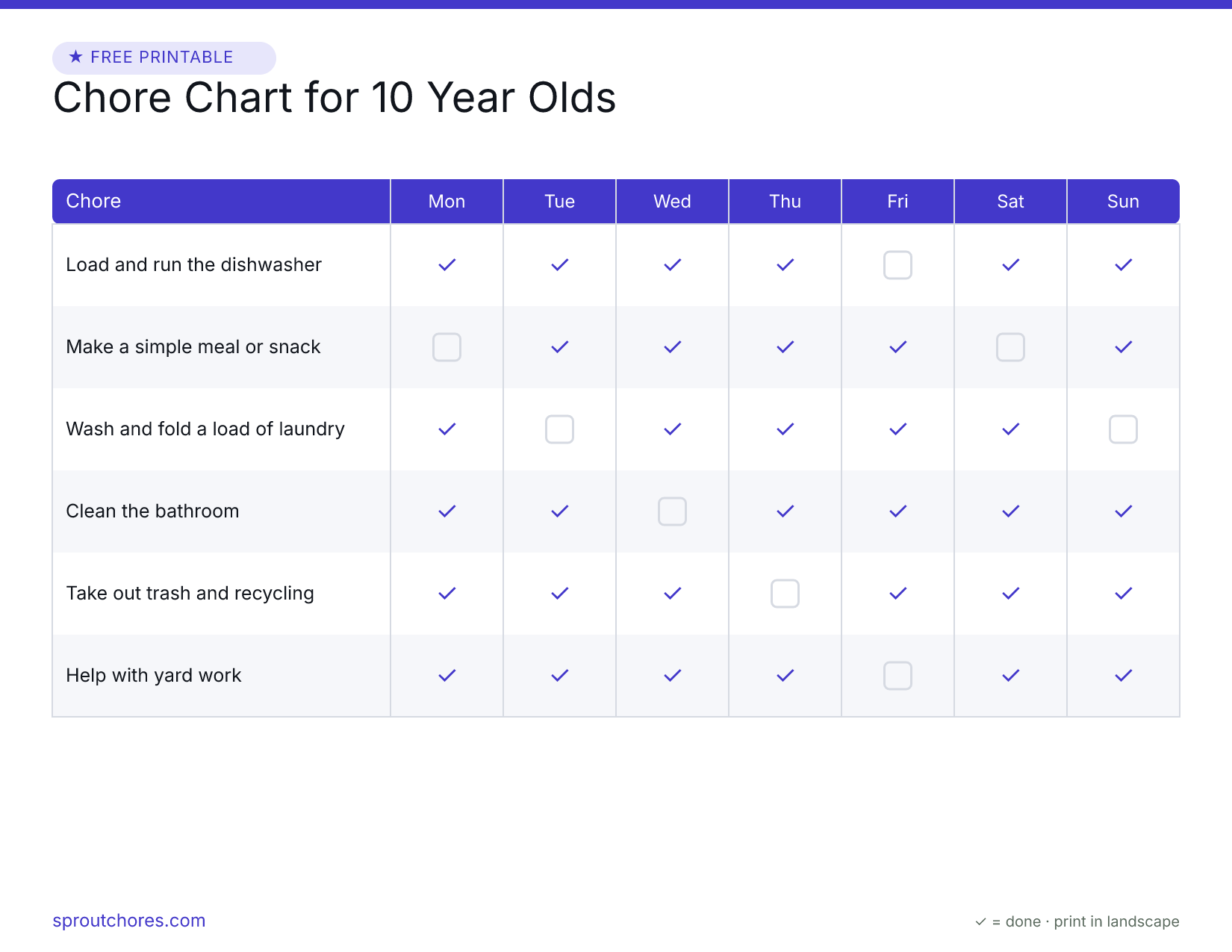
Ten is the age where a chore can finally turn into a real contribution instead of a supervised lesson. A ten-year-old can take a job, work it from one end to the other, and hand you back something you don't have to quietly redo. I'm Andrew. My wife and I are the SproutChores family, raising four kids from nine to eighteen, with a season of fostering folded in along the way, and a ten-year-old is right in the sweet spot we built this chart for. Make a personalized one with the tool above in about a minute, or print the version below. Here's the lens I'd ask you to hold while you use it, because it shapes the rest of this page: I don't think of a chore chart as a way to get the house clean. I think of it as practice for adulthood. The chart is how my wife and I keep an honest read on who's keeping up; it was never meant to be the thing that makes a kid care.
| Chore | Mon | Tue | Wed | Thu | Fri | Sat | Sun | Remove |
|---|---|---|---|---|---|---|---|---|
| Load and run the dishwasher | ||||||||
| Make a simple meal or snack | ||||||||
| Wash and fold a load of laundry | ||||||||
| Clean the bathroom | ||||||||
| Take out trash and recycling | ||||||||
| Help with yard work |
Tip: choose Landscape in the print dialog for the best fit.
Print in landscape for the best fit. A few reminders from our family to yours: do it together the first few times, keep the chart somewhere everyone can see it, and reward steady effort over a perfect job. — The SproutChores family
Want every age in one file? Get the free Age-by-Age Pack
Six printable charts (ages 4–10) plus reward and routine sheets, in one tidy PDF — free, straight to your inbox.
We email you new printables now and then — unsubscribe anytime. Privacy.
Something went wrong — please try again in a moment.
✓ Almost there — check your inbox!
We just emailed you a confirmation link. Click it to confirm, and your free Age-by-Age Chore Chart Pack lands in your inbox moments later.
Age-appropriate chores for 10 Year Olds
Every chore below is pre-loaded in the generator above and is something a child in this age range can realistically manage with a little initial guidance:
- Load and run the dishwasher
- Make a simple meal or snack
- Wash and fold a load of laundry
- Clean the bathroom
- Take out trash and recycling
- Help with yard work
What a 10-Year-Old Can Genuinely Take On
At ten, the limiting factor usually isn't ability anymore, it's ownership. A ten-year-old can be handed a whole job and trusted to finish it without a parent shadowing every step. Running a load of dishes through start to finish. Pulling the trash together and getting it out. Stepping into actual cooking rather than just stirring whatever's already in the bowl. If your kid leans toward it, outdoor work and small repairs fit here too. Our youngest tags along on yard jobs and fix-it projects and fires off questions about every tool in the box, and I lean into that on purpose, because the kid who wants to understand how things work today is building skills that pay off for the next decade.
What I'd reset are your expectations, not the task list. The work will be uneven for a good while, and uneven is fine at ten. When something needs correcting, I'd fix it shoulder to shoulder with my kid as a quick lesson rather than slipping in behind them to redo it after they've walked off, because silently undoing a child's effort tells them the effort didn't count. And don't strip the plain self-care basics off the chart just because the bigger jobs showed up. Owning a household task and taking care of your own room aren't competing for the same slot; they teach the same lesson, which is that a ten-year-old is a working part of the household and not a guest in it. Let the difficulty climb as their reliability climbs, not before.
Why Progress at This Age Is Slow, and How to See It
The most useful thing I can tell a parent of a ten-year-old is that this works the way losing weight works. You won't notice a difference from one day to the next, or even one month to the next, and if you're watching for a sudden flip you'll convince yourself nothing is landing. The change only shows up when you set today next to where you started. Our nine-year-old now collects every bag of trash in the house entirely on his own, grabs a bag, heads upstairs, works through the rooms, and brings it all down without a single reminder from me. That was not a breakthrough one Tuesday. It was the payoff of years of the same low-key expectation, repeated until it stopped being a thing we asked for and became a thing he just does.
So the job of the chart is to make that slow progress visible to you, the parent, not to spark motivation in your kid. Where the motivation actually lives is the family itself, the simple, steady understanding that everyone here pitches in because we belong to each other. A ten-year-old doesn't keep a counter clean for a sticker; they keep it clean because the expectation behind it never wobbles.
Two practical levers have outdone every clever system for us. First, give a heads-up before you expect something to happen. Telling a kid to drop everything and do a job this instant tends to trigger a standoff; saying the same job is coming up in an hour gives their brain time to shift gears on its own, and that single habit has quietly dissolved more chore arguments in our home than I can count. Second, don't chase a perfect system, build one that's easy to restart. Life will knock it flat now and then with a busy stretch or a trip away. A chart you can simply pick back up the next morning will outlast a flawless one that never recovers the first time real life interrupts it.
Allowance at Ten, and Why We Don't Pay Per Job
We do pay an allowance, and ten falls squarely inside the years we use one, so here's the honest mechanics plus the part most advice skips. We do not put a price on individual chores. There's a modest weekly amount at this stage, and whether it actually arrives depends on the whole week taken together: was the work done to a real standard, did they keep up without being chased, and what was the attitude behind it. A ten-year-old who technically does the jobs but does them sloppily, or only after a fight, hasn't earned it the way a kid who quietly stays on top of things has.
The reason I refuse to price jobs out is that a ten-year-old is plenty sharp enough to do the math. The moment they can see that one task is worth more than another, you've handed them a menu, and they'll skip whatever doesn't pay well enough to bother. Tying the money to overall follow-through instead keeps helping from turning into a string of little transactions, and it protects the bigger message that we contribute because we're family, not because there's a payout attached.
The other line I hold firmly is keeping rewards and consequences out of the chore lane entirely. We don't make our kids buy screen time or fun by doing tasks. When screens do get pulled in our house, it's a response to a behavior problem, and it stays well clear of the chart. The instant those wires touch, a quick kid turns every chore into a negotiation. If you'd rather attach no money at all, that's a perfectly good call too. The chart does its real job, giving you a clear picture of how each kid is doing, with or without a dollar sign anywhere on it.
Frequently asked questions
- What chores should a 10-year-old be responsible for?
- By ten, most kids can own a whole job rather than just helping with one. That means running and emptying the dishwasher, gathering and taking out the trash, stepping into real cooking, and keeping their own room and morning routine handled with little prompting. If your child is interested, outdoor work and small repairs are well within reach too. The shift from earlier ages isn't a longer list, it's that you can hand a ten-year-old a task and expect them to carry it from start to finish on their own. Pick the jobs that fit your kid from the printable or the maker above, and let the expectation rise as their reliability does.
- Should I pay my 10-year-old for doing chores?
- In our house there's an allowance at this age, but we deliberately don't pay job by job. A ten-year-old is sharp enough to price out which chores are worth their time and skip the rest, so instead we gate a modest weekly amount on the whole week: the quality of the work, staying on track without being nagged, and attitude. We also wall the money off from screen time and other rewards. The aim is to teach reliable follow-through, not to turn helping the family into a series of paid transactions. Whether you tie money to chores at all is your family's call, and the chart works the same either way.
- How is a chore chart for a 10-year-old different from one for an 8-year-old?
- The format can look similar, but the expectations should level up noticeably. An eight-year-old often still needs shared or supervised tasks and a fair amount of redoing. By ten, a child can take a multi-step job, like running the dishwasher or helping cook a meal, and complete it independently, plus take on outdoor work if they're inclined. The real difference is the amount of trust and independence you extend, and the standard you hold them to, rather than the chores themselves. That's why a chart built for the eight-to-ten range works best when you raise the bar as the child proves they can handle it.
- My 10-year-old does chores fine for a while, then stops. What helps?
- This is normal, and the fix usually isn't a new reward, it's the unglamorous machinery around the chart. Two things move the needle for us. Give advance notice instead of sudden demands, so a heads-up that a job is coming in an hour replaces ordering them to drop everything right now, which heads off most standoffs. And build the routine to be easy to restart, because a busy week or a trip will eventually knock it over, and a chart you can pick back up the next morning beats a perfect one that collapses for good. Underneath both, lean on the steady expectation that everyone in the family pitches in. The chart's job is to show you when to step in, not to do the motivating for you.

About the author
More free printables
Get the free Age-by-Age Chore Chart Pack
Six printable charts (ages 4–10) plus reward and routine sheets, in one tidy PDF. We'll also send new printables and the occasional real parenting tip. The charts on this site are always free — no sign-up needed.
We email you new printables now and then — unsubscribe anytime. Privacy.
Something went wrong — please try again in a moment.
✓ Almost there — check your inbox!
We just emailed you a confirmation link. Click it to confirm, and your free Age-by-Age Chore Chart Pack lands in your inbox moments later.