Chore Chart for a 9-Year-Old
Somewhere around nine, a kid crosses a quiet line: the chore stops being a thing you coach them through and becomes a thing they can simply carry on their own. I'm Andrew, a dad of four between nine and eighteen, and our youngest is right in this stage, so the printable and the generator at the top of this page come straight out of what's actually happening in our house. Before you print anything, here's the lens I'd offer you. I grew up with a chore chart on the wall and I do this with my own kids now, but I changed one big thing about why. I don't hand my nine-year-old a job to get the dishwasher emptied. I hand it to him because emptying a dishwasher, reliably and without being chased, is rehearsal for being a capable adult. That reframe changes everything downstream, including how you read the chart. In our family the sheet isn't a scoreboard the kid plays for prizes. It's a record we keep so we can see, at a glance, which kid is keeping pace and which one has quietly drifted and needs us to step back in. The reason they do the work isn't the chart. It's that everyone under this roof pulls their weight, and a nine-year-old is plenty old enough to be one of those people.
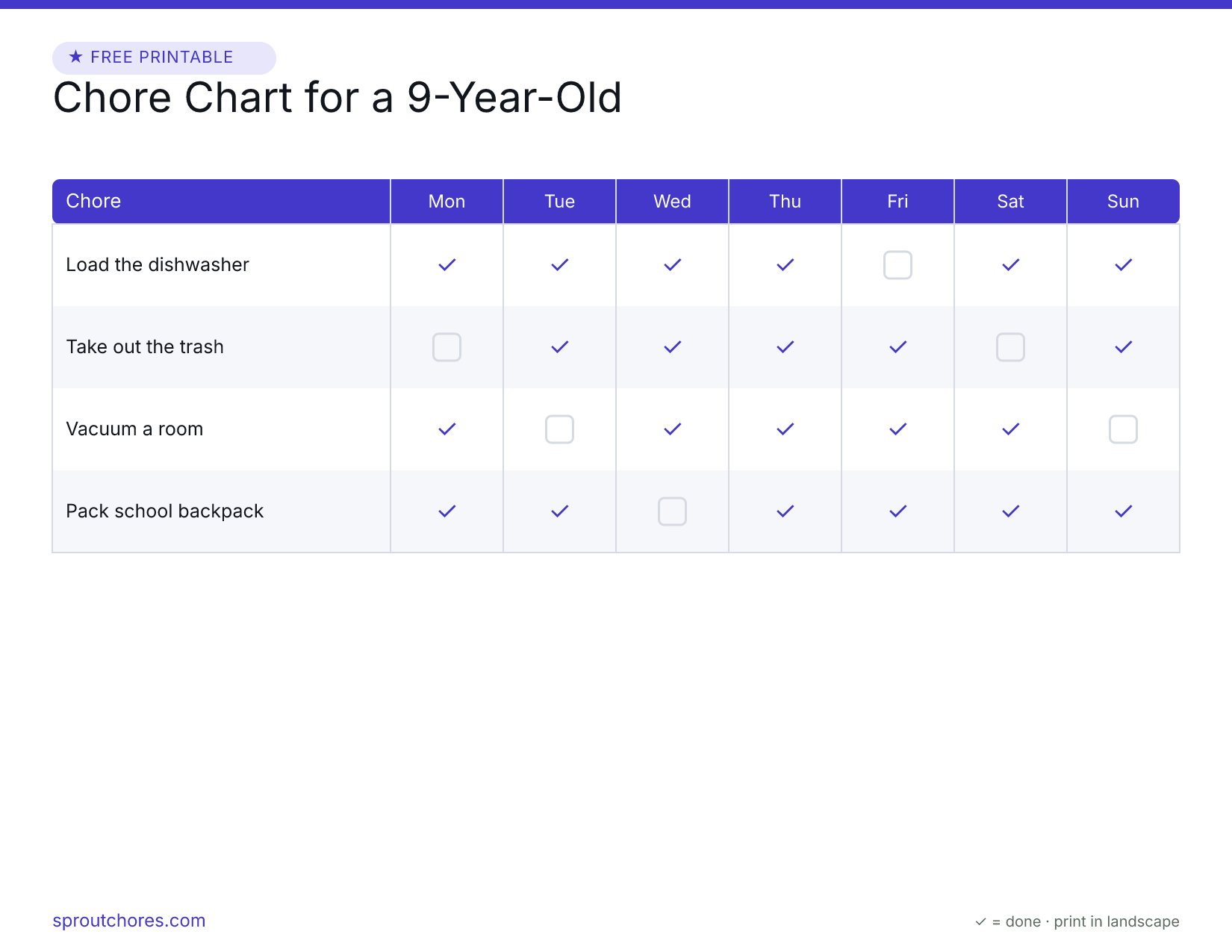
| Chore | Mon | Tue | Wed | Thu | Fri | Sat | Sun | Remove |
|---|---|---|---|---|---|---|---|---|
| Load the dishwasher | ||||||||
| Take out the trash | ||||||||
| Vacuum a room | ||||||||
| Pack school backpack |
Tip: choose Landscape in the print dialog for the best fit.
Print in landscape for the best fit. A few reminders from our family to yours: do it together the first few times, keep the chart somewhere everyone can see it, and reward steady effort over a perfect job. — The SproutChores family
Want every age in one file? Get the free Age-by-Age Pack
Six printable charts (ages 4–10) plus reward and routine sheets, in one tidy PDF — free, straight to your inbox.
We email you new printables now and then — unsubscribe anytime. Privacy.
Something went wrong — please try again in a moment.
✓ Almost there — check your inbox!
We just emailed you a confirmation link. Click it to confirm, and your free Age-by-Age Chore Chart Pack lands in your inbox moments later.
Age-appropriate chores for a 9-Year-Old
Every chore below is pre-loaded in the generator above and is something a child in this age range can realistically manage with a little initial guidance:
- Load the dishwasher
- Take out the trash
- Vacuum a room
- Pack school backpack
What a 9-Year-Old Can Actually Own
The real marker at nine isn't a longer list of jobs, it's that a single job can now be owned end to end without anyone hovering. A nine-year-old can be the person responsible for the dishes, can run the trash out on the right day, can put a shared room back together without a play-by-play, and can take a genuine turn in the kitchen, prepping and measuring rather than just stirring while you do the actual cooking. I'll give you the concrete one from our house, because it's the clearest picture I have of what this age looks like when it's working. Our nine-year-old now handles all the household trash entirely on his own. He grabs a bag, heads upstairs, works through every can in the house, and comes back down, and I never once say a word about it. What I want you to hear is that this was not a switch we flipped at nine. It's the payoff of years of slowly handing things over and letting him struggle through the early sloppy versions. So when you build a chart for a nine-year-old, whether it's a boy or a girl, aim for a small number of jobs they can finish to a real standard, not a wall of twenty boxes. And don't strip out the self-care basics just because the bigger work has arrived. Making the bed and brushing teeth belong on the same sheet as taking out the trash, because they carry the identical message: you live here, so you contribute here.
How to Make It Stick Without Nagging
Most charts die in week three, and in my experience it's almost never the kid's fault, it's the design. People build one perfect, ambitious system, then a vacation or a sick week or a busy stretch knocks it over, and they conclude the whole thing failed. It didn't fail. It just wasn't built to survive normal life. The charts that last in our house are the ones that are dead simple to restart on any random Tuesday after everything fell apart, with no guilt and no relaunch ceremony. Build for the bad weeks, not the ideal ones. The second thing that quietly solved a mountain of conflict for us is advance notice. There's a world of difference between telling a nine-year-old to empty the dishwasher this instant and telling him that in about an hour the dishwasher needs doing. The first invites a standoff; the second gives him room to finish what he's on and arrive at the task already braced for it. A chart does some of that work for you by laying out the day before it happens, which is part of why we print ours and tape it where the kid physically walks past it. A sheet you keep current is something a child can rely on, and that reliability is exactly what builds trust over time. We saw that most vividly during our years as foster parents, where a predictable rhythm mattered even more than it does for our own kids, because so much of what looked like defiance turned out to be a child who simply didn't know what was coming next. Once the routine was steady, the fighting fell away. You don't have to be fostering for the takeaway to count: consistency, not cleverness, is what makes a chart stick.
Allowance and Rewards, Kept Off the Chart
Here's where we part ways with a lot of advice, so I'll just be straight about it. We do pay an allowance, and it begins back in the early family-chore years, around five or six, at a modest weekly amount. At nine it's still small. But it has never been a price list, and we don't put a dollar value on individual jobs. What the money rides on is the shape of the whole week: was the work done with care, did it get done without a running tally of reminders, and what was the attitude carrying it. A nine-year-old who technically clears every box but does it carelessly, or only after a fight, hasn't earned it the way a kid who simply kept the rhythm has. Hanging the allowance on that overall pattern, rather than pricing chores one by one, kills the haggling before it starts, the trap where a kid wants to know what a task pays before they'll lift a finger. We also keep treats and screen time walled off from the chart entirely. We don't make our kids buy fun or screen time with labor. When the younger ones were this age, the everyday reward was a cheap bin from the dollar store they could pick from once or twice a week when both the work and the spirit behind it held up, cheap enough that it stayed a nod of recognition rather than a bribe. The thread through every age in our family is the same: the chore is the floor, the baseline of belonging here, and any money or treat sits beside it as recognition of consistency, never as the reason the work got done.
Frequently asked questions
- What chores can a 9-year-old realistically do?
- By nine, a child can own real jobs from start to finish instead of just helping: washing or loading the dishes, taking the trash out on collection day, resetting shared rooms without supervision, and taking a real turn at cooking like prepping and measuring. Our own nine-year-old now gathers all the household trash on his own, unprompted, which is what this age looks like when you've handed things over patiently over time. Keep daily self-care items on the chart alongside the bigger jobs. The printable and generator here are built for exactly this level of independence.
- How much should I pay a 9-year-old for chores?
- In our house there's an allowance, but it's deliberately not pay-per-chore. We keep the weekly amount modest at this age and tie it to the whole week, the care behind the work, getting it done without constant reminders, and the attitude, rather than putting a price on each task. Paying task by task teaches a kid to negotiate and turns helping into a transaction. Anchoring the money to overall follow-through keeps the real message intact: we all pitch in because we're family, and the allowance simply recognizes that they kept it up. Whether you attach money at all is your call; the chart works either way.
- How do I get a 9-year-old to stick with their chore chart?
- Build it to survive a bad week, not just a good one, so it's easy to restart after a vacation or a chaotic stretch instead of being abandoned. Give advance notice rather than barking orders on the spot; a chart helps by showing the day before it arrives. Print it and post it where your kid actually walks by, not in an app on your phone they never open. And remember the chart's real job is to help you track who's keeping pace, not to manufacture motivation. The drive comes from the steady expectation that everyone here contributes, which holds long after the novelty of the chart wears off.
- Is a chore chart for a 9-year-old boy different from one for a girl?
- Not really in structure. We've raised both, and the differences we notice come down to the individual child's temperament and interests, not boy versus girl. The level of independence and the trust you extend matter far more than gender. Build the chart around what your particular nine-year-old can handle and is curious about, and the same clean layout serves either one. If your child gravitates toward outdoor work or kitchen jobs, lean into that; just don't assume a boy's chart and a girl's chart need to look fundamentally different.

About the author
More free printables
Get the free Age-by-Age Chore Chart Pack
Six printable charts (ages 4–10) plus reward and routine sheets, in one tidy PDF. We'll also send new printables and the occasional real parenting tip. The charts on this site are always free — no sign-up needed.
We email you new printables now and then — unsubscribe anytime. Privacy.
Something went wrong — please try again in a moment.
✓ Almost there — check your inbox!
We just emailed you a confirmation link. Click it to confirm, and your free Age-by-Age Chore Chart Pack lands in your inbox moments later.