Chore Chart for an 11-Year-Old, With an Optional Money Column
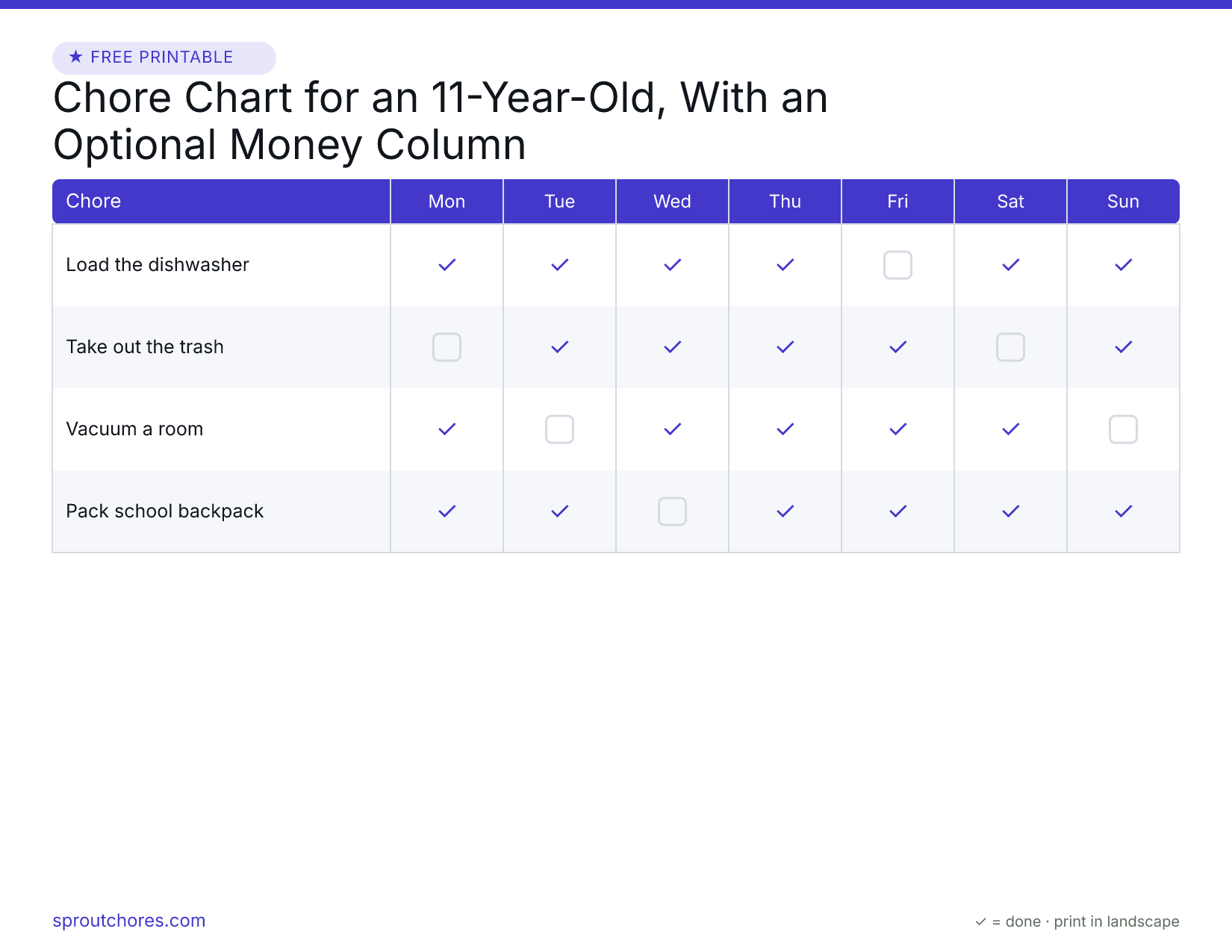
Eleven is a quietly pivotal age. Your kid is no longer a little one you supervise through every step, but they aren't a teenager you negotiate a monthly arrangement with either. They can take on real multi-step jobs, they're starting to notice money, and a lot of them are genuinely interested in how the systems around them work. The editable chart below is built for that in-between moment: a printable, weekly chore chart for an 11-year-old with a money column you can switch on or leave off, plus a running total at the bottom so the dollar amounts reflect your home instead of mine. I'm Andrew. My wife and I are the SproutChores family, raising four kids between nine and eighteen, and along the way we've fostered as well. We have kept some version of a chart going at every age in that span. Here's the frame I'd ask you to keep before you start typing in jobs and numbers: in our house, a chart like this exists so my wife and I can keep an honest read on how each kid is doing. It was never built to make the kid care. That part comes from something older and steadier, and the sections below walk through how we handle it at eleven, including how to price work without turning your kitchen into a checkout line.
| Chore | Value | Mon | Tue | Wed | Thu | Fri | Sat | Sun | Remove |
|---|---|---|---|---|---|---|---|---|---|
| Load the dishwasher | |||||||||
| Take out the trash | |||||||||
| Vacuum a room | |||||||||
| Pack school backpack | |||||||||
| Weekly total | 0.00 | ||||||||
Tip: choose Landscape in the print dialog for the best fit.
Print in landscape for the best fit. A few reminders from our family to yours: do it together the first few times, keep the chart somewhere everyone can see it, and reward steady effort over a perfect job. — The SproutChores family
Want every age in one file? Get the free Age-by-Age Pack
Six printable charts (ages 4–10) plus reward and routine sheets, in one tidy PDF — free, straight to your inbox.
We email you new printables now and then — unsubscribe anytime. Privacy.
Something went wrong — please try again in a moment.
✓ Almost there — check your inbox!
We just emailed you a confirmation link. Click it to confirm, and your free Age-by-Age Chore Chart Pack lands in your inbox moments later.
Let an 11-Year-Old Help Build the Chart
One thing that genuinely separates eleven from the younger ages is that a tween can often take part in designing their own system, and at this age that's worth leaning into. We've watched it firsthand. One of our daughters around this age was the kid who'd spend a whole amusement-park ride working out the mechanism behind the illusion instead of just enjoying the spook of it, and she's the same way about a chore chart. Handing her the structure and letting her arrange and own it landed far better than presenting her with a finished list to obey. So before you lock the chart down, I'd sit your eleven-year-old down with the maker above and let them have a real say in it.
That doesn't mean they pick whether they contribute. The expectation that everyone in this family carries part of the load isn't up for a vote, and I'd be plain about that. What's open for input is the shape of things: which jobs land on which days, the order they like to knock them out in, whether the money column is even turned on. An eleven-year-old who helped assemble the plan tends to argue with it a lot less, because it stopped being your rulebook and became their routine.
A quick, honest caveat, because every kid is wired differently. Not all of them light up at the idea of running their own chart, and you'll know fast which kind you've got. Some tweens take to a system and tweak it happily; others stare straight through it. If yours falls in the second camp, the chart still earns its keep as a tracking tool for you the parent, and you simply do more of the day-to-day steering yourself. Build around the kid in front of you rather than the one a chart assumes you have.
How to Set a Fair Price When You Turn the Money Column On
If you flip on the money column, the chart hands you a slot beside each job and a weekly total at the bottom. What it can't do is tell you what a job is worth in your house, because that's yours to decide based on your budget, your kid's age, and what counts as a heavy lift versus a quick tidy. A few rules of thumb have kept this fair and sane for us over the years.
Start from the top and work down, not the bottom up. Settle on a figure you're genuinely comfortable parting with for a full week of solid effort, then spread that across the jobs, and let the running total confirm you haven't quietly committed to more than you meant to. Pricing each task in isolation is how parents wake up on Sunday owing a small fortune.
Weigh the unpleasant and the demanding heavier than the merely time-consuming. A bathroom nobody wants to touch can fairly carry more than refilling the dog's bowl, even when both take about the same five minutes. And let the numbers rise as your kid grows more capable; a job an eleven-year-old gets credit just for attempting will, in a couple of years, simply be expected, and the value should move with the bar.
Here's the trap I'd steer you clear of, learned the hard way: don't bill your eleven-year-old job by job like a contractor's invoice. A kid this age is more than sharp enough to read a price list and start shopping it, holding out for the lucrative chores and quietly skipping the cheap ones. We've found money sticks better when it's tied to how the whole week went than to ticking individual boxes. So I'd treat that weekly total less as a tab you settle line by line and more as a snapshot of a dependable week. If your kid coasted, leaned on constant reminders, or did everything halfway, the number can reflect that, and you say so out loud well in advance so it never feels like an ambush.
What Stays Unpaid, the Extra Jobs Worth Paying For, and the Money Lesson Underneath
The decision that makes or breaks a money chart is drawing a clear line between what's for sale and what never will be. In our home, the basic upkeep of shared life carries no price at all. Clearing your own plate, keeping your room livable, wiping a counter you splashed, looking after the pet you begged for, none of that earns a cent, the same way nobody pays my wife or me to cook dinner. You do it because you live here and the people you live with are counting on you. I grew up with chores that were never once attached to a dollar, and my parents had that exactly right: pitching in is the cost of belonging, not a transaction.
Pay, when it shows up, belongs on two things: overall dependability across the week, and the bigger optional jobs that sit outside the usual rotation, the kind you'd otherwise hire out or tackle yourself. Washing the car, clearing a corner of the garage, a real yard project, an afternoon minding a younger sibling, those are fair to attach a number to. The chart lets you flag which rows are unpaid family duties and which are paid extras, and I'd genuinely mark them, right there on the page, so the dollar column never quietly turns plain old belonging into something your kid expects a fee for.
There's a longer game here, and it's the whole reason we bother. I don't think of chores as a way to get the house clean. I think of them as rehearsal for running a life. An eleven-year-old who has practiced doing real work because it's theirs to do, money or no money, walks toward adulthood with something a paycheck can't hand them. So when you do use the money column, treat it as a teaching tool: help your kid pick something to save toward and watch how many good weeks it takes to get there, which teaches the value of consistency better than any lecture. One firm boundary, though, from how we run things at home: keep money in its own lane, well away from screens and discipline. We don't make our kids earn screen time by doing chores, and we don't dock allowance as punishment for some unrelated blowup. When a real behavior problem comes up, pulling screens is the tool we reach for, and it stays clear of the chart entirely. Tangle those wires and a clever eleven-year-old starts treating chores, money, attitude, and privileges as one big tradeable pile, and you'll find yourself negotiating everything.
Frequently asked questions
- What chores should an 11-year-old be responsible for?
- By eleven most kids can own a whole multi-step job and finish it without you hovering: running and emptying the dishwasher, a load of laundry start to finish, gathering and taking out the trash, real cooking rather than just stirring, cleaning a full bathroom, and keeping their own room and routine handled. If your kid leans toward it, outdoor work and small repairs fit too. Alongside those, plenty of tweens can take on the occasional bigger optional job, like washing the car or watching a younger sibling for an hour. Pick the jobs that suit your kid from the printable or the maker above, and let the expectations rise as their reliability does.
- How much should I pay an 11-year-old on a chore chart with money?
- There's no universal rate, so work from the top down: decide what you're comfortable handing over for a full week of genuinely good work, then spread that across the jobs and let the chart's weekly total confirm the figure before anyone earns it. Weight the harder or less pleasant chores higher, and raise the amounts as your kid grows more capable. The one thing I'd avoid is pinning a fixed price to each task, because an eleven-year-old will read that like a menu and shop it. In our house the money is tied to how the whole week went, the quality, staying on track without nagging, and the attitude behind it, rather than billed chore by chore.
- Is a chore chart for an 11-year-old boy different from one for a girl?
- Where capability is concerned, in our experience almost not at all. An eleven-year-old of either gender can cook, clean a bathroom, do laundry, handle the trash, and pitch in on bigger projects. What actually differs is what holds a kid's attention. Our son was drawn to tools and repairs early on, while one of our daughters would rather take a system apart to understand how it works. We lean into whatever each kid is naturally pulled toward, then widen the list outward from there. I'd build the chart around your particular tween's strengths and interests rather than splitting it into boy jobs and girl jobs.
- Should chores be connected to screen time or used as punishment at this age?
- We keep them firmly separate. We don't make our kids work to earn screens or fun, and we don't shave money off the chart over an unrelated argument. When a genuine behavior problem comes up, losing screen time is the tool we use, and it lives in its own lane, away from the chart and its dollar amounts. The moment those wires touch, a sharp eleven-year-old turns every chore into a bargaining chip. Keeping money, chores, screens, and discipline as four separate conversations keeps the chart honest and keeps your kid budgeting instead of negotiating.

About the author
More free printables
Get the free Age-by-Age Chore Chart Pack
Six printable charts (ages 4–10) plus reward and routine sheets, in one tidy PDF. We'll also send new printables and the occasional real parenting tip. The charts on this site are always free — no sign-up needed.
We email you new printables now and then — unsubscribe anytime. Privacy.
Something went wrong — please try again in a moment.
✓ Almost there — check your inbox!
We just emailed you a confirmation link. Click it to confirm, and your free Age-by-Age Chore Chart Pack lands in your inbox moments later.