Chore Chart for a 13-Year-Old That Starts Handing Over the Reins
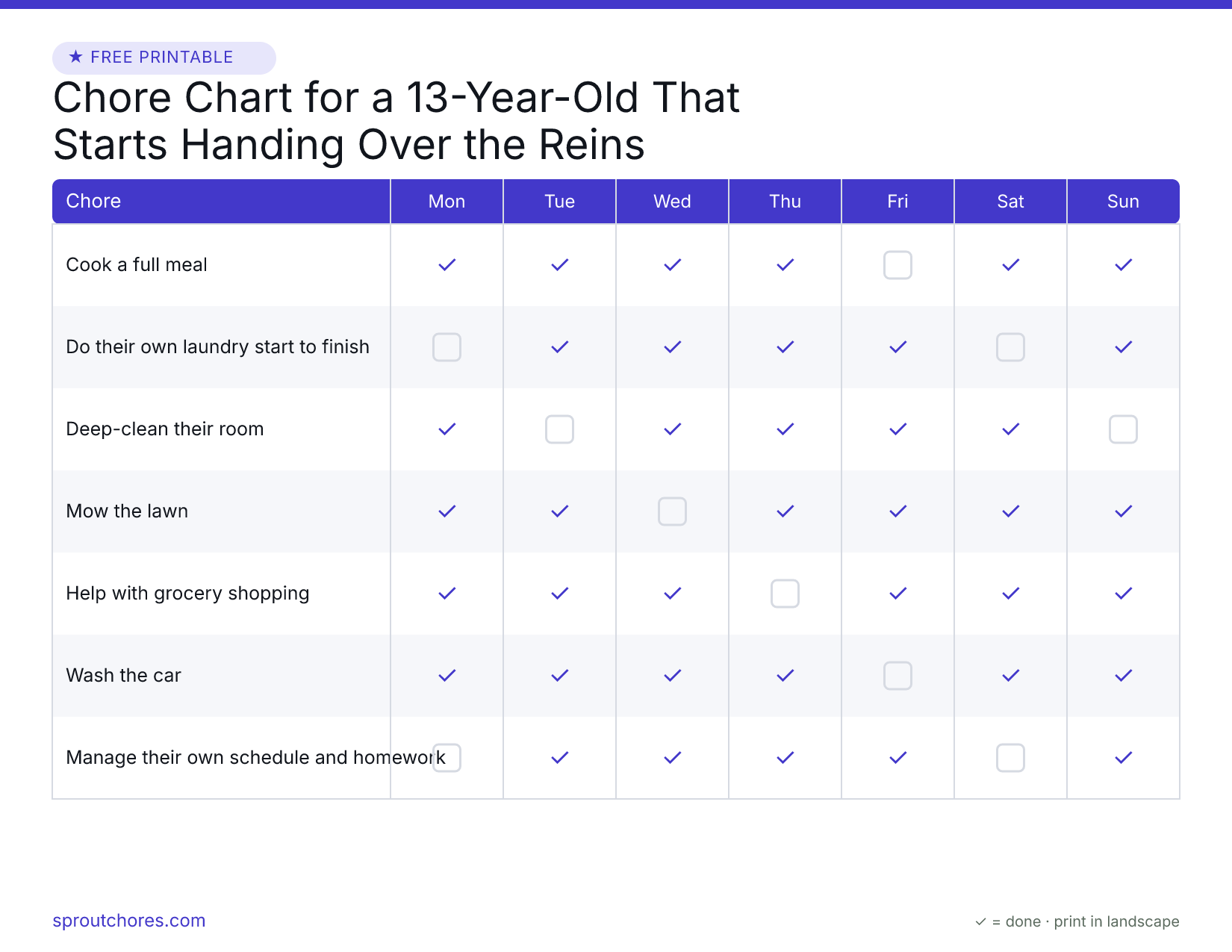
Thirteen is a strange, hopeful in-between age. Your kid isn't a little one who needs a job called out step by step anymore, but they're not the near-adult a sixteen-year-old is turning into either. That's exactly why a chore chart for a 13-year-old should look different from the one you'd hand a younger child: the point at this age is to slowly stop being the person who assigns and remembers every task, and to start letting your thirteen-year-old carry more of that themselves. I'm Andrew, and my wife and I are the SproutChores family. We're raising four kids between nine and eighteen, and we've fostered children along the way too, so we've kept some version of a chart taped up at basically every age you can name. The printable below is built for that handover moment at thirteen. Before you print it, though, I want to be honest about one thing that shapes how I'd use it: the chart is really a tracking tool for you, the parent. It's how you keep an eye on whether your thirteen-year-old is keeping up, not a gadget for making them care. The caring comes from something else entirely, and I'll get into that.

| Chore | Mon | Tue | Wed | Thu | Fri | Sat | Sun | Remove |
|---|---|---|---|---|---|---|---|---|
| Cook a full meal | ||||||||
| Do their own laundry start to finish | ||||||||
| Deep-clean their room | ||||||||
| Mow the lawn | ||||||||
| Help with grocery shopping | ||||||||
| Wash the car | ||||||||
| Manage their own schedule and homework |
Tip: choose Landscape in the print dialog for the best fit.
Print in landscape for the best fit. A few reminders from our family to yours: do it together the first few times, keep the chart somewhere everyone can see it, and reward steady effort over a perfect job. — The SproutChores family
Want every age in one file? Get the free Age-by-Age Pack
Six printable charts (ages 4–10) plus reward and routine sheets, in one tidy PDF — free, straight to your inbox.
We email you new printables now and then — unsubscribe anytime. Privacy.
Something went wrong — please try again in a moment.
✓ Almost there — check your inbox!
We just emailed you a confirmation link. Click it to confirm, and your free Age-by-Age Chore Chart Pack lands in your inbox moments later.
Age-appropriate chores for a 13-Year-Old That Starts Handing Over the Reins
Every chore below is pre-loaded in the generator above and is something a child in this age range can realistically manage with a little initial guidance:
- Cook a full meal
- Do their own laundry start to finish
- Deep-clean their room
- Mow the lawn
- Help with grocery shopping
- Wash the car
- Manage their own schedule and homework
What a 13-Year-Old Can Realistically Own
By thirteen the question stops being whether your kid is capable and starts being whether they'll follow through on their own. A thirteen-year-old can absolutely run a load of laundry from hamper to drawer, put together a simple dinner, keep a bathroom genuinely clean rather than just tidied, handle the trash and recycling, and take on a real weekend project like clearing out a garage corner or a stretch of yard work. None of that is beyond them. The muscle that's still forming is the invisible one: doing the job to a standard you'd actually sign off on, and finishing it without you standing over their shoulder.
So I'd use the chart a little differently at thirteen than at ten or eleven. Instead of a grid you police box by box, treat it as a shared list your kid is increasingly responsible for reading and running themselves. A younger child usually can't hold a sequence of tasks in their head or track their own progress; that's normal, and you carry that load for them. A thirteen-year-old is right at the edge of being able to do it. Some days they'll manage it beautifully; other days they'll drift, and you'll still need to nudge. That's not a failure of the chart. It's the whole point of this age, watching them practice self-management with a safety net still under them.
On the boy-versus-girl searches that bring a lot of parents here: in our house, capability has never split along gender lines at thirteen. Every one of ours could clean, cook, and do laundry. What actually differs is what each kid gravitates toward. Our son latched onto anything involving a tool and a repair from the time he was small, while one of our daughters would rather pull a system apart to understand how it works. I'd lean into that. Give a thirteen-year-old some of the jobs that fit what pulls at their attention, then stretch the list outward from there, rather than sorting chores into a boy column and a girl column.
The Real Shift: From You Reminding Them to Them Owning It
The hardest and most valuable move at thirteen is the one nobody prints on a chart: stepping back so your kid starts to own the responsibility rather than waiting to be chased. I came at this the hard way. I didn't take direction well as a kid, especially from my mom, so with my own children I've stopped trying to argue them into agreeing with my reasoning. Instead I put the useful tools and information in front of them, make it plain that they can lean on those tools or set them aside, and then let the responsibility genuinely sit with them. It's teaching, not chasing. The chart is one of those tools. My job is to show my thirteen-year-old how it works and hand it over, not to hover behind it.
What makes that handover survivable is letting real consequences land instead of rescuing every stumble. When a task at this age slides, I try not to swoop in and fix it for them, because the lesson a rescue teaches is that not doing the thing simply summons help. I'd rather the miss cost them something honest and proportionate, the same way it would in the wider world, and then let them pick themselves up and choose better next time. That's a lot easier to hold at thirteen than at eight, because a thirteen-year-old can actually connect a slip today to a result tomorrow.
One small, free lever has ended more standoffs in our house than anything fancy: telling a kid what's coming before I need it done. Springing a job on a thirteen-year-old the second it crosses my mind reliably draws out resistance. Giving them a heads-up, that we'll be tackling the kitchen in about an hour, lets them wrap up whatever they're absorbed in and get their head around what's next, and a startling number of arguments simply never get started. And I'd build your chart to be easy to restart, not perfect. Most systems don't collapse because the design was wrong; they collapse because a busy week or a trip knocks them over and nobody props them back up. Keep one you can dust off and put back on the fridge after real life interrupts it.
Allowance at Thirteen, Without Turning the House Into a Checkout Lane
Plenty of parents come here looking to bolt a money amount onto each row, and I'd gently steer you off that. A thirteen-year-old is more than sharp enough to read a per-chore price list and start comparison shopping, skipping the cheap jobs and holding out for the ones worth their time. That's not laziness; it's them being smart about a system you handed them. We've never paid by the task. In our home there's an allowance, but what a kid ends up with reflects the whole picture, whether they stayed on top of their responsibilities, held a real standard, and kept a decent attitude about it, rather than a tally of individual chores. For our younger kids that's a modest weekly amount; for the older teens it eventually turns into something closer to a monthly job-style arrangement.
Thirteen usually sits right on that line. Your kid probably isn't ready to run their whole life on a monthly figure the way an older teen can, but they're past the point where a childish sticker system means anything. A chart whose money reflects a dependable week is a good rehearsal for the more grown-up version coming in a year or two. Whatever amount you land on, I'd keep it aimed at wants rather than needs, we always cover the needs, which is exactly why losing a slice of the wants money actually registers with a kid.
And I'd keep rewards and screen time in a completely separate lane from all of this. We don't make our kids earn screens by doing chores, and we don't shave money off because of some unrelated blowup. When a genuine behavior problem comes up, pulling screen time is a tool we use, but it lives on its own, nowhere near the chore chart. The instant those wires touch, a clever thirteen-year-old starts treating chores, money, attitude, and privileges as one big tradeable pile, and suddenly you're negotiating everything. The thing that actually drives the behavior isn't the dollar anyway. It's the plain expectation that everyone here pitches in because we share this home. Our years of fostering made that vivid: for kids who'd arrived from homes with almost no steady structure, what settled them wasn't any reward, it was the predictability, knowing what came next and trusting that the rules wouldn't quietly shift on them. Even with a confident, money-minded thirteen-year-old, that dependable structure is the real engine. The allowance is just a small, useful layer riding on top.
Frequently asked questions
- What chores should a 13-year-old be responsible for?
- By thirteen, capability isn't really the limit anymore. A thirteen-year-old can run their own laundry start to finish, put together a simple meal, deep-clean a bathroom rather than just tidy it, handle the trash and recycling, keep shared spaces livable, and take on a bigger weekend job like yard work or clearing a space in the garage. What you're actually coaching at this age is the follow-through, doing the job to a standard that would pass and finishing it without being reminded twice. The printable here keeps the wording plain and grown-up so it reads like a responsibility list rather than a kids' grid.
- Should I pay my 13-year-old for chores?
- We don't pay per task, because a thirteen-year-old will just price out which chores are worth their time and skip the rest. In our house there's an allowance, but it reflects the whole picture, staying on top of their responsibilities, holding a standard, and keeping a reasonable attitude, rather than a menu of individual jobs. Thirteen tends to sit between a small weekly amount and the more grown-up monthly setup our older teens have. You can use the chart to track it, just treat the number as a snapshot of a dependable week, not a bill you owe row by row.
- How do I get my 13-year-old to do chores without constant reminders?
- The most useful move is to start handing over the responsibility instead of chasing it. We put the tools and expectations in front of our kids, make clear where the responsibility sits, and then let honest consequences land when something slips rather than rescuing every miss, which is what finally teaches follow-through. Giving advance notice helps enormously too: telling a thirteen-year-old what's coming an hour ahead, instead of demanding it on the spot, heads off most standoffs. And we keep chores completely separate from screens and behavior so nothing turns into a bargaining chip.
- Is there a difference between a chore chart for a 13-year-old boy and a girl?
- In our experience, almost none where capability is concerned. A thirteen-year-old of either gender can cook, clean, do laundry, handle the trash, and take on bigger projects. What genuinely varies is interest. Our son was drawn to tools and repairs while one of our daughters loved figuring out how things work, so we leaned the chart into what each kid was naturally pulled toward and widened it from there. I'd build it around your particular thirteen-year-old's strengths rather than splitting the list into boy chores and girl chores.

About the author
More free printables
Get the free Age-by-Age Chore Chart Pack
Six printable charts (ages 4–10) plus reward and routine sheets, in one tidy PDF. We'll also send new printables and the occasional real parenting tip. The charts on this site are always free — no sign-up needed.
We email you new printables now and then — unsubscribe anytime. Privacy.
Something went wrong — please try again in a moment.
✓ Almost there — check your inbox!
We just emailed you a confirmation link. Click it to confirm, and your free Age-by-Age Chore Chart Pack lands in your inbox moments later.