Chore Chart for Teenagers: A Free Printable Built for Age 15
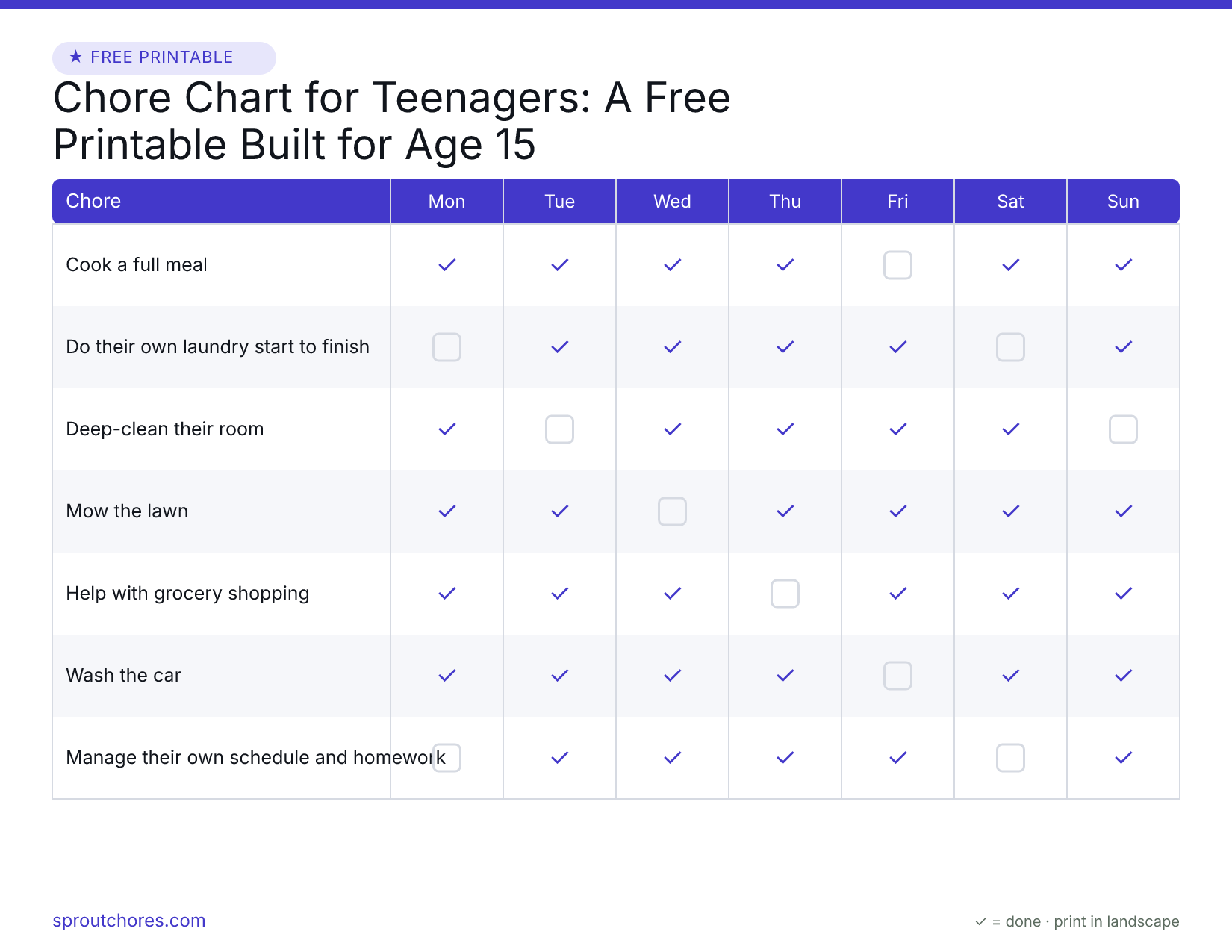
A chore chart for teenagers is a different beast than one for little kids, and if you have a fifteen-year-old at home you already feel it. Nobody this age is chasing a sticker, and a colorful grid on the fridge can read as faintly insulting to someone who's a few years from leaving for college. So let me set your expectations honestly before you print anything. I'm Andrew, and my wife and I are the SproutChores family, raising four kids from nine to eighteen and fostering along the way. Our fifteen-year-old is the one I had in mind building this. She's sharp, endlessly curious about how things work, and (like her dad) gets pulled off course by the next interesting thing without even noticing. The printable below is made for exactly that kind of teenager: plain wording, grown-up tasks, no cartoons, and an allowance column you can switch on if it fits your family. One thing I want clear from the start, because it shapes everything that follows: think of this chart as your dashboard, not your kid's motivator. It's how you see who's keeping up, not a machine for making them care.

| Chore | Mon | Tue | Wed | Thu | Fri | Sat | Sun | Remove |
|---|---|---|---|---|---|---|---|---|
| Cook a full meal | ||||||||
| Do their own laundry start to finish | ||||||||
| Deep-clean their room | ||||||||
| Mow the lawn | ||||||||
| Help with grocery shopping | ||||||||
| Wash the car | ||||||||
| Manage their own schedule and homework |
Tip: choose Landscape in the print dialog for the best fit.
Print in landscape for the best fit. A few reminders from our family to yours: do it together the first few times, keep the chart somewhere everyone can see it, and reward steady effort over a perfect job. — The SproutChores family
Want every age in one file? Get the free Age-by-Age Pack
Six printable charts (ages 4–10) plus reward and routine sheets, in one tidy PDF — free, straight to your inbox.
We email you new printables now and then — unsubscribe anytime. Privacy.
Something went wrong — please try again in a moment.
✓ Almost there — check your inbox!
We just emailed you a confirmation link. Click it to confirm, and your free Age-by-Age Chore Chart Pack lands in your inbox moments later.
Age-appropriate chores for Teenagers: A Free Printable Built for Age 15
Every chore below is pre-loaded in the generator above and is something a child in this age range can realistically manage with a little initial guidance:
- Cook a full meal
- Do their own laundry start to finish
- Deep-clean their room
- Mow the lawn
- Help with grocery shopping
- Wash the car
- Manage their own schedule and homework
What Fifteen Is Actually For (It's Not About the Dishes)
Here's the reframe that changed how I run all of this. When I was a kid, chores were about getting work done, the dishwasher emptied, the trash out. Somewhere along the way I stopped seeing it that way. The unloaded dishwasher isn't the point. The point is the capable adult on the other side of it. By fifteen, your teen is genuinely close to running their own life, and the chart is one of the last structured chances you get to rehearse that with them under your roof.
What that looks like in practice: a fifteen-year-old can take a household job and carry it from start to finish without you hovering. Cooking an actual dinner, running their own laundry from the hamper all the way back to the drawer, keeping a shared room livable, handling a bigger weekend project. The skills aren't really in question at this age. What you're coaching now is the harder, quieter stuff, finishing what they start, holding a real standard, and not needing to be told twice. That's why this printable strips out the icons and keeps the language adult. You're not teaching a teen what a broom is. You're helping them build the follow-through that nobody hands you in your twenties if you didn't practice it earlier.
How to Make It Stick With a Distractible Teen
Let me be candid about the version of this that fails, because we've lived it. A parent sits down, designs a flawless system, color-codes the week, and it works beautifully right up until a vacation or a heavy school stretch knocks it sideways. Then it never restarts, and the conclusion becomes the chart didn't work. The chart was fine. It just wasn't built to survive an ordinary disrupted week. So design yours to be easy to pick back up after it falls apart, because it will fall apart, and that's normal, not failure.
The single move that has killed more chore arguments in our house than anything else is giving notice before I expect something. Walking up to a focused teenager and demanding a job right this second almost guarantees friction. Telling them an hour ahead that we'll be tackling it after lunch gives their brain time to land. With our fifteen-year-old especially, who can vanish into a project and genuinely lose track of the world, that heads-up is the difference between cooperation and a standoff. None of this lives on the chart, but it's the unglamorous machinery that makes the chart possible.
And a word on what doesn't belong anywhere near this: we keep screens and behavior in a totally separate lane from chores. We don't make our kids earn screen time by doing tasks, and we don't dock chores when someone's attitude goes sideways. When there's a real behavior issue, pulling screen time is the lever we use, and it stays well clear of the chore chart. The moment those wires touch, a clever teenager turns every single thing in the house into a negotiation. Keep chores boring and non-negotiable, just part of how this family runs, and you save yourself a thousand small fights.
The Allowance Column, and Why We Stopped Paying Per Task
You can turn on a money column in this printable, and plenty of families want one, so here's how we actually handle it, plus a warning. We don't price chores. The instant a fifteen-year-old can see that dishes are worth one amount and the trash another, they'll quietly run the numbers and skip whatever isn't worth their time. That's not them being lazy, that's them being smart, and you set it up.
What works better for us at this age looks less like a chore chart and more like a job. Our teenagers get a set amount each month, and that money is strictly for wants, the coffee run with friends, the thing they've been eyeing, never for needs, which we always cover. The amount isn't attached to checkboxes. It rides on the full picture: did the work hold a real standard, did they stay consistent, and was their attitude where it should be. Along with that monthly amount comes the understanding that we can call on them for agreed jobs we line up in advance, watching a younger sibling, a deep clean, cooking a night. Let the follow-through slip and the figure shrinks when the month closes. Let it really collapse and the money pauses entirely until they string together a couple of dependable weeks and earn it back. Because it funds wants and not needs, losing it actually stings, which is the whole point.
If you'd rather keep using the chart's money column as a simple record, that's completely fine, just treat the number as a snapshot of a solid week rather than a tab you owe line by line. I'll add one thing from our years as foster parents, because it reframes what the money is even for. The kids who came to us from homes with little steady structure didn't steady themselves because of any reward. They steadied because the days became predictable, and they could finally trust that the rules wouldn't shift under them. That predictability did far more than any dollar ever could. Even with a confident, money-motivated fifteen-year-old, the real engine here is the dependable structure you actually keep up with. The allowance is just a small useful layer sitting on top of it.
Frequently asked questions
- What chores should a 15-year-old be responsible for?
- By fifteen, the question isn't really which tasks they're capable of, because they can run almost anything in the house on their own, cooking a real meal, doing their own laundry, dishes, trash and recycling, keeping shared spaces livable, and pitching in on bigger weekend jobs. What you're coaching at this age is the standard and the follow-through: doing the job properly and finishing it without being reminded twice. The printable here keeps the wording plain and adult so it reads like the responsibility list it is.
- Should I pay my teenager for chores?
- We don't pay per task, because a teen will just price out which chores are worth their time. What's worked for us looks more like a job: a set monthly amount that's for wants and not needs, gated on quality, consistency, and attitude rather than individual boxes. If the follow-through fades, the amount gets trimmed at month-end. You can absolutely use the chart's money column, just treat it as a record of how the whole week went, not a price tag on each chore.
- How do I get a distractible 15-year-old to actually do their chores?
- The biggest fix in our house was giving advance notice instead of demanding things on the spot. Telling our easily-distracted fifteen-year-old an hour ahead lets her brain catch up and heads off the standoff. We also keep chores completely separate from screens and behavior so nothing becomes a bargaining chip, and we lean on the expectation itself rather than the chart to do the motivating. The chart's real job is to let us see who's keeping up so we know when to step in.
- Is a chore chart even worth it for a teenager, or should I just expect them to help?
- Both, honestly. The expectation that everyone pitches in is what drives the behavior, not the chart. But the chart still earns its place by giving you, the parent, a clear read on how each kid is doing week to week. With our teens it gradually becomes more of a tracking dashboard for us than a guide for them. Build it so it's easy to restart after a busy week throws it off, because real life always does, and a system you can pick back up beats a perfect one that never recovers.

About the author
More free printables
Get the free Age-by-Age Chore Chart Pack
Six printable charts (ages 4–10) plus reward and routine sheets, in one tidy PDF. We'll also send new printables and the occasional real parenting tip. The charts on this site are always free — no sign-up needed.
We email you new printables now and then — unsubscribe anytime. Privacy.
Something went wrong — please try again in a moment.
✓ Almost there — check your inbox!
We just emailed you a confirmation link. Click it to confirm, and your free Age-by-Age Chore Chart Pack lands in your inbox moments later.