Chore Chart for a 14-Year-Old: A Free Printable Built Around Independence
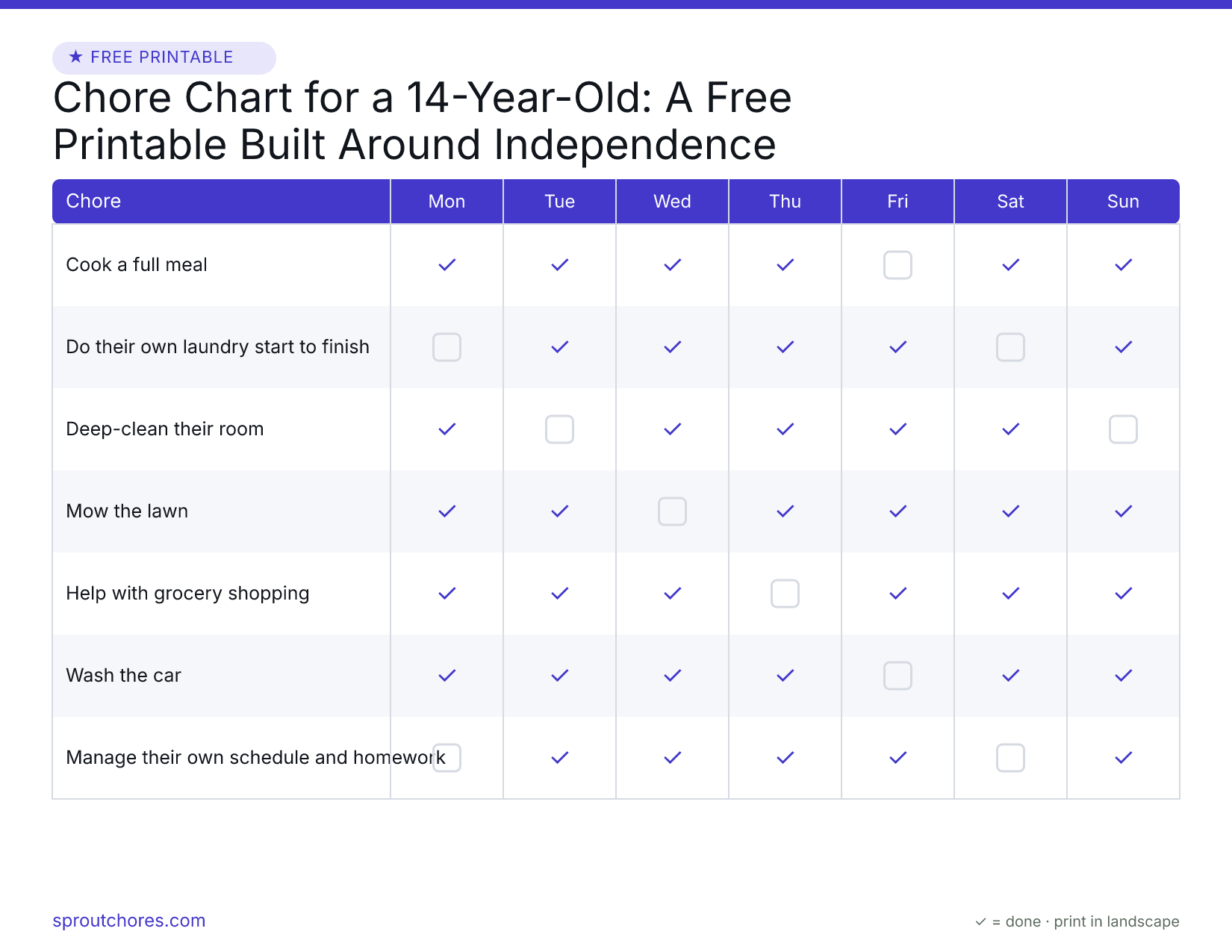
A chore chart for a 14-year-old is doing a very different job than the sticker grid you taped to the fridge when this same kid was six. Fourteen is a hinge age. Your teen is no longer a child you're teaching what a task is, and not yet the near-adult who's a step from moving out, but they're close enough to that finish line that this year is when the whole point of the exercise quietly changes. I'm Andrew, and my wife and I are the SproutChores family, raising four kids from nine to eighteen, with a stretch of foster parenting mixed in. Our own fourteen-to-fifteen range is where I stopped handing out daily assignments and started handing over whole pieces of running a life: your own laundry, an actual dinner on the table, keeping track of your own week without me being your alarm clock. The editable chart below is built for exactly that handoff. It's plainly worded, free of cartoons, and set up so you can shape it around the areas your fourteen-year-old is ready to own. One thing to fix in your mind before you print it, because it colors everything else on this page: the chart is a way for you to see how they're carrying that responsibility, not a gadget for making them care. The caring has to come from somewhere sturdier than a checkbox.

| Chore | Mon | Tue | Wed | Thu | Fri | Sat | Sun | Remove |
|---|---|---|---|---|---|---|---|---|
| Cook a full meal | ||||||||
| Do their own laundry start to finish | ||||||||
| Deep-clean their room | ||||||||
| Mow the lawn | ||||||||
| Help with grocery shopping | ||||||||
| Wash the car | ||||||||
| Manage their own schedule and homework |
Tip: choose Landscape in the print dialog for the best fit.
Print in landscape for the best fit. A few reminders from our family to yours: do it together the first few times, keep the chart somewhere everyone can see it, and reward steady effort over a perfect job. — The SproutChores family
Want every age in one file? Get the free Age-by-Age Pack
Six printable charts (ages 4–10) plus reward and routine sheets, in one tidy PDF — free, straight to your inbox.
We email you new printables now and then — unsubscribe anytime. Privacy.
Something went wrong — please try again in a moment.
✓ Almost there — check your inbox!
We just emailed you a confirmation link. Click it to confirm, and your free Age-by-Age Chore Chart Pack lands in your inbox moments later.
Age-appropriate chores for a 14-Year-Old: A Free Printable Built Around Independence
Every chore below is pre-loaded in the generator above and is something a child in this age range can realistically manage with a little initial guidance:
- Cook a full meal
- Do their own laundry start to finish
- Deep-clean their room
- Mow the lawn
- Help with grocery shopping
- Wash the car
- Manage their own schedule and homework
What a 14-Year-Old Can Really Own (Not Just Do)
By fourteen, capability isn't the question anymore. Your teen can run a washer, plate a meal, scrub a bathroom, and mind a younger sibling for an afternoon. So the interesting shift at this age isn't adding harder tasks to a list, it's moving from assigning individual jobs to handing over an entire domain and stepping back.
That distinction matters more than it sounds. Telling a fourteen-year-old to fold the laundry today is still parenting by the task. Telling them the laundry is now theirs, hamper to drawer, on whatever rhythm keeps everyone in clean clothes, is asking them to own an outcome and manage themselves toward it. That second version is the one that builds an adult. In our house I lean into a few of these on purpose at this age: their own laundry cycle start to finish, cooking one real dinner the family actually eats, and taking charge of their own schedule instead of leaning on me to remember it for them. The chart is where those ownership areas get written down so both of us can see whether the thing is actually getting carried.
I think about all of this the way my own thinking shifted years ago. I used to see chores as a means to a clean house. I don't anymore. The clean kitchen is a happy byproduct; what I'm really building is a person who can run a household and a life without me standing behind them. At fourteen you're genuinely close enough to that to make it feel real, which is why I'd rather hand over a whole responsibility, watch them fumble it, and coach the recovery than keep issuing tidy little instructions they'll never get to practice owning.
How to Make It Stick: Hand Over Tools, Then Let Consequences Teach
Here's the part that trips up good, organized parents, and I say this as someone who has done it wrong plenty. You cannot lecture a fourteen-year-old into follow-through. I learned this partly from my own teenagers and partly from how badly I took that kind of talking-to at their age. A long explanation of why they should stay on top of their responsibilities is, to a fourteen-year-old, just noise to nod through until you stop. It teaches nothing.
What actually works for us is closer to how a decent boss operates than how a nagging parent does. I give my teen the tools and the plain information, I make crystal clear where their responsibility begins and ends, and then I get out of the way. I'll always help if they ask. What I won't do is chase them. And when they let something slide, I let the real result land instead of swooping in to fix it. One of ours once dropped the ball on something that mattered, waved off the help I offered, and ended up missing an event she'd been looking forward to. It was genuinely hard to hold that line, but a consequence that mirrors how the actual world works, miss the thing at your job and you lose the perk, teaches in a way a rescue never could. She sorted it out the next time on her own.
That's the trap worth naming: over-rescuing. If a kid this age learns that dropping a responsibility summons a parent to catch them, they'll keep dropping it and pour their energy into whatever they'd rather be doing. Letting them feel a fair, real-world-shaped consequence is how the lesson finally sticks.
Two smaller levers make the whole thing smoother. The first is advance notice. Springing a job on a focused fourteen-year-old the second it occurs to you almost guarantees a standoff, whereas a heads-up an hour ahead lets them wrap up what they're doing and get their head around what's next. That single habit has defused more friction in our house than anything else. The second is building a chart you can restart without ceremony. Most systems don't fail because the design was wrong; they fail because a busy week or a trip knocks them over and nobody stands them back up. Build yours so it's easy to dust off after it collapses, because it will, and that's ordinary, not defeat.
Money at Fourteen: The On-Ramp, Not the Motivator
Plenty of parents land here searching for how to pay a fourteen-year-old, so let me be straight about how we handle it, and about what we deliberately don't do. We don't put a price on individual chores. The moment a sharp fourteen-year-old sees that one job pays more than another, they'll run the numbers and quietly skip whatever isn't worth their time. That's not them being lazy; it's them being rational about a system you accidentally set up.
Instead, any money we hand over rides on the whole picture: did the work hold a real standard, did they stay consistent without being prodded, and was the attitude where it should be. It's tied to overall follow-through, never to a tally of boxes. Fourteen is really the on-ramp to the setup we use with our older teens, which looks less like a chore chart and more like a job, a set monthly amount that funds their wants, the coffee runs and the things they've been eyeing, while we cover every actual need no matter what. Because it pays for wants and not needs, a shrinking figure at month's end actually registers. A fourteen-year-old usually isn't ready to run entirely on that arrangement yet, but a chart that rewards a dependable week is the perfect rehearsal for it, and they arrive at the full teen version steadier for having practiced here first.
Just as important is what we keep well away from the money and the chart: screens and behavior. We don't make our kids earn screen time by doing chores, and we don't shave money off because an unrelated mood went sideways. When there's a genuine behavior problem, pulling screens is the lever we use, and it lives in its own lane. Let those wires touch and a clever fourteen-year-old will turn every request in the house into a negotiation, which is the last thing you want with someone this good at arguing. The reason they contribute at all shouldn't be the dollar or the device. It should be the plain expectation that everyone under this roof pitches in. One thing our fostering years drove home is how much that steadiness matters: kids who'd come from homes with almost no structure settled not because of any reward, but because the days became predictable and they could finally trust the rules to hold. The dependable structure you actually keep up is doing the heavy lifting. The money is a small, useful layer on top of it.
Frequently asked questions
- What chores should a 14-year-old be responsible for?
- At fourteen, the honest answer is that capability isn't really the limiting factor, they can cook a real meal, run their own laundry from hamper to drawer, handle dishes and trash, keep shared spaces livable, and take on bigger weekend jobs. What I'd focus on at this age isn't piling on harder tasks; it's handing over whole areas to own rather than assigning them piece by piece. In our house that means things like their own laundry cycle, cooking a dinner the family eats, and managing their own schedule. The printable keeps the wording plain and grown-up so it reads like the responsibility list it actually is.
- Should I pay my 14-year-old for chores?
- We don't pay per task, because a teen will just price out which jobs are worth doing and skip the rest. What works for us is money that rides on the full picture, quality, consistency, and attitude, rather than a figure stapled to each chore. Fourteen is really the warm-up for the monthly, job-style setup we use with older teens, where a set amount funds wants and not needs. You can absolutely use the chart's money column, just treat the total as a read on how the whole week went, not a bill you owe line by line.
- How do I get my 14-year-old to actually do their chores without nagging?
- The move that changed things for us was to stop lecturing and start handing over the tools, making plain where their responsibility sits, and then letting real consequences do the teaching when they drop the ball. A fourteen-year-old tunes out a long talking-to, but a fair, real-world-shaped result sinks in. We also give advance notice instead of demanding things on the spot, which heads off most standoffs, and we resist the urge to rescue them every time, because being caught every time just teaches them that not doing it works.
- Is a chore chart babyish for a 14-year-old?
- It can feel that way if it's the wrong chart, which is why this one drops the cartoons and reads like a plain list of responsibilities. And it helps to reframe what the chart is for: with a teenager it becomes less of a guide for them and more of a dashboard for you, a quick way to see who's keeping up so you know when to step in. The motivation itself comes from the plain expectation that everyone in the family contributes, not from the grid on the wall. Built and framed that way, most fourteen-year-olds take it far more seriously than a sticker sheet.

About the author
More free printables
Get the free Age-by-Age Chore Chart Pack
Six printable charts (ages 4–10) plus reward and routine sheets, in one tidy PDF. We'll also send new printables and the occasional real parenting tip. The charts on this site are always free — no sign-up needed.
We email you new printables now and then — unsubscribe anytime. Privacy.
Something went wrong — please try again in a moment.
✓ Almost there — check your inbox!
We just emailed you a confirmation link. Click it to confirm, and your free Age-by-Age Chore Chart Pack lands in your inbox moments later.