Chore Chart for a 3-Year-Old (What Age 3 Can Really Do + Free Printable)
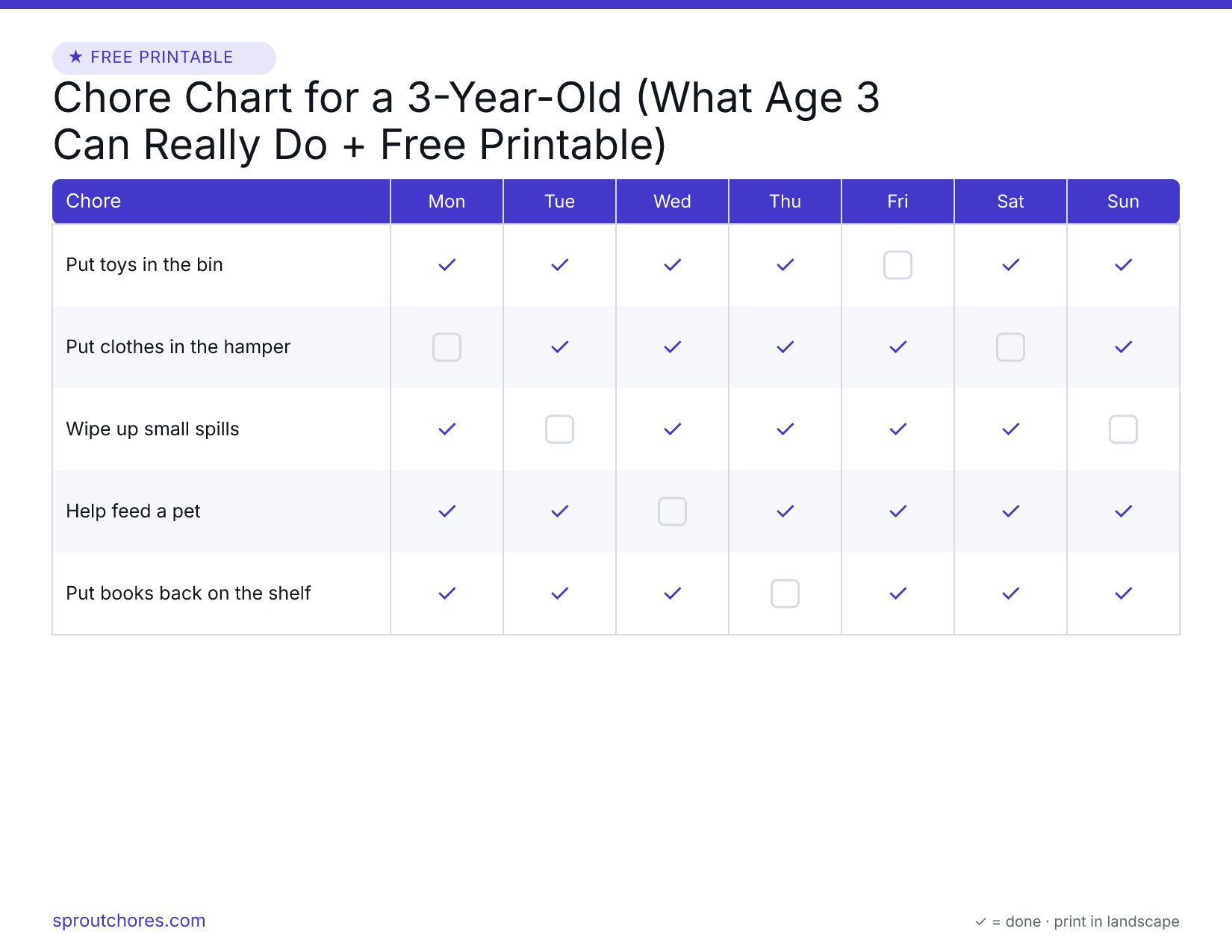
At three, a chore chart isn't about a clean room. It's about a little person noticing, maybe for the first time, that there are things they can do all by themselves. A three-year-old can't read a word yet, but they can study a row of small pictures, figure out what each one is asking, and move through them in order without you hovering. That's why the chart above leads with icons instead of text. I'm Andrew, and my wife and I are raising four kids, now somewhere between 9 and 18, and we've also fostered three children who were almost exactly this age when they came to us. What stuck with us across all of them is simple: at three you're not trying to get jobs done, you're giving a child their very first sense of \"this part is mine to handle.\" The list you see is scaled to what a three-year-old can genuinely pull off, and you can print it as-is or rework it for your own kid in a minute or two. Below I'll walk through what's actually realistic at this age, how to get a picture chart to take hold, and the honest answer on rewards and money.
| Chore | Mon | Tue | Wed | Thu | Fri | Sat | Sun | Remove |
|---|---|---|---|---|---|---|---|---|
| Put toys in the bin | ||||||||
| Put clothes in the hamper | ||||||||
| Wipe up small spills | ||||||||
| Help feed a pet | ||||||||
| Put books back on the shelf |
Tip: choose Landscape in the print dialog for the best fit.
Print in landscape for the best fit. A few reminders from our family to yours: do it together the first few times, keep the chart somewhere everyone can see it, and reward steady effort over a perfect job. — The SproutChores family
Want every age in one file? Get the free Age-by-Age Pack
Six printable charts (ages 4–10) plus reward and routine sheets, in one tidy PDF — free, straight to your inbox.
We email you new printables now and then — unsubscribe anytime. Privacy.
Something went wrong — please try again in a moment.
✓ Almost there — check your inbox!
We just emailed you a confirmation link. Click it to confirm, and your free Age-by-Age Chore Chart Pack lands in your inbox moments later.
Age-appropriate chores for a 3-Year-Old
Every chore below is pre-loaded in the generator above and is something a child in this age range can realistically manage with a little initial guidance:
- Put toys in the bin
- Put clothes in the hamper
- Wipe up small spills
- Help feed a pet
- Put books back on the shelf
What Age 3 Can Genuinely Do
Set the bar somewhere a three-year-old can actually reach, and that means nearly everything belongs to them and their own things. The dependable wins are looking after themselves and clearing up the mess they personally made: pulling on clothes that are forgiving enough for small hands to win at, brushing teeth, dropping dirty laundry in the hamper, and rounding up the toys they just scattered across the floor. None of this leaves you with a tidy house, and that's fine, because tidy isn't the assignment. The assignment is that a three-year-old begins to carry one small job from start to finish, and a picture chart gives them a way to check their own progress against something they can read.
The most powerful tool you've got at this age is the fact that they want to be you. A three-year-old will line up to do whatever a grown-up is doing, so the fastest way to teach a task is to do your grown-up version right beside them while they attempt their tiny version. Wiping the counter? Hand over a cloth and give them one section. If they're itching to push the vacuum because you are, let them, and teach a single piece of it rather than the whole routine. You're only after a brief, no-stakes go at it. The familiarity you build now is what makes that same task feel old and ordinary, not strange and new, when they're five and you genuinely need their help. One thing I'd save for later: jobs that serve the whole household, like cleaning a shared bathroom. We layer those in closer to four. At three, the chart stays squarely about taking care of yourself.
Getting a Picture Chart to Actually Take Hold
The thing that finally made charts work for our youngest was less about the chart and more about its location. Rather than one big page stuck to the fridge, we broke the cues apart and put each picture exactly where its task lives. The teeth picture goes up at the bathroom sink. The dressing picture sits by the drawer. The toy-cleanup picture stays in the play corner. A three-year-old who's standing in the right spot can look at the picture and know what to do next without an adult reading the steps out loud over their shoulder. That's the line between a chart your child follows on their own and a chart you end up nagging them through. A printed sheet does this perfectly well too, so feel free to cut it into pieces and post each one where it belongs.
It's also why apps never did much for us with kids this small. The app is on a parent's phone, buried in a pocket where a pre-reader will never glance at it, so it can't possibly cue a child who can't read and can't reach it. Paper at their eye level can. And the consistency this builds goes deeper than habit, something I saw most plainly during fostering. The little ones who arrived with us calmed down and found their footing faster once the same pictures showed up in the same places every single day, because a routine they could run themselves handed them something dependable to lean on. That steadiness did far more for rough bedtimes and overwhelming feelings than any treat could have. Your own three-year-old draws on the same predictability, even when the stakes look smaller from the outside. A routine they can see and run by themselves is what holds the whole thing together.
Rewards and Allowance: Why We Keep Them Off the Chart
Here's where I part ways with most of the chore-chart advice out there, so I'll be straight about it. For us the chart is a tracking tool for the parents, not a motivation engine pointed at the kid. Its real purpose is to let us glance over and gauge how each child is doing, so we know when something needs our attention. The push to actually do the work should grow out of one plain, repeated idea, that everyone in this family chips in, and not from a sticker or a payout waiting at the end of a row. Teach a three-year-old that helping only counts when there's a prize on the table, and you've handed yourself a much harder job for the next decade and a half.
So at three there's no allowance and nothing paid out per task. Money doesn't enter our picture until the family-chore years closer to five or six, and even then it's a modest weekly amount that hinges on how well and how reliably the work gets done and the attitude behind it, never itemized chore by chore like a snack machine. We keep screen time out of the chore conversation entirely, too. We've never made a child earn their shows by finishing a job. Losing screen time was only ever a response to real misbehavior, not a currency you buy back by sweeping the floor. If you want to mark a good stretch for a little one, tie it to honest effort and a good attitude rather than to a filled-in chart. Keep the cash, the treats, and the chart in their own lanes, and the chart stays exactly what it's meant to be: a calm, truthful read on how your three-year-old is settling into the family.
Frequently asked questions
- What chores can a 3-year-old actually do?
- Mostly self-care and tidying up their own mess: getting dressed in easy clothes, brushing teeth, putting dirty laundry in the hamper, and gathering up the toys they were just playing with. They can also "help" with bigger jobs like wiping a table or pushing the vacuum, more for the practice than any real result. Don't expect a clean room or finished work at this age. You're teaching a child to carry one small task from start to finish on their own, not getting your house cleaned. Leave shared-space jobs like the bathroom for around age four.
- Why use a picture chart instead of words for a 3-year-old?
- A three-year-old can't read but can easily recognize a row of pictures and work through them in order. A text chart asks them to follow instructions they literally can't decode, while icons let them run the routine themselves. What worked best for us was splitting the pictures up and posting each one where its task happens, like a teeth icon at the sink, so the chart turns into a self-guided cue instead of something you read aloud. That's why this printable leads with icons, with text as an option if you want it.
- Should I pay or reward my 3-year-old for chores?
- We don't, and I'd suggest holding off too. There's no allowance at three in our house. Money doesn't start until around five or six, and even then it's tied to doing the work well and consistently with a good attitude, never handed out task by task. We also keep treats and screen time off the chart completely. The chart is a tracking tool for you as the parent, and the real motivation should come from the expectation that the whole family pitches in. If you want to celebrate a good week, connect it to genuine effort, not to checking boxes.
- Is a chore chart different for a 3-year-old boy versus a girl?
- Not in any meaningful way. The realistic tasks at three are identical regardless of gender: self-care and tidying their own things, learned mostly by copying you. Some kids gravitate toward particular jobs, but that's personality, not boy versus girl, so follow the actual child's interests instead of a label. Whether you're building a chart for a 3-year-old boy or girl, shape it around what that specific kid can manage and let the pictures do the heavy lifting.

About the author
More free printables
Get the free Age-by-Age Chore Chart Pack
Six printable charts (ages 4–10) plus reward and routine sheets, in one tidy PDF. We'll also send new printables and the occasional real parenting tip. The charts on this site are always free — no sign-up needed.
We email you new printables now and then — unsubscribe anytime. Privacy.
Something went wrong — please try again in a moment.
✓ Almost there — check your inbox!
We just emailed you a confirmation link. Click it to confirm, and your free Age-by-Age Chore Chart Pack lands in your inbox moments later.