Chore Chart for a 4-Year-Old: Realistic Tasks + Free Printable
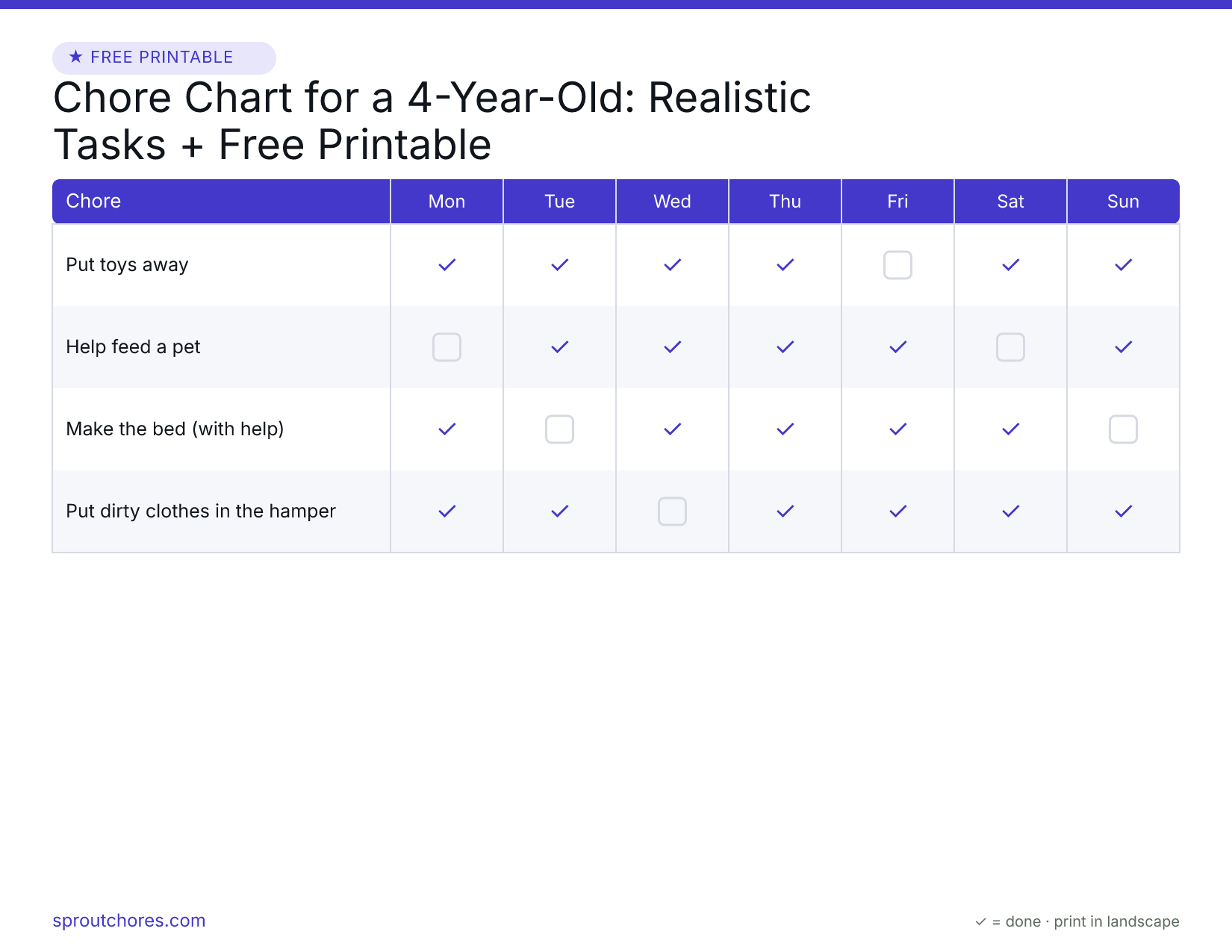
Four is the age where a chore chart stops being only about your kid and starts, just barely, being about the household too. A three-year-old is busy mastering their own zipper and toothbrush. By four, a child can hold a little more, and this is the year we hand them their first job that helps somebody other than themselves. The chart above is built around that shift, and you can print it with picture icons or rework it for your own kid in under a minute. I'm Andrew, raising four kids with my wife (they're 9 through 18 now), and we've also fostered three little ones who were right in this preschool window. Here's the part nobody warns you about: at four, the job won't be done well, and that is genuinely okay. What you're after isn't a clean bathroom. It's the dawning idea, in a very small person, that this family takes care of itself and that they're now one of the people who helps. Below is what age four can actually pull off, how to keep a chart going past the first exciting week, and where money and rewards belong (and don't).
| Chore | Mon | Tue | Wed | Thu | Fri | Sat | Sun | Remove |
|---|---|---|---|---|---|---|---|---|
| Put toys away | ||||||||
| Help feed a pet | ||||||||
| Make the bed (with help) | ||||||||
| Put dirty clothes in the hamper |
Tip: choose Landscape in the print dialog for the best fit.
Print in landscape for the best fit. A few reminders from our family to yours: do it together the first few times, keep the chart somewhere everyone can see it, and reward steady effort over a perfect job. — The SproutChores family
Want every age in one file? Get the free Age-by-Age Pack
Six printable charts (ages 4–10) plus reward and routine sheets, in one tidy PDF — free, straight to your inbox.
We email you new printables now and then — unsubscribe anytime. Privacy.
Something went wrong — please try again in a moment.
✓ Almost there — check your inbox!
We just emailed you a confirmation link. Click it to confirm, and your free Age-by-Age Chore Chart Pack lands in your inbox moments later.
Age-appropriate chores for a 4-Year-Old: Realistic Tasks + Free Printable
Every chore below is pre-loaded in the generator above and is something a child in this age range can realistically manage with a little initial guidance:
- Put toys away
- Help feed a pet
- Make the bed (with help)
- Put dirty clothes in the hamper
What a 4-Year-Old Can Realistically Handle
The bedrock at four is still everything a younger toddler is practicing: dressing themselves, brushing their teeth, and clearing away the mess they made. We've always found teeth go smoother when a parent stands at the next sink doing the same thing, because a four-year-old copies a grown-up far faster than they follow an instruction. None of that is new. What's new at four is one deliberate step outward: a small job in a space the whole family shares.
In our house that usually meant something modest in a common room, like helping wipe down a stretch of the bathroom or pitching in on a space everyone uses rather than just their own bedroom. The specific task matters less than the lesson buried inside it, which is that some work exists for other people, not only for you. That's a real conceptual jump for a preschooler, and it's the whole reason age four is worth marking differently from age three.
Here is the expectation to set for yourself, not your kid: you will quietly redo most of this after bedtime. A four-year-old's idea of a wiped counter and yours are not the same document. Don't let that discourage you, and please don't correct every streak in front of them, because the point right now is participation, not a finished result. The way we kept it sane was to leave the personal, every-single-day items (dressing, teeth, picking up toys) on the daily part of the chart, and park the shared-space job on the weekly side where it shows up once or twice rather than as a daily demand. That cadence is about all a four-year-old's attention can carry, and it leaves room for the standard to climb on its own as they grow into it.
How to Keep the Chart Going Past Week One
Most charts die for one of two reasons, and neither is the kid's fault. The first is that we build something elaborate, and then a holiday or a sick week or a trip to grandma's knocks it over and we decide the whole approach failed. It didn't fail; it just wasn't designed to survive an ordinary, interrupted life. The version that lasts is the one you can pick back up in five minutes after it's been ignored for ten days, so build something forgiving from the start and let the gaps be fine.
The second reason charts stall is that we expect them to do the motivating. We've come to see the chart very differently: it's an instrument for the parent, a quick read on how each child is tracking and when we need to lean in, not a gadget meant to bribe a preschooler into cooperating. The actual fuel is the plain, repeated reality that everyone here pitches in because this is our home together. Hang a sticker economy on top of that and a four-year-old quietly learns that helping only counts when there's a payout, which is the last thing you want to teach a person you'll be raising for another fourteen years.
Two small levers made an outsized difference for us. One is visibility: with kids this young we put the cues exactly where the action happens rather than on a single chart by the fridge. A picture by the sink, a picture by the dresser, each one a self-running reminder a pre-reader can follow without you narrating it. That's why printing this with icons matters so much at four; your kid can't read a list, but they can absolutely read a clear little drawing. The second lever is a heads-up. "We're cleaning up in about ten minutes" lands so much better than springing a task the instant you want it, because it gives a small brain time to switch gears. That single habit defused more standoffs in our house than any reward ever did.
This is also where our years as foster parents quietly reshaped how we think about all of this. The three children we took in were around this age, and a steady, predictable rhythm did more for them than I can easily explain. When they finally knew what came next, every day, the fighting at transitions faded, because a lot of what we'd read as defiance turned out to be a child who simply felt unmoored. You don't have to be fostering for that to apply. Every four-year-old leans on knowing what's coming, and a chart taped to the wall is really just a visible promise that today will be predictable.
Money, Rewards, and Why We Keep Them Off the Chart at Four
This is the question parents ask first, so I'll be direct: at four we don't pay an allowance, and we don't make chores the price of screen time. Money doesn't enter the picture in our house until kids are a bit older, somewhere around five or six, and even then it isn't doled out one coin per task like a snack machine. It's a small weekly amount, and what governs it is the broader picture of how carefully and how reliably a child works and the attitude they bring, not a tally of boxes. A four-year-old is simply too young for any of that, and pricing chores this early teaches the wrong reason for helping.
We do allow ourselves one small, intentional treat, and the key is that it lives apart from the chart entirely. We've kept a cheap grab-bin of dollar-store odds and ends, and now and then, when a child genuinely put in good effort with a good attitude, they got to choose something from it. Because the items cost almost nothing, we never had to ration it or turn it into a points system, and it stayed tied to how a kid worked rather than to a filled-in row. We also draw a hard line around screens: losing screen time is a consequence for real misbehavior in our house, never a currency a four-year-old buys back by tidying up. Keep the money in one lane, the little treats in another, and the chart in its own, and the chart stays exactly what it should be at this age: a calm, honest record of a preschooler learning to belong to a family that works together.
Frequently asked questions
- What chores can a 4-year-old realistically do?
- Mostly self-care plus one small job that helps the whole family. Reliable items are getting dressed, brushing teeth, and clearing their own toys and messes, all of which a four-year-old can mostly handle on their own with picture prompts. What you add at four is a single shared-space task, like helping wipe part of the bathroom or tidying a room everyone uses. Don't expect it done well; you'll redo a lot of it after bedtime, and that's normal. At four you're building the habit and the idea that they help the family, not getting a spotless house.
- How is a chore chart for a 4-year-old different from age 3?
- At three, almost everything on the chart is about the child caring for themselves and their own things. The change at four is that you add one job aimed at the whole household, like a small bit of the bathroom or a shared room, so they start to grasp that some work exists for other people, not just for them. Keep the daily self-care items going every day and put that new shared-space job on the weekly side, once or twice a week, which is about all a four-year-old's attention will carry.
- Should I pay or reward my 4-year-old for chores?
- We don't pay an allowance at four and we don't tie chores to screen time. In our house, money doesn't start until around five or six, and even then it's a small weekly amount based on overall effort, reliability, and attitude rather than priced per task. For little ones we keep one small treat completely separate from the chart, a cheap grab-bin a child can pick from occasionally when they've worked well with a good attitude. The chart isn't a payout machine; it's a way for you to see how your preschooler is doing.
- Is a chore chart for a 4-year-old boy different from a girl?
- No, not in any way that matters at this age. The realistic tasks at four are the same regardless of gender: self-care, cleaning up their own mess, and one small shared job. Individual kids gravitate toward different chores, but that comes down to personality, not boy versus girl, so follow the child in front of you rather than a label. Whether you're building a chart for a 4-year-old boy or girl, size it to what they can genuinely manage and let the picture icons carry the routine.

About the author
More free printables
Get the free Age-by-Age Chore Chart Pack
Six printable charts (ages 4–10) plus reward and routine sheets, in one tidy PDF. We'll also send new printables and the occasional real parenting tip. The charts on this site are always free — no sign-up needed.
We email you new printables now and then — unsubscribe anytime. Privacy.
Something went wrong — please try again in a moment.
✓ Almost there — check your inbox!
We just emailed you a confirmation link. Click it to confirm, and your free Age-by-Age Chore Chart Pack lands in your inbox moments later.