Chore Chart for a 5-Year-Old: Free Printable + Generator
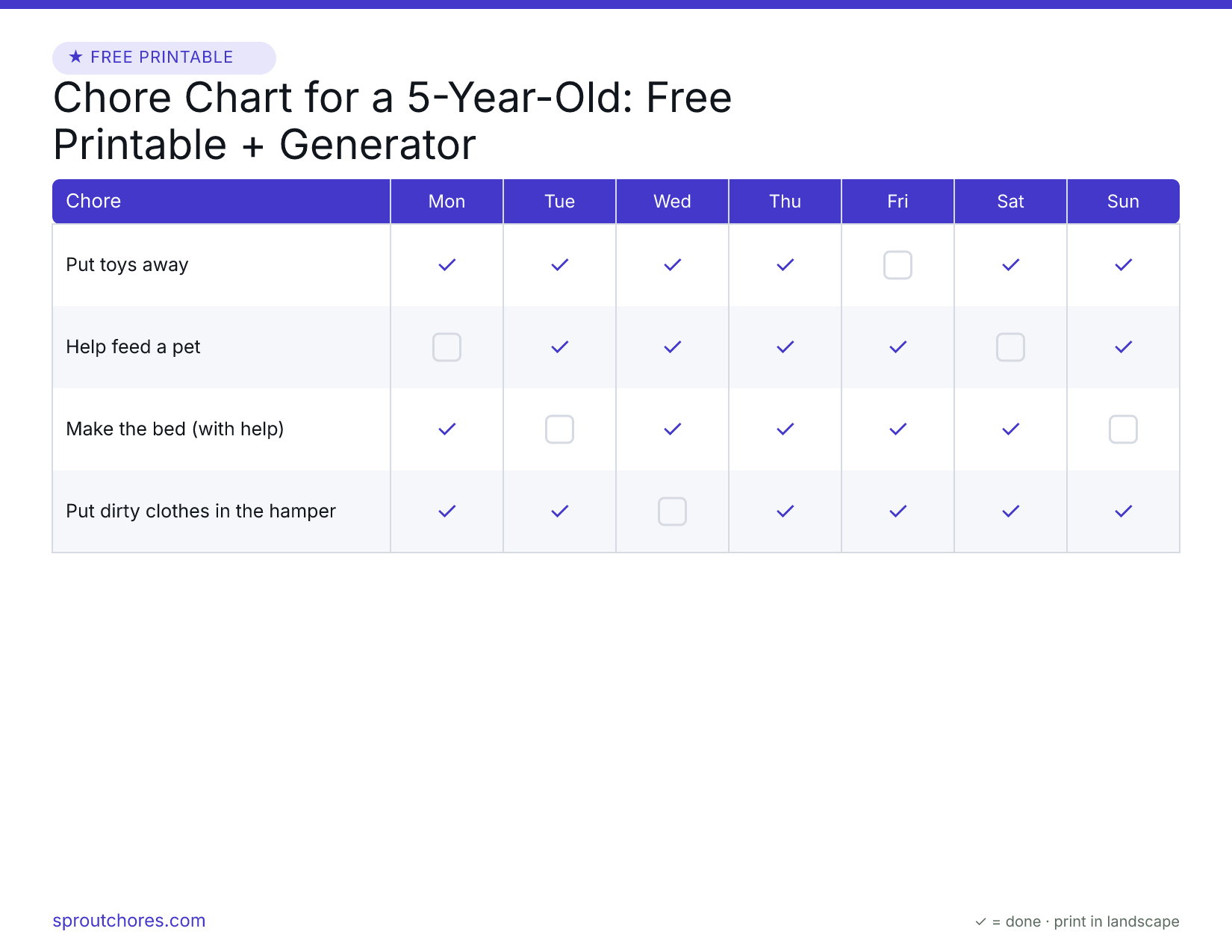
Five is the age where a child starts to feel genuinely capable. They can follow two or three steps in a row, they're proud to do what the grown-ups do, and kindergarten is teaching them that there's a rhythm to the day. A simple chore chart fits right into that. We're Andrew and the SproutChores family, raising four kids (now 9 to 18) and fostering along the way, and the way we think about a chart at this age might surprise you. We don't see it as a way to squeeze work out of a kindergartner. We see it as early practice for becoming a capable person. The list above is built for what a five-year-old can actually do, and you can print it with picture icons or adjust it for your own child in a couple of clicks. Below is how we'd approach it.
| Chore | Mon | Tue | Wed | Thu | Fri | Sat | Sun | Remove |
|---|---|---|---|---|---|---|---|---|
| Put toys away | ||||||||
| Help feed a pet | ||||||||
| Make the bed (with help) | ||||||||
| Put dirty clothes in the hamper |
Tip: choose Landscape in the print dialog for the best fit.
Print in landscape for the best fit. A few reminders from our family to yours: do it together the first few times, keep the chart somewhere everyone can see it, and reward steady effort over a perfect job. — The SproutChores family
Want every age in one file? Get the free Age-by-Age Pack
Six printable charts (ages 4–10) plus reward and routine sheets, in one tidy PDF — free, straight to your inbox.
We email you new printables now and then — unsubscribe anytime. Privacy.
Something went wrong — please try again in a moment.
✓ Almost there — check your inbox!
We just emailed you a confirmation link. Click it to confirm, and your free Age-by-Age Chore Chart Pack lands in your inbox moments later.
Age-appropriate chores for a 5-Year-Old: Free Printable + Generator
Every chore below is pre-loaded in the generator above and is something a child in this age range can realistically manage with a little initial guidance:
- Put toys away
- Help feed a pet
- Make the bed (with help)
- Put dirty clothes in the hamper
What a 5-year-old can realistically do
At five, the bulk of the chart should still be self-care: getting dressed without a standoff, brushing teeth, dropping dirty clothes in the hamper, and clearing away their own messes. The new piece you can layer on is a small contribution to spaces the whole family shares. In our house that looked like carrying their own plate to the counter, helping lay out forks and napkins, giving a low shelf a wipe, or feeding a pet while you stand close by. Pick a handful of these, not a wall of them.
Here's the part nobody likes to say out loud: the work will not be good, and you'll quietly finish or fix a lot of it after they're in bed. That's normal, and it isn't the point. A chart at five isn't there to produce a clean house. It's there so your child starts to grasp that they're part of something bigger than themselves and that they have a real job in keeping it running. We've come to think of every one of these little tasks as a rep, the same way an adult practices a skill before they're good at it. The polish comes later, on its own, as the child grows into it. For now, a five-year-old who shows up and tries has already done the thing that matters.
How to make the chart actually stick
The biggest shift for us was realizing who the chart is really for. It isn't a gadget to motivate a five-year-old; it's an instrument for the grown-ups. When we glance at it, we can see how each kid is tracking and decide whether anyone needs a nudge or a hand. The drive to pitch in doesn't come from the paper, it comes from a message we say over and over until it's just background truth in the house: this is our home and everyone has a hand in caring for it. Once a task is simply part of the furniture of the day, the nightly negotiation mostly disappears.
A trick that has saved us more conflicts than I can count is giving warning before a transition. A cold 'go tidy the toys right now' tends to land as an ambush and gets pushback. But a heads-up first, something like letting them know that in a little while it'll be clean-up time, gives a young child the chance to wrap up what they're doing and arrive at the task already prepared for it. Five-year-olds aren't great at switching gears on a dime, and that small bit of runway turns a meltdown into a non-event.
The other thing we'd tell any parent: build a chart that can fall apart and be picked back up. The most common reason these systems die is that they were too perfect to survive a normal week. A holiday hits, someone's sick, the routine slips for three days, and the family decides the whole idea failed. It didn't fail, it just wasn't built to bend. Keep the list short and forgiving enough that you can simply start it again on Monday without guilt or fanfare. A chart you can restart easily is one you'll still be using a year from now.
Allowance and rewards at age five
Five or six is around when money can enter the conversation in our house, and we keep it modest, roughly five dollars a week. But it is deliberately not a price tag stuck on each chore. We learned this from the way Andrew grew up: there were always chores, but they were never a transaction, because you help out for the simple reason that you're part of the family. So the small allowance we give is tied to the broad picture, whether a child put in honest effort across the week, kept their attitude in a good place, and stayed reasonably on top of things, rather than a coin dropped in a slot for each completed task.
We also keep treats and screen time in a completely separate lane from the chart. The moment chores turn into the currency you spend to earn fun, the 'we all pitch in' idea quietly evaporates. If a screen ever gets pulled in our house, it's a response to genuinely poor behavior, not the thing a kid buys back by sweeping a floor. Holding those lanes apart, the chart over here, money and privileges over there, has kept the whole arrangement calmer and a lot more honest about why we do any of it.
Frequently asked questions
- What chores should a 5-year-old have on a chart?
- Lead with self-care: getting dressed, brushing teeth, putting clothes in the hamper, and tidying their own toys. Then add one or two small contributions to shared spaces, like setting out napkins, carrying their plate to the counter, or feeding a pet with you nearby. Keep the list short. At five, a handful of tasks a child can actually finish beats a long list that turns into a nightly fight.
- Should I pay a 5-year-old an allowance for chores?
- In our house, allowance can start around age five or six at about five dollars a week, but we never pay per task. It's tied to the bigger picture, honest effort, a decent attitude, and staying on track over the week, rather than a payout for each box checked. We keep it that way on purpose so the core idea survives: we help because this is our family and our home, not because there's a coin attached to taking out the trash.
- What do I do when my 5-year-old refuses to do a chore?
- More often than not, what looks like refusal at this age is really a child who's been asked to switch gears too fast. The fix that's worked best for us is a warning before the transition, letting them know a task is coming in a few minutes so they can finish what they're doing and arrive ready. Stay calm and matter-of-fact, expect effort rather than a perfect result, and resist quietly doing it for them. If a whole list keeps blowing up, it's usually too long, so trim it and start fresh.
- My five-year-old loses interest in the chart after a week. Is that normal?
- Completely normal, and it's worth remembering the chart was never meant to entertain your child. Its real job is to let you, the parent, see how things are going. The motivation comes from the expectation and the family rhythm, not the paper. If the chart itself goes stale, that's fine; what matters is that the routine holds. And don't be discouraged when a slow week or a holiday throws it off. The point is to be able to start it up again easily, not to keep an unbroken streak.

About the author
More free printables
Get the free Age-by-Age Chore Chart Pack
Six printable charts (ages 4–10) plus reward and routine sheets, in one tidy PDF. We'll also send new printables and the occasional real parenting tip. The charts on this site are always free — no sign-up needed.
We email you new printables now and then — unsubscribe anytime. Privacy.
Something went wrong — please try again in a moment.
✓ Almost there — check your inbox!
We just emailed you a confirmation link. Click it to confirm, and your free Age-by-Age Chore Chart Pack lands in your inbox moments later.