Chore Chart for a 6-Year-Old
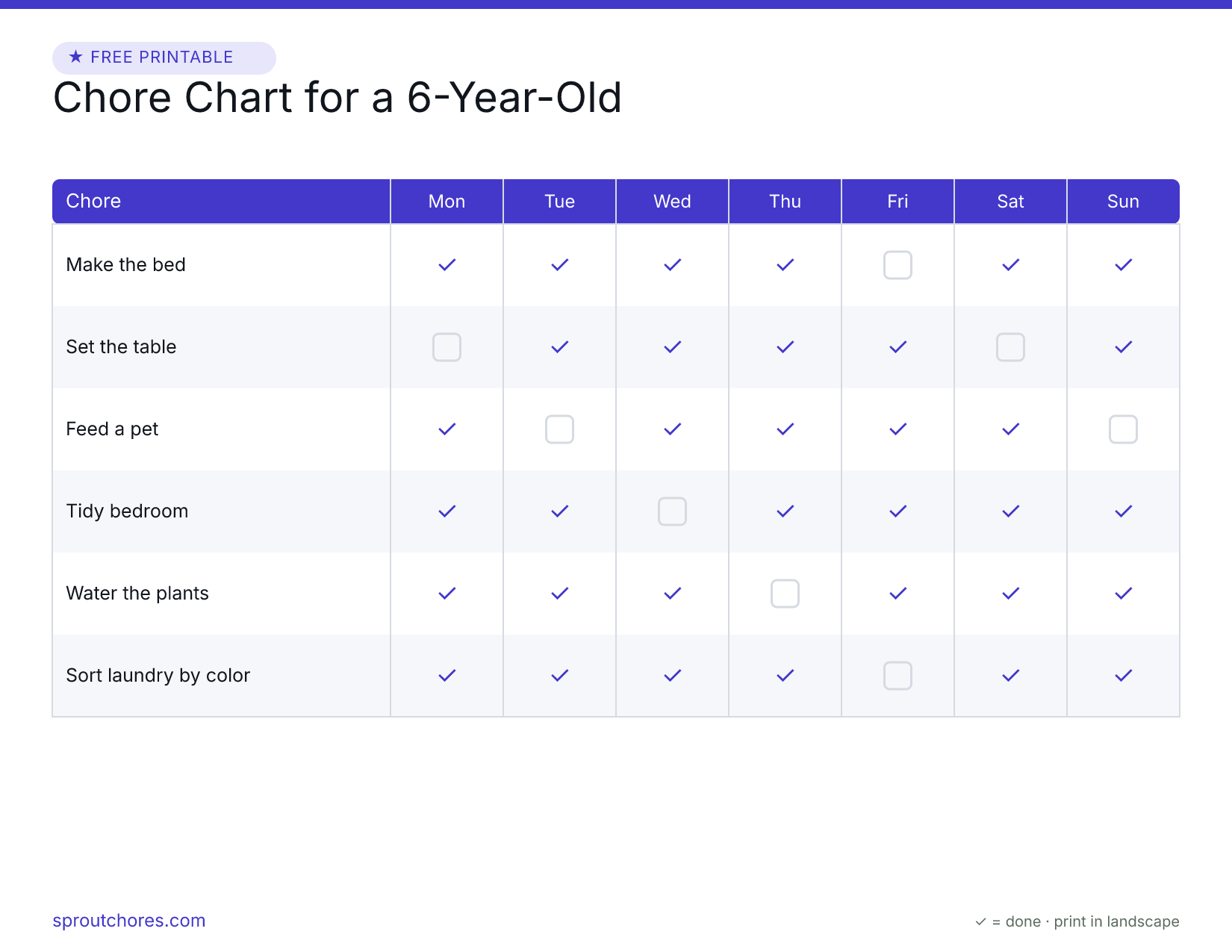
Six is the year the training wheels start to come off. At five, a chore chart is mostly about getting a child used to the idea that they have a part to play; by six, they can actually be held to it. In our house — I'm Andrew, a dad of four and, for a season, a foster parent — this is the age where I stop thinking of chores as cute practice and start thinking of them as the real thing: the first genuine rehearsal for running a life. Use the generator above to put together a personalized chart in about a minute, or print the one below. I'll be upfront about how we see it, though. The chart isn't a gadget for talking your kid into cooperating. It's a notebook for the parent — a quick way to see who's keeping up and who's quietly drifting. What gets a six-year-old to the dishes isn't a box waiting to be checked; it's the steady, unremarkable fact that in this family, everyone has a hand in keeping it running.
| Chore | Mon | Tue | Wed | Thu | Fri | Sat | Sun | Remove |
|---|---|---|---|---|---|---|---|---|
| Make the bed | ||||||||
| Set the table | ||||||||
| Feed a pet | ||||||||
| Tidy bedroom | ||||||||
| Water the plants | ||||||||
| Sort laundry by color |
Tip: choose Landscape in the print dialog for the best fit.
Print in landscape for the best fit. A few reminders from our family to yours: do it together the first few times, keep the chart somewhere everyone can see it, and reward steady effort over a perfect job. — The SproutChores family
Want every age in one file? Get the free Age-by-Age Pack
Six printable charts (ages 4–10) plus reward and routine sheets, in one tidy PDF — free, straight to your inbox.
We email you new printables now and then — unsubscribe anytime. Privacy.
Something went wrong — please try again in a moment.
✓ Almost there — check your inbox!
We just emailed you a confirmation link. Click it to confirm, and your free Age-by-Age Chore Chart Pack lands in your inbox moments later.
Age-appropriate chores for a 6-Year-Old
Every chore below is pre-loaded in the generator above and is something a child in this age range can realistically manage with a little initial guidance:
- Make the bed
- Set the table
- Feed a pet
- Tidy bedroom
- Water the plants
- Sort laundry by color
What a 6-Year-Old Can Realistically Take On
Six is the doorway into the stretch where I genuinely expect the job to happen. The self-care basics should mostly be on autopilot by now — dressing, teeth, getting their own dirty clothes into the hamper — so a six-year-old's chart can lean harder into real contributions to the house. This is where we start adding things like helping with the dishes, taking on a piece of the trash routine, clearing and wiping the table, feeding and watering a pet, and pitching in with a step or two of cooking under supervision. With our son, this was the age the outdoor and hands-on jobs entered the mix, and a funny thing happened: he turned helping into a chance to ask a hundred questions about how everything worked. That curiosity ended up being worth more than the work itself.
The honest caveat is that you should still expect rough edges. The table will have streaks, the fold will be lopsided. But the bar does start to rise at six, and the thing I'm really watching for is whether the job gets done without me standing over them reminding every five minutes. The way I've come to think about it: I'm not running this chart to get a clean kitchen out of a six-year-old. The kitchen is a side effect. The actual product is a capable adult, and we're a decade out from delivery. Framing it that way takes the pressure off the result and puts it where it belongs — on the practice.
Making It Stick Without Turning It Into a Battle
The single most useful lever we ever found costs nothing: warn them it's coming. "Go unload the dishwasher right now" reliably sparks a standoff. "In about an hour we're unloading the dishwasher" gives a six-year-old time to finish what they're doing in their own head and arrive at the task already braced for it. That small bit of lead time defused more arguments in our house than any reward ever did, and it costs you nothing but a sentence.
The other thing I'd tell any parent is to build a system that can break and be put back together. Most charts don't fail because they were badly designed — they fail because a vacation or a sick week or a chaotic stretch knocks them over, the family decides "this doesn't work for us," and quits. The truth is the plan just wasn't built to survive real life. Aim for something you can drop for a week and pick straight back up, not a perfect machine that shatters the first time you skip a day.
Underneath all of it is plain consistency, and that's the part fostering hammered home for us. When we took in children who'd had almost no dependable rhythm before, a predictable daily structure they could actually count on did more for their settling, sleep, and self-control than any prize we could have offered. A lot of what reads as defiance in a young child is really just not knowing what comes next. The same logic carries straight over to your own six-year-old: a chart sticks because the expectation behind it never wobbles, not because it's exciting. The novelty always wears off. The routine is what stays.
Allowance and Rewards (and Why We Keep Them Apart)
Six is right about where money enters the picture for us — a small weekly allowance, in the neighborhood of five dollars. But it has never worked like a vending machine where each chore drops a coin. The allowance hangs on the bigger picture: did the work get done well, did they stay on track across the week without constant chasing, and did they go about it with a reasonable attitude. Coast through everything in a sulk and the money reflects that; show up and put in honest effort and it follows. I learned this from my own upbringing in reverse — my parents tried tying allowance to chores and it muddied the message. You contribute because you're family, full stop. The money is a separate lesson about reliability.
That separation is deliberate everywhere in our house. We don't make our kids earn screen time or fun by grinding through tasks; losing screen time only ever shows up as a consequence for genuinely poor behavior, never as the currency chores are paid in. For everyday encouragement at this age, we kept it light with a dollar-store grab box — a cheap pick once or twice a week when a child had worked well and stayed pleasant about it. Because the items barely cost anything, we never had to ration it or turn it into a points economy. Whether you attach allowance to any of this is genuinely your family's call. The chart does its tracking job either way; the money is just one more tool for teaching follow-through, not the engine that makes a six-year-old help.
Frequently asked questions
- What chores can a 6-year-old do?
- By six, most kids have the basic self-care down and can take on real contributions to the household. In our experience that means helping with the dishes, owning a piece of the trash routine, clearing and wiping the table, feeding and watering a pet, tidying their own room, and helping with a couple of safe cooking steps under supervision. The shift from age five is that you can start expecting the job to actually get finished — and finished with fewer reminders each week. The printable and generator on this page are built for that level.
- Should I pay a 6-year-old for chores?
- In our house, allowance starts around age five or six at roughly five dollars a week, but we never pay per task. We tie it to the bigger picture — quality of work, staying on track over the week, and attitude — rather than handing out money chore by chore. Day-to-day family chores aren't a paid transaction; they're simply part of belonging to the family. Keeping allowance and rewards separate from the chart itself is what protects that message. Whether you use money at all is up to you; the chart works the same either way.
- My 6-year-old won't do their chores — what works?
- The first thing I'd try is advance notice. Instead of "do this now," tell them roughly an hour ahead that the task is coming. That small bit of warning lets a six-year-old prepare mentally and heads off the standoff before it starts — it solved more conflicts in our house than any reward. Beyond that, stay calm and let the expectation, not your temper, do the work; lean on the routine being predictable; and resist quietly finishing the job yourself, which only teaches them their effort didn't count.
- How many chores should a 6-year-old have?
- A short, dependable core beats a long list every time. With a houseful of kids, we learned that a handful of tasks that genuinely get done is worth far more than an ambitious chart that turns into a nightly fight. Keep a steady daily backbone the child can run mostly on their own, and add a job or two as the habit takes hold. If the whole routine is dragging into meltdowns or running long, that's your sign to trim it, not push harder.
- Are chore apps better than a printed chart at this age?
- For a six-year-old, we've found paper wins. We did everything on printed pages and taped them up right where the work happens, because the chart only helps if the child can actually see it. Most apps live on a parent's phone, out of the kid's sight, which quietly drains their usefulness at this age. A printed chart on the fridge or a bedroom door sits in your child's line of sight all day and does the reminding for you.

About the author
More free printables
Get the free Age-by-Age Chore Chart Pack
Six printable charts (ages 4–10) plus reward and routine sheets, in one tidy PDF. We'll also send new printables and the occasional real parenting tip. The charts on this site are always free — no sign-up needed.
We email you new printables now and then — unsubscribe anytime. Privacy.
Something went wrong — please try again in a moment.
✓ Almost there — check your inbox!
We just emailed you a confirmation link. Click it to confirm, and your free Age-by-Age Chore Chart Pack lands in your inbox moments later.