Montessori Chore Chart: Practical-Life Work, Organized by Age
Montessori classrooms don't really have a word for "chores." The everyday tasks of caring for yourself and your surroundings fall under what's called practical life — purposeful work a child does because it's genuinely useful, not because a sticker is waiting on the other side. The idea is that the doing is the payoff. Below, you'll find those well-documented practical-life principles translated into an age-by-age chart you can actually post on the fridge, and the generator further down will print one to fit whatever stage your child is in. One honest note before we go further, because I'd rather be straight with you than sell you something: I'm Andrew, a dad of four kids between 9 and 18, and my wife and I are also foster parents. We've never run a certified Montessori household. So nothing here is dressed up as inside knowledge we don't have. What I've put together is the researched thinking behind Montessori practical life and how to apply it at home — and in the few spots where our own family genuinely arrived at the same conclusion, I'll point it out and explain how we got there.
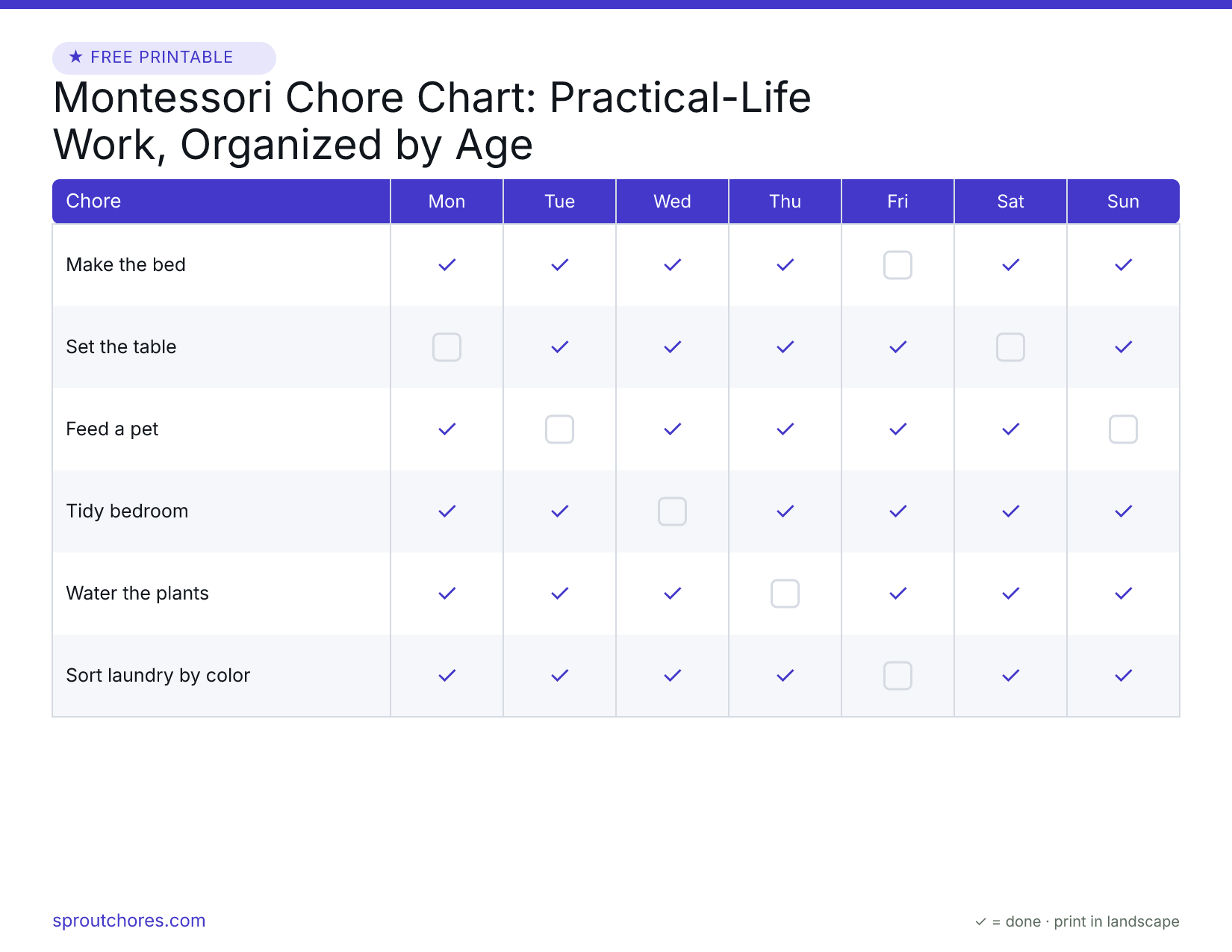
| Chore | Mon | Tue | Wed | Thu | Fri | Sat | Sun | Remove |
|---|---|---|---|---|---|---|---|---|
| Make the bed | ||||||||
| Set the table | ||||||||
| Feed a pet | ||||||||
| Tidy bedroom | ||||||||
| Water the plants | ||||||||
| Sort laundry by color |
Tip: choose Landscape in the print dialog for the best fit.
Print in landscape for the best fit. A few reminders from our family to yours: do it together the first few times, keep the chart somewhere everyone can see it, and reward steady effort over a perfect job. — The SproutChores family
Want every age in one file? Get the free Age-by-Age Pack
Six printable charts (ages 4–10) plus reward and routine sheets, in one tidy PDF — free, straight to your inbox.
We email you new printables now and then — unsubscribe anytime. Privacy.
Something went wrong — please try again in a moment.
✓ Almost there — check your inbox!
We just emailed you a confirmation link. Click it to confirm, and your free Age-by-Age Chore Chart Pack lands in your inbox moments later.
What practical life means in a Montessori home
The method comes from Maria Montessori, an Italian physician who began observing young children closely in the early 1900s. She grouped the small acts of daily living — pouring water, buttoning a coat, wiping a table — into an area she called practical life, and she treated them as serious developmental work rather than busywork to keep little hands occupied. The goal was never a spotless kitchen. It was concentration, coordination, growing independence, and an internal sense of order. A few ideas shape what a Montessori-leaning chart should look like. The tasks have to be authentic; children can tell the difference between real work and a job invented to keep them busy, and they disengage from the fake kind quickly. The space around them is set up so success is possible without an adult standing over their shoulder — a hook they can reach, a low shelf with a cloth on it, a stool at the sink. And the grown-up's role is to show the task once, unhurried, then back away and tolerate a clumsy first attempt. The well-known line associated with this approach, "help me to do it myself," sums up the whole posture. A chart in this spirit simply names the work and shows its order. It isn't a leaderboard.
A Montessori-style chore chart, broken down by age
Because Montessori work is tuned to where a child sits developmentally, the right chart grows alongside the child instead of dumping a long checklist on a preschooler. Roughly: at 2 to 3 years, keep it to self-care and gentle care of the surroundings — dropping clothes in a hamper, mopping a small spill with a sponge, giving a plant a drink, carrying a plate over to the sink — one or two repeatable items with picture cues, nothing more. From 3 to 6, add a bit of sequence and ownership: dressing without help, fixing a simple snack, sweeping with a broom sized for them, feeding a pet, dusting a low shelf. Between 6 and 9, the work starts to serve the whole house — folding laundry, loading dishes, helping at the stove, sorting recycling, tending a patch of garden. From 9 to 12, you're aiming for planning and seeing a thing through end to end: running a full load of wash on their own, prepping one part of dinner, handling the trash on a set schedule, fixing something small beside you. Use the generator below to print a chart for a single age band or for several siblings at once. A caveat from our own kitchen: when our youngest were small and I'd ask them to clean a shared space, the result was honestly a mess I'd quietly fix later. That's not failure — that's the age. Early on, a finished, gleaming job isn't the target at all. The target is that the child starts to feel like part of the household's machinery. The polish shows up later, and it climbs steadily as they grow more able.
Why we leave stickers and pay out of it
Here's a spot where Montessori thinking and our family's stance landed in the same place by different paths. Montessori practice intentionally steers clear of handing out prizes for practical-life work, on the reasoning that a bribe from outside can slowly crowd out a child's own desire to contribute. We don't reward the chart either, but our reasoning is simpler and a little more practical: the chart was never built to motivate the kids. It's an instrument for the two of us — a quick read on who's keeping pace and who could use a nudge from a parent. The reason any of our children do their work is that they live here, and people who live somewhere take part in running it. That plain expectation is what does the motivating. We do have an allowance, but we keep it at arm's length from any individual task. It reflects the broad picture — the care that goes into the work, whether they stay on top of things without being chased, and the spirit they bring — rather than a per-job rate. Treats and screen time sit in a completely separate compartment; we don't ask the kids to earn fun by clocking chores. If you print the version with checkboxes, my suggestion is to read each mark as a note for yourself about what got handled, not as a token the child is banking toward a payout.
Picture cues, predictable rhythm, and why visible charts work
A young child can't read a written list, which is precisely why Montessori materials lean so hard on real objects and clear images. A picture chart works because the next step is visible to the child without anyone narrating it. We found our own version of this with our youngest by placing small picture cards right at the location where each step happens — images posted exactly where a child would be standing when they needed them — so the pictures carried the order instead of me repeating myself. It turned a stream of reminders into something the child could run alone. It's also why we've stayed with printed charts taped up where the work actually occurs rather than burying everything in an app. A child never opens the app, so the app stays invisible, and for little ones visibility is most of the game. The bigger reward, though, is the rhythm itself. Fostering taught us this in a way I wasn't expecting. The young children who came to us had been living without much structure, and our first job wasn't getting tasks done — it was helping them feel safe. We set a dependable daily order: the same meals, the same play, the same wind-down toward bed, every single day. There was pushback at the start. But once a child trusted what was coming next, the fighting over transitions faded. So much of what reads as defiance is really uncertainty, and a steady routine quietly answers the question a child can't put into words: what happens now? Montessori's emphasis on order in the environment isn't only about tidiness — for a child, knowing the shape of the day is a kind of safety.
Frequently asked questions
- Are chore charts actually Montessori?
- A true Montessori environment doesn't hang a wall chart of chores with rewards attached. Practical-life work is folded into the ordinary day, and the work itself is meant to be the reward. That said, a simple picture chart that lists real tasks and shows their order fits the spirit nicely for home use. Keep prizes out of it, and treat it as a way to show the child what comes next rather than a scoreboard to beat.
- What Montessori chores can a toddler do?
- Around 2 to 3, keep it to self-care and small acts of caring for the surroundings: dropping clothes in a hamper, wiping a spill with a cloth, watering a plant, carrying a plate to the sink, helping lay out the table. Demonstrate the task slowly one time, then let them attempt it imperfectly. Plan on redoing some of it — at this age, the habit and the feeling of belonging matter far more than a clean result.
- Should a Montessori chore chart use rewards or stickers?
- The Montessori instinct is to skip outside rewards so a child's own drive to pitch in stays intact. We agree, though in our house the chart is framed as a tracking tool for parents rather than a motivator pointed at the child. If you use a sticker version, read the marks as a record of what got done for your own reference. The real fuel should be the expectation that everyone living in the home takes part in running it.
- Is a printable chart or an app better for young kids?
- For young children a printed chart, taped up right where the work happens, usually wins. Kids can't act on a reminder they never see, and apps tend to live out of sight on a parent's phone. A visible picture chart at the child's eye level lets them check the next step on their own, which is the entire point. The generator on this page prints a chart you can post exactly where the work gets done.

About the author
More free printables
Get the free Age-by-Age Chore Chart Pack
Six printable charts (ages 4–10) plus reward and routine sheets, in one tidy PDF. We'll also send new printables and the occasional real parenting tip. The charts on this site are always free — no sign-up needed.
We email you new printables now and then — unsubscribe anytime. Privacy.
Something went wrong — please try again in a moment.
✓ Almost there — check your inbox!
We just emailed you a confirmation link. Click it to confirm, and your free Age-by-Age Chore Chart Pack lands in your inbox moments later.