Chore Chart for a 7-Year-Old
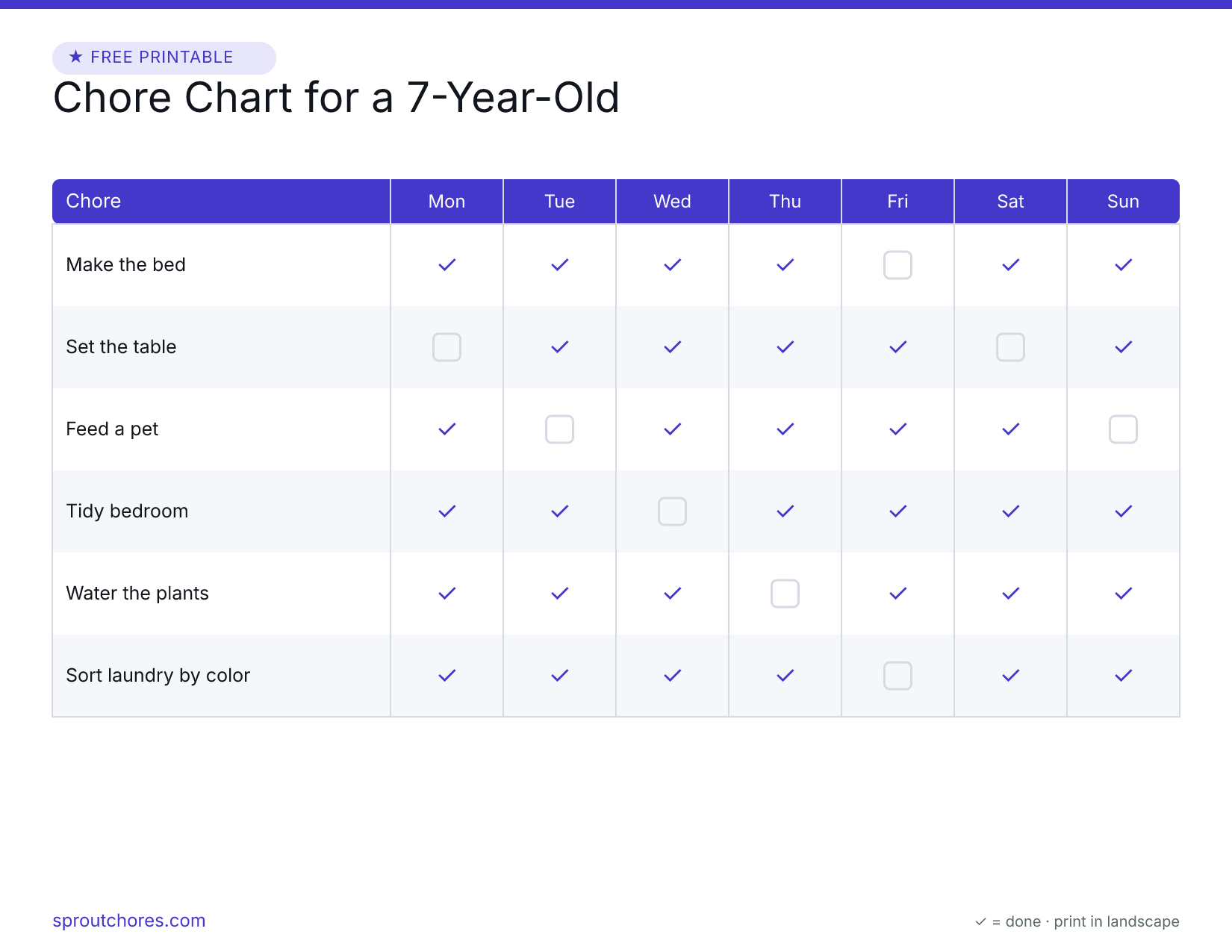
Seven is the year the training wheels start coming off. At six, a chore is still half a lesson you're walking them through; by seven, most kids can carry a job on their own and need you reminding them a little less each week. I'm Andrew — a dad of four (ages nine to eighteen), and my wife and I have also spent time as foster parents — and in our house this is the age where the chart quietly changes purpose. It stops being a learning game and becomes an honest record of who's actually pulling their weight. Build a personalized chart with the generator above in under a minute, or print the one below. I'll be plain about how we use it: the chart is a tool for us, the parents, to see at a glance who's keeping up and who needs a nudge. We don't run it as a prize machine. The reason a seven-year-old does their part isn't a sticker or a payout — it's that helping is simply what belonging to this family looks like.
| Chore | Mon | Tue | Wed | Thu | Fri | Sat | Sun | Remove |
|---|---|---|---|---|---|---|---|---|
| Make the bed | ||||||||
| Set the table | ||||||||
| Feed a pet | ||||||||
| Tidy bedroom | ||||||||
| Water the plants | ||||||||
| Sort laundry by color |
Tip: choose Landscape in the print dialog for the best fit.
Print in landscape for the best fit. A few reminders from our family to yours: do it together the first few times, keep the chart somewhere everyone can see it, and reward steady effort over a perfect job. — The SproutChores family
Want every age in one file? Get the free Age-by-Age Pack
Six printable charts (ages 4–10) plus reward and routine sheets, in one tidy PDF — free, straight to your inbox.
We email you new printables now and then — unsubscribe anytime. Privacy.
Something went wrong — please try again in a moment.
✓ Almost there — check your inbox!
We just emailed you a confirmation link. Click it to confirm, and your free Age-by-Age Chore Chart Pack lands in your inbox moments later.
Age-appropriate chores for a 7-Year-Old
Every chore below is pre-loaded in the generator above and is something a child in this age range can realistically manage with a little initial guidance:
- Make the bed
- Set the table
- Feed a pet
- Tidy bedroom
- Water the plants
- Sort laundry by color
What a 7-Year-Old Can Realistically Handle
Seven sits at the upper end of the early-school years, and the difference from age six is less about brand-new abilities and more about expectation. A six-year-old is learning a job exists; a seven-year-old should be able to start and finish that job with you reminding them less and less. They can take charge of their own room and morning routine, keep their belongings off the floor, manage simple table and pet duties, and begin pitching in on work that isn't just about their own stuff — a shared bathroom counter, a tidy-up of a common room. That last bit matters. The moment a child does a job that helps everyone, not only themselves, the idea that the whole family is in this together stops being a speech and starts being something they live. I try to keep one frame front and center: I don't see chores as a way to get the house cleaned. I see them as rehearsal for being a capable adult. So at seven the win isn't a flawless fold or a streak-free table — it's that the same small person started the task and saw it through. The quality will lag for a while, and that's fine. If something genuinely needs fixing, we fix it side by side as a teaching moment, never silently behind their back, because quietly redoing their work tells them their effort didn't count.
How to Make a 7-Year-Old's Chart Actually Stick
Two things have done more for us than any clever system. The first is keeping the chart physical and posting it where the work happens — printed and taped up, not hidden in an app on a grown-up's phone where the kid never lays eyes on it. A seven-year-old who can see the chart all day will use it; one who can't, won't. The second is a habit I'd hand any parent for free: give advance notice. 'Go clear the table this second' tends to spark a standoff, while 'we're clearing the table in about ten minutes' gives a kid the runway to switch gears on their own. That one shift has defused more chore battles in our home than I can count. Underneath the design, though, the real reason charts last is that the expectation behind them never wavers — not because the chart is fun. I saw this most starkly during our fostering years: for children who'd had almost no dependable structure before us, a steady rhythm they could count on did far more for settling in and self-regulation than any reward ever did. What read as defiance was usually just not knowing what came next. The same truth holds for your own seven-year-old. And don't aim for a perfect system — aim for one that's easy to restart. Life will blow it up now and then with a vacation or a rough week. A chart you can simply pick back up the next morning beats a flawless one that collapses the first time real life interrupts it.
Allowance, Money, and Keeping Rewards Out of It
Seven falls inside the years where we do tie a small allowance to chores, but with guardrails. We don't price jobs out one by one. There's a modest weekly base — roughly five dollars at this stage — and whether it lands depends on three things together: how well the work was done, whether they stayed on track without us nagging, and the attitude they brought. Do the jobs reliably and with a decent spirit and the money follows; drift or grumble through them and it doesn't. Just as important is what we refuse to mix in. We don't make our kids buy screen time or fun with chores — losing screen time only ever shows up as a consequence for poor behavior, never as a currency they earn at the chart. For the occasional extra reward at this age we use a cheap dollar-store grab-bin, picked from once or twice a week when the work was strong and the attitude good, and even that hangs on effort, not on the chart itself. The thread through all of it: money here is meant to teach reliability and following through, not to turn helping your family into a string of paid transactions. And honestly, whether you attach any money at all is your family's call — the chart does its tracking job either way.
Frequently asked questions
- What chores can a 7-year-old do?
- A seven-year-old can usually take care of their own bedroom and morning routine, keep their belongings tidied up, manage simple table and pet jobs, and begin helping with shared-space work like wiping down a bathroom counter or straightening a common room. The real change from age six isn't a longer list — it's that you can expect the same child to start and finish the job with fewer and fewer reminders. The printable and generator on this page are built for exactly that level. Pick the tasks that fit your child and let the expectation rise as their reliability does.
- Should I pay my 7-year-old for chores?
- In our house we use a small weekly allowance at this age — around five dollars — but we don't pay job by job. Whether it's earned depends on three things together: the quality of the work, staying on track without constant reminders, and attitude. We also keep it walled off from screen time and other rewards. The point is to teach reliable follow-through, not to make every bit of helping a paid transaction. Whether you connect money to chores at all is up to your family; the chart works the same with or without it.
- How do I get my 7-year-old to stick with their chore chart?
- Keep the chart on paper and post it where the work actually happens rather than burying it in a phone app — at this age, kids need to physically see it. Lean on advance notice, too: a heads-up that a job is coming in a few minutes heads off far more standoffs than a sudden demand. Most of all, treat the chart as a tracking tool for you, not a motivator for them. The motivation comes from a steady, unwavering expectation that everyone in the family pitches in. When the novelty fades, the routine carries on, because a consistent structure holds things together better than any reward.
- My 7-year-old does the chores but not very well. Is that a problem?
- Not at seven. At this age the goal is steady progress, not a perfect result. Expect the crooked fold and the streaky table for a while — what matters is that they started and finished the job themselves. If something genuinely needs correcting, do it together as a teaching moment instead of quietly redoing it after they've gone, which only signals their effort didn't count. The quality climbs over months and years of consistency, not overnight. One of our older kids now handles a real responsibility start to finish, unsupervised, and none of that happened in a day — it built up from years of letting imperfect work be good enough at the time.

About the author
More free printables
Get the free Age-by-Age Chore Chart Pack
Six printable charts (ages 4–10) plus reward and routine sheets, in one tidy PDF. We'll also send new printables and the occasional real parenting tip. The charts on this site are always free — no sign-up needed.
We email you new printables now and then — unsubscribe anytime. Privacy.
Something went wrong — please try again in a moment.
✓ Almost there — check your inbox!
We just emailed you a confirmation link. Click it to confirm, and your free Age-by-Age Chore Chart Pack lands in your inbox moments later.