Chore Chart for a 12-Year-Old, With a Money Column
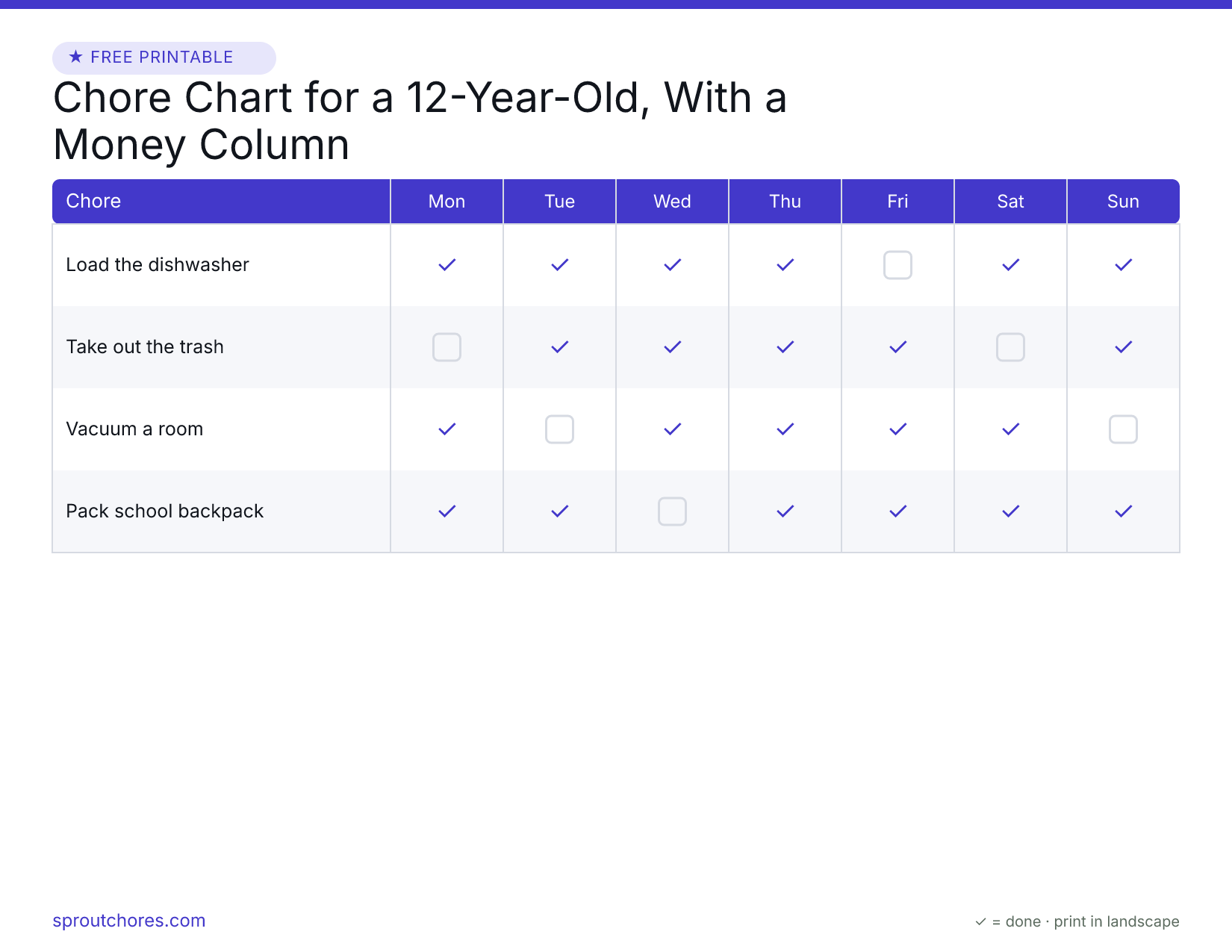
Twelve sits right on the seam between childhood and the teen years. Your kid can wash a load of laundry, run the dishwasher, and watch a younger sibling for an hour, but they're also starting to care a lot about having a few dollars of their own. The editable chart below is built for exactly that moment: a clean, daily chore chart for a 12-year-old with a money column you fill in yourself and a weekly total that adds up at the bottom, so the dollar amounts fit your family rather than ours. I'm Andrew. My wife and I are the SproutChores family, raising four kids spread from nine to eighteen, and over the years we've also opened our home to foster children. We've kept a chart going at every one of those ages. Before you start typing numbers into the boxes, I want to walk through how we handle money at twelve, because the way you wire the pay piece together now quietly sets up whether your kid coasts on it or actually grows from it.
| Chore | Value | Mon | Tue | Wed | Thu | Fri | Sat | Sun | Remove |
|---|---|---|---|---|---|---|---|---|---|
| Load the dishwasher | |||||||||
| Take out the trash | |||||||||
| Vacuum a room | |||||||||
| Pack school backpack | |||||||||
| Weekly total | 0.00 | ||||||||
Tip: choose Landscape in the print dialog for the best fit.
Print in landscape for the best fit. A few reminders from our family to yours: do it together the first few times, keep the chart somewhere everyone can see it, and reward steady effort over a perfect job. — The SproutChores family
Want every age in one file? Get the free Age-by-Age Pack
Six printable charts (ages 4–10) plus reward and routine sheets, in one tidy PDF — free, straight to your inbox.
We email you new printables now and then — unsubscribe anytime. Privacy.
Something went wrong — please try again in a moment.
✓ Almost there — check your inbox!
We just emailed you a confirmation link. Click it to confirm, and your free Age-by-Age Chore Chart Pack lands in your inbox moments later.
Pay for a Reliable Week, Not a Price Tag on Each Job
The natural instinct, the second you add a money column, is to build a little menu: dishes are worth this, the trash is worth that, mowing pays the most. It looks fair and clean on paper. The problem is that a twelve-year-old is more than sharp enough to read that menu and start shopping. They'll happily skip the cheap jobs, hold out for the lucrative ones, and treat helping around the house like a side gig they can clock out of whenever the price isn't right.
We'd point you somewhere different. Let the money stand for the shape of the whole week, not the going rate of any single task. In our home, what a kid ends up with reflects whether they stayed on it day after day, did the work to a standard we'd actually accept, and didn't make us hover over them to get there. The printable gives you a place to jot amounts and a running total, and we'd treat that total as a snapshot of a dependable week rather than a bill you owe row by row.
A few things we'd keep in mind at this age:
- Keep the figures sane. A twelve-year-old's total should land somewhere between trivial and a real paycheck, enough to matter, not enough to buy their way out of helping. We began a small weekly amount back in the early grade-school years and let it climb as the kid matured, not just when another birthday rolled by.
- Let the bottom number breathe. A week full of nagging and half-finished jobs can show up as a smaller total, and we say so out loud well before it ever happens, so it never feels like an ambush.
- Aim it at what's genuinely in reach. By twelve a kid can own an evening in the kitchen or handle a full bathroom from top to bottom, so the stakes can grow alongside the trust.
The column is there to make a steady week visible and worth something. It is not a vending machine your kid feeds one chore at a time.
What Stays Unpaid, and Why That Line Matters Most
If there's one decision that keeps a money chart from turning your kitchen into a checkout lane, it's choosing up front which rows carry a dollar amount and which never will.
In our house, the basic upkeep of daily life simply isn't for sale. Picking up after yourself, clearing your own plate, wiping a counter you splashed, keeping the rooms everyone shares from sliding into chaos, none of that earns a thing. We're straightforward about the reason. You live here, you're one of us, and people who share a home take care of it and of each other. Once a twelve-year-old has truly taken that to heart, the everyday jobs stop being something to haggle over, and that shift is worth more than any allowance you could hand them.
The pay, when it shows up, belongs on the larger optional work and on overall dependability, not on the ordinary daily list. Scrubbing the car, clearing out a corner of the garage, a genuine yard project, an afternoon of looking after a little sibling, those are the rows where a number earns its keep. The chart lets you flag which lines are paid and which aren't, so the boundary sits right there on the page where your kid can see it too.
There's a longer game here. Andrew grew up with chores that were never attached to money, and the lesson stuck: you contribute because you belong to the family, full stop. We've carried that forward, and at the same time we don't run chores to get the housework done. We run them because we're trying to raise people who can handle a household and a life of their own someday. A twelve-year-old who has practiced doing real work because it's theirs to do, not because a dollar was dangling, walks into adulthood with something most paychecks can't buy.
From the Daily Chart Toward the Teen Setup
Twelve is a launch pad, and it helps to know what you're launching toward. With our older kids, the day-to-day chart eventually got tough to police, so we moved to something closer to a monthly arrangement: a set amount that comes with the standing understanding that we can ask for jobs agreed on ahead of time, and a figure that shrinks at the end of the month if the effort fades. That money funds wants, never needs, which is exactly why losing a slice of it actually registers. A twelve-year-old usually isn't ready to run their whole life on that yet, but a chart that rewards a solid week is the perfect rehearsal for it, and your kid arrives at the teen version steadier because they cut their teeth on this one.
A couple of levers have made all of this smoother in our house. The first is giving notice. Springing a job on a twelve-year-old the instant you think of it tends to draw out the heels and the eye-rolls, but a heads-up an hour ahead lets them finish what they're doing and get their head around what's coming, and a startling number of standoffs simply never start. The second is building a system that survives real life. Charts don't usually fail because the design was wrong; they fail because a vacation or a wild week knocks them over and nobody puts them back up. So we'd rather you keep a chart that's easy to dust off and restart than chase a flawless one that crumbles the first busy stretch.
One thing our years of fostering hammered home: for kids who'd come from homes with very little steady structure, the chart's real gift was never the money on it, it was the predictability. Knowing what was expected, and trusting that the rules wouldn't quietly change on them, settled those kids and folded them into the household far faster than we'd have guessed. You don't have to be a foster parent for that to land. Even with a confident twelve-year-old, the chart you actually keep up with is doing the quiet, heavy work; the money is a small, useful layer riding on top.
A note on the boy-and-girl question, since plenty of parents arrive searching it: at twelve we've never found that capability splits down gender lines. What's real is that kids lean toward what holds their attention. Our son was glued to anything involving a tool and a repair from early on, while one of our daughters would rather take a system apart to see how it ticks. Use that. Hand a twelve-year-old the jobs that play to what they're naturally drawn to, then stretch outward from there, rather than carving the chart up by boy chores and girl chores.
Frequently asked questions
- How much money should I put on a 12-year-old's chore chart?
- We'd keep it modest and pin it to the week as a whole rather than to each separate job. In our home the amount started small in the early grade-school years and grew as the kid matured, so by twelve it's real pocket money without being a salary. We don't run a per-chore price list. The total reflects whether the week's work was kept up, done to a standard, and done without constant chasing. The printable lets you set your own figures in the money column and watch them total up for the week.
- Is it better to use a chore chart with money or just give a 12-year-old allowance?
- At twelve a money chart is a useful bridge between the two. It keeps a visible record of how the week actually went, which is the chart's biggest payoff for you as a parent, while teaching that money follows reliable follow-through rather than a single task. With our teens we eventually retired the daily chart for a monthly job-style setup, but most twelve-year-olds aren't there yet. A chart whose money column rewards a steady week is the cleanest practice run for the more independent arrangement that comes later.
- Should chores be tied to screen time or behavior at this age?
- We keep them firmly apart. We don't make our kids work to earn screens or fun, and we don't shave money off the chart because of an unrelated blowup. When a real behavior problem comes up, losing screen time is the tool we reach for, and it lives in its own lane, separate from the chart and its dollar amounts. Cross those wires and a clever twelve-year-old starts treating money, chores, attitude, and privileges as one big tradeable pile, and you'll be negotiating everything. Keeping them separate keeps the chart honest.
- What's the difference between a chore chart for a 12-year-old boy and a girl?
- In our experience, almost nothing where capability is concerned. A twelve-year-old of either gender can cook, clean a bathroom, do laundry, handle the trash, and pitch in on bigger projects. What actually varies is interest. Our son gravitated toward tools and repairs while one of our daughters loved figuring out how things work, so we leaned into what each kid was drawn to and then widened the list from there. We'd build the chart around your particular kid's strengths and interests rather than splitting it by gender.

About the author
More free printables
Get the free Age-by-Age Chore Chart Pack
Six printable charts (ages 4–10) plus reward and routine sheets, in one tidy PDF. We'll also send new printables and the occasional real parenting tip. The charts on this site are always free — no sign-up needed.
We email you new printables now and then — unsubscribe anytime. Privacy.
Something went wrong — please try again in a moment.
✓ Almost there — check your inbox!
We just emailed you a confirmation link. Click it to confirm, and your free Age-by-Age Chore Chart Pack lands in your inbox moments later.