Chore Chart for Adults
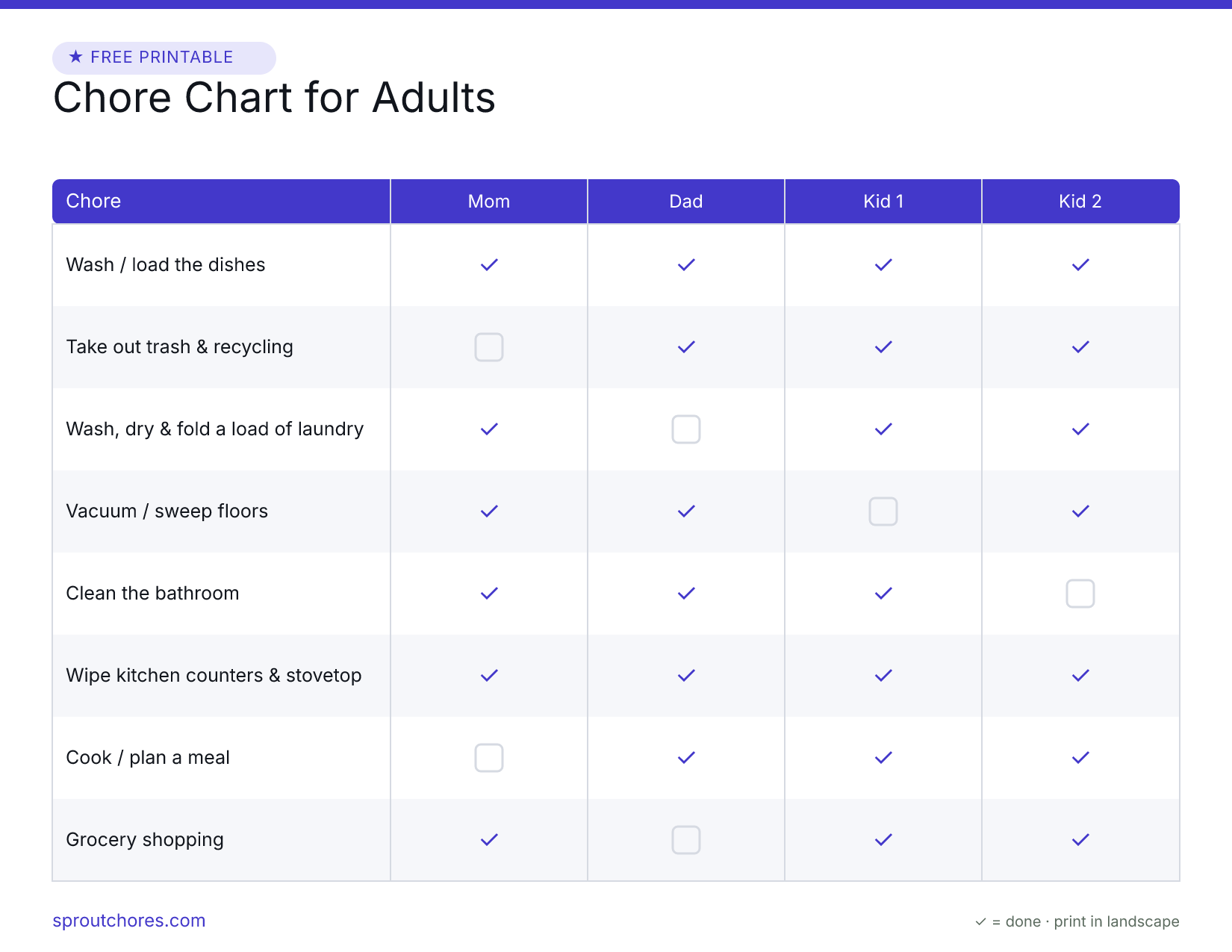
A chore chart for adults isn't a sticker board with a gold star at the end of the week. It's a shared picture of who's responsible for what, so the dishes, the trash, and the bathroom stop being a running argument and just become things that get handled. Whether you live solo and want a weekly rhythm you can trust, you're splitting a house with a partner, or you're three roommates trying to keep a kitchen livable, the right chart turns invisible mental load into something everyone can see. I'm Andrew, and along with my wife I've spent years building systems that survive a busy household — four kids of our own, plus the foster children we've cared for. The same principle that runs our home runs every chart here: we all contribute, and the chart is just the honest record of it. Use the generator below to build your own adult chore chart in a minute, then pick the version that fits your living situation — and read on for what actually makes one of these last past the first hard week.
| Chore | Mom | Dad | Kid 1 | Kid 2 | Remove |
|---|---|---|---|---|---|
| Wash / load the dishes | |||||
| Take out trash & recycling | |||||
| Wash, dry & fold a load of laundry | |||||
| Vacuum / sweep floors | |||||
| Clean the bathroom | |||||
| Wipe kitchen counters & stovetop | |||||
| Cook / plan a meal | |||||
| Grocery shopping | |||||
| Tidy shared living areas | |||||
| Change bed linens |
Tip: choose Landscape in the print dialog for the best fit.
Print in landscape for the best fit. A few reminders from our family to yours: do it together the first few times, keep the chart somewhere everyone can see it, and reward steady effort over a perfect job. — The SproutChores family
Want every age in one file? Get the free Age-by-Age Pack
Six printable charts (ages 4–10) plus reward and routine sheets, in one tidy PDF — free, straight to your inbox.
We email you new printables now and then — unsubscribe anytime. Privacy.
Something went wrong — please try again in a moment.
✓ Almost there — check your inbox!
We just emailed you a confirmation link. Click it to confirm, and your free Age-by-Age Chore Chart Pack lands in your inbox moments later.
Why most adult chore charts quit by week two
The version of this that fails is almost always the same: someone gets inspired, builds a beautiful all-or-nothing system, and then real life shows up. A work trip, a sick week, a holiday — and the whole thing collapses. The conclusion people draw is 'charts don't work for us.' The truer conclusion is that the chart was never built to survive a bad week.
We learned this the hard way running a full house. The systems that actually last aren't the most detailed ones — they're the ones that are easy to restart. You should be able to fall completely off the chart for a week and pick it right back up on Monday without guilt or a fresh redesign. Build for recovery, not perfection.
The second quiet killer is the surprise demand. 'Do the dishes right now' lands like an order and breeds resistance, even between adults who love each other. We've found that a little advance notice changes everything — naming a task ahead of time so the other person can mentally prepare for it. A chart does that work for you automatically: nobody is being ambushed, because the whole week is already on the wall. That alone has settled more standoffs in our home than any clever rule ever did.
Solo, couples, or roommates — pick the chart that fits
There's no single right chore chart for adults, because a one-person apartment, a married household, and a four-person rental are genuinely different problems. The generator above lets you build for your situation, and the printables here are split the same way.
If it's just you, a chart mostly fights forgetting and decision fatigue. A simple weekly chore chart for adults — a steady loop of what happens which day — means you're not re-deciding the same things every morning. Daily versions help if you'd rather see one small list each day than a wall of the whole week at once.
When you live with a partner, the chart's real job is making fairness visible. Most resentment between couples isn't about who scrubbed the tub; it's about who's silently tracking everything. Writing it down moves that load out of one person's head and onto a shared house chore chart you both agreed to.
Roommates are their own thing. You don't share the same standards, the same schedule, or the same idea of 'clean,' and you can't lean on goodwill the way family can. A roommate chart works best when it's blunt and specific — names, tasks, days — so 'I thought you had the kitchen' stops being a recurring conversation. Pick the version that matches your home and let the agreement, not the nagging, do the enforcing.
The grown-up version of "we all contribute"
Here's the belief underneath all of this, and it's the same one we use with our kids: chores aren't a transaction, they're membership. In our house we don't pay anyone per task or hand out rewards for basic upkeep, because the moment a chore comes with a price tag, people start asking 'what do I get?' instead of 'what does this home need?' Contribution is just part of belonging to the household.
That reframe matters for adults too, and honestly it's the whole point of doing chores at all — they were always practice for running your own life. The skill you're protecting as a grown-up isn't a spotless counter; it's being someone a household can rely on. A chart helps because it keeps the conversation about the shared agreement rather than about mood, memory, or who's keeping score.
We also saw, fostering little ones who'd had no dependable structure, how much a predictable rhythm settles a home. What looks like friction is often just uncertainty about what comes next — and that's as true in a shared adult home as it is for a child. A chart you can see removes the guesswork. So treat it as a tracking tool and a standing agreement, not a leverage device. Build something you can restart after a rough week, keep it visible, and let the shared expectation carry the weight.
Frequently asked questions
- How do I make a chore chart for adults that we'll actually use?
- Keep it visible and keep it restartable. The two reasons adult charts fail are that they're too elaborate to recover after a busy week, and that tasks get demanded out of nowhere. Build a simple weekly loop you can post where everyone sees it, agree on it together, and treat a missed week as a Monday reset rather than proof it 'doesn't work.' Use the generator above to make one in about a minute, then print it and put it somewhere you can't avoid it.
- How should couples or roommates split chores fairly?
- Fair usually means visible more than it means perfectly equal. Most household resentment comes from one person silently carrying the mental load of tracking everything. Writing tasks down on a shared chart — with names and days, not vague good intentions — moves that load out of one head and into an agreement you both signed off on. For roommates especially, be specific and blunt: name who owns the kitchen and when, so 'I thought you had it' stops happening.
- Should adults get a reward for doing chores?
- In our view, no — basic upkeep is just part of running a home, not something you bribe yourself or a partner to do. We keep that line clear even with our kids: contribution comes from belonging to the household, not from a payout. For adults, the 'reward' is a home that runs smoothly and a fairer split of the load. If you want extra motivation, a clear shared agreement and a chart you can actually see tends to outperform any treat system.

About the author
More free printables
Get the free Age-by-Age Chore Chart Pack
Six printable charts (ages 4–10) plus reward and routine sheets, in one tidy PDF. We'll also send new printables and the occasional real parenting tip. The charts on this site are always free — no sign-up needed.
We email you new printables now and then — unsubscribe anytime. Privacy.
Something went wrong — please try again in a moment.
✓ Almost there — check your inbox!
We just emailed you a confirmation link. Click it to confirm, and your free Age-by-Age Chore Chart Pack lands in your inbox moments later.