Daily Chore Chart for Adults (Daily, Weekly & Monthly)
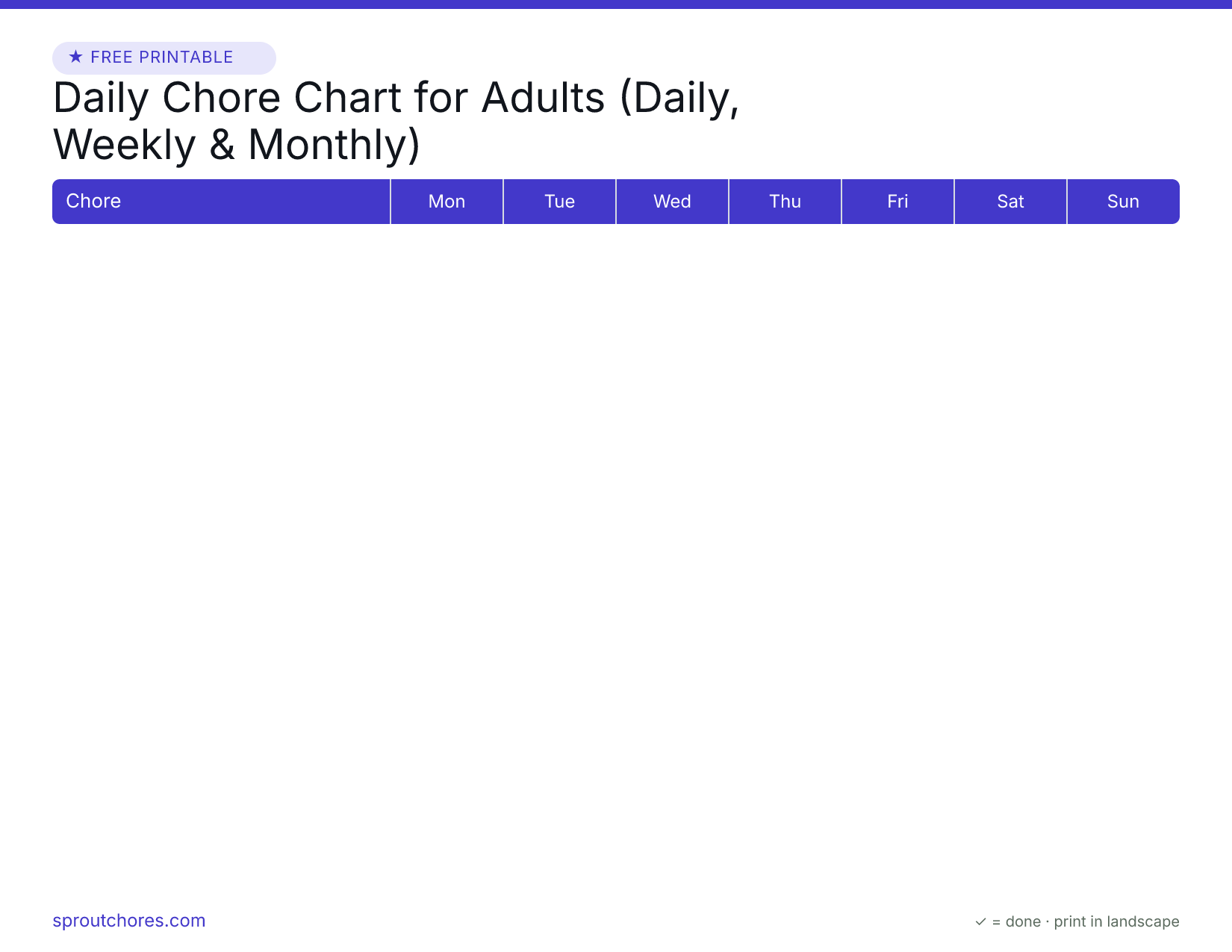
A daily chore chart for adults answers a quieter question than most chore charts do: not who's doing what, but what does today actually need from me? When you're the one adult keeping a household running — living on your own, or simply the person the house leans on — there's no column to hand things off to and no one else tracking the list. It all lives in one head, which is exactly how a home slides from \"fine\" to \"how did it get like this?\" with no single bad day to blame. This page builds the fix: a short daily rhythm you can trust, backed by weekly and monthly tiers so the bigger jobs don't vanish until they become a crisis. I'm Andrew — my wife and I run a full house with four kids from nine to eighteen, and we've cared for foster children along the way — and while my home is anything but quiet, the systems I lean on for my own share of the work are built for exactly this: one person, a lot to remember, and no interest in re-deciding it every morning. Build your chart in the blank maker above, fill in the tasks your place really needs, and read on for how to decide what belongs on each tier.
| Chore | Mon | Tue | Wed | Thu | Fri | Sat | Sun | Remove |
|---|
Tip: choose Landscape in the print dialog for the best fit.
Print in landscape for the best fit. A few reminders from our family to yours: do it together the first few times, keep the chart somewhere everyone can see it, and reward steady effort over a perfect job. — The SproutChores family
Want every age in one file? Get the free Age-by-Age Pack
Six printable charts (ages 4–10) plus reward and routine sheets, in one tidy PDF — free, straight to your inbox.
We email you new printables now and then — unsubscribe anytime. Privacy.
Something went wrong — please try again in a moment.
✓ Almost there — check your inbox!
We just emailed you a confirmation link. Click it to confirm, and your free Age-by-Age Chore Chart Pack lands in your inbox moments later.
Daily, weekly, monthly: what goes on each tier
The reason a three-tier chart beats a flat to-do list is that not every job runs on the same clock, and pretending they do is how you end up either doing too much or forgetting the things that matter. So the first real skill here is sorting your tasks by how fast they actually fall apart, not by how loud they feel.
Your daily tier should be short — just the handful of small resets that keep a place genuinely livable and that spiral fast when you skip them. These are the jobs where three neglected days turn into an actual mess rather than a minor one. The weekly tier holds the bigger work that's fine for several days but starts to show by the end of the week; this is where a daily chart shades into a weekly cleaning rhythm. And the monthly tier is really there to rescue you from your own memory — the deep, occasional tasks you'd otherwise never think about until they became a problem. Writing them down once means they surface on schedule instead of ambushing you.
The generator above starts blank on purpose, because the exact tasks your place needs are yours to decide, not mine to prescribe. Fill in your own daily, weekly, and monthly lists, keep the daily one honest and small, and print it or keep editing it on screen as your life shifts.
When you're the only one on the chart
A shared chart's main job is to make one person's mental load visible to everyone else. When you're running things solo, that pressure valve doesn't exist — there's no partner quietly tracking what's left and no built-in accountability beyond your own follow-through. That changes what the chart has to do for you, and it's where a few specific habits earn their keep.
The biggest one is to stop carrying the list in your head. If a task isn't written somewhere your eyes will actually land on it, it may as well not exist — I've learned that about myself the hard way, since I'm easily pulled off-task, and anything I don't get out of my head simply evaporates. For the small daily items, the companion trick is to just do them the moment you notice them, before the thought slips away.
It also helps enormously to schedule the demanding work for when your energy is genuinely highest rather than whenever you happen to glance at the chart. I'm sharpest before the sun's up — I do my planning on a long early-morning walk and fade in the evening, while my wife is the reverse. Neither is wrong. Knowing your own clock and putting the heavy tier there, instead of fighting your natural rhythm, is one of the least glamorous and most effective things you can do.
Keep it small, keep it restartable, keep it honest
Two things quietly sink a solo chart. The first is making the daily tier too ambitious. A long daily list looks responsible on Monday and becomes one more thing you dodge by Thursday, so trim it until it can survive your worst, most exhausted day — that's the version that actually holds. The second is treating any missed stretch as proof the whole thing failed. Real life will knock you off it: a trip, a brutal week, a stomach bug. A good chart isn't the one that never breaks; it's the one you can drop completely and pick back up the following Monday without guilt or a full redesign.
The monthly tier deserves its own mercy. A deep job can feel like a wall you'd rather not start, so break it into finishable pieces and let yourself call each one done — clean the shelves this month, get behind the appliances next — instead of demanding the whole thing in one heroic afternoon. And prune without apology: keep today's list to only what genuinely matters today, and park everything else somewhere out of sight where it can wait.
One last thing about what this chart is and isn't. Grown adults don't need gold stars, and this was never meant to be a motivation gimmick. Think of it as a mirror, not a whip — a way to glance down and see honestly whether the place is holding together, so you catch the drift early instead of in a crisis. The reason to keep it isn't a prize waiting at the end of the week; it's the plain satisfaction of a home that runs, and of being someone your own life can rely on.
Frequently asked questions
- What should be on a daily chore chart for adults?
- Keep the daily tier to the few small resets that keep your place livable — the jobs where skipping a couple of days leaves you with a real mess rather than a minor one. Everything bigger belongs on the weekly or monthly tier. Because no two homes need the same things, the maker here starts blank: you fill in the tasks your place actually requires instead of following a stranger's list. A quick test — if letting a task sit for three days would genuinely bother you, it's probably a daily; if not, push it out to weekly.
- How do I split chores into daily, weekly, and monthly?
- Match each task to how fast it actually decays, not to how urgent it feels in the moment. Anything that falls apart within a day or two goes daily. Jobs that are fine for several days but look rough by the weekend go weekly — that's your weekly cleaning rhythm. Deep or occasional tasks you'd otherwise forget entirely go monthly, since that tier mostly exists to surface the things your memory drops. Keep the daily list short so it survives a tired day, and let the weekly and monthly tiers carry the rest.
- How do I stick to a daily chore chart when I live alone?
- With no one else tracking the list, the fix is to stop keeping it in your head. Post it where you'll physically see it, handle the small daily items the moment you notice them before they slip your mind, and put the demanding jobs at the time of day your energy is actually highest instead of whenever you happen to look. Treat a missed week as a Monday restart rather than a failure — a chart you can drop and resume beats a perfect one you abandon. And keep today's view to only what matters today, parking the rest out of sight so it isn't nagging at you.

About the author
More free printables
Get the free Age-by-Age Chore Chart Pack
Six printable charts (ages 4–10) plus reward and routine sheets, in one tidy PDF. We'll also send new printables and the occasional real parenting tip. The charts on this site are always free — no sign-up needed.
We email you new printables now and then — unsubscribe anytime. Privacy.
Something went wrong — please try again in a moment.
✓ Almost there — check your inbox!
We just emailed you a confirmation link. Click it to confirm, and your free Age-by-Age Chore Chart Pack lands in your inbox moments later.