Chore Chart for Autistic Adults: A Free, Editable Visual Task Chart
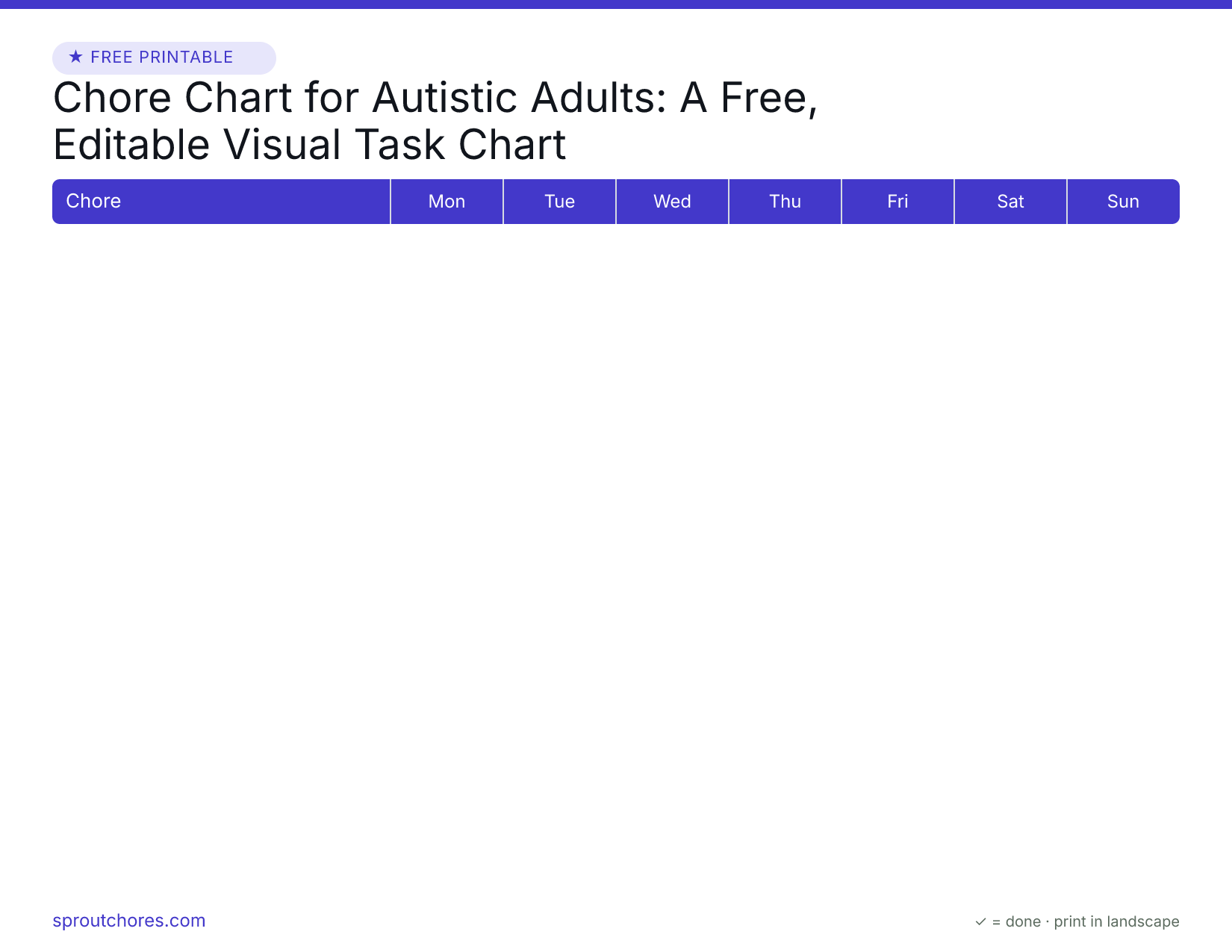
If most chore charts feel like they were designed for someone whose brain runs on a factory schedule, not yours, this one is built differently. I am Andrew. I have four kids, my wife and I foster, and I am also one of two brothers in our forties who both recognize ourselves on the autism spectrum. Nobody sat us down and diagnosed it as kids, but looking back the pattern is unmistakable in both of us. So I am not writing this from a textbook. I am writing it from a lifetime of quietly figuring out what actually lets me get through a week without drowning in it. The generator on this page builds a blank, editable chart: you drop in your own tasks across your own week and decide how full or how empty it should be. There is no preset list telling you what your days ought to contain, and no cartoon clip-art. It is a plain visual frame you can shape to fit the way your attention, energy, and sensory limits really work, and it is one piece of a larger toolkit I will walk through below.
| Chore | Mon | Tue | Wed | Thu | Fri | Sat | Sun | Remove |
|---|
Tip: choose Landscape in the print dialog for the best fit.
Print in landscape for the best fit. A few reminders from our family to yours: do it together the first few times, keep the chart somewhere everyone can see it, and reward steady effort over a perfect job. — The SproutChores family
Want every age in one file? Get the free Age-by-Age Pack
Six printable charts (ages 4–10) plus reward and routine sheets, in one tidy PDF — free, straight to your inbox.
We email you new printables now and then — unsubscribe anytime. Privacy.
Something went wrong — please try again in a moment.
✓ Almost there — check your inbox!
We just emailed you a confirmation link. Click it to confirm, and your free Age-by-Age Chore Chart Pack lands in your inbox moments later.
Why a blank chart beats a preset one for how you actually live
Preset chore charts assume a fairly standard life running at a fairly standard pace. If your days do not look like that, a ready-made list mostly generates guilt about all the rows that do not apply to you. A blank chart flips that. You are not measuring yourself against a template someone else wrote; you are describing your own life back to yourself so you can see it clearly.
That clarity is the real point. Speaking only from my own experience, the thing that quietly wears me down is not the tasks themselves but carrying them around unwritten. Even a small backlog of things I am half-remembering turns into a low hum of I-should-be-doing-that that never switches off. The relief comes the moment everything is out of my head and onto a page I can look at, because then my brain stops guarding the list and I can actually work through it. A blank editable chart is exactly that: a place to set the load down where you can see its real size.
So when you build yours, think of it first as a tracking tool, not a motivator. It is there to show you, honestly, what this week holds and how it is going, not to shame you into being a different person. A short list you genuinely finish teaches your brain the chart is a safe place to look. A crowded one you abandon teaches the opposite. Leave rows blank on purpose. An empty square is not a failure; it is breathing room you chose.
Choosing what goes on the chart (and what stays off it)
The instinct when you get a fresh grid is to fill it. Resist that. Deciding what does not belong on the chart matters as much as deciding what does.
I find it helps to sort tasks into two piles. One pile is genuinely fixed: a bill with a real deadline, a commitment to a specific person, an appointment you cannot move. Those go on the chart and stay there. The other pile is softer than it first appears. A lot of what feels urgent is really optional, or at least postponable. When I catch myself spiraling, I will pull something off the list entirely and tell myself that if it still matters next week, I can add it back when I have the bandwidth. Nine times out of ten it either turns out not to matter or waits just fine. Keeping the visible chart down to what actually needs attention right now is one of the most calming things I do.
For the softer pile, a second trick: keep a separate, tucked-away list somewhere the chart cannot see. Everything you are not doing this week lives there instead of cluttering the page in front of you. That way the working chart stays lean and honest, and nothing genuinely gets lost, because you know exactly where the parked items are waiting.
A note on tasks that touch other people. In our house I have learned to hand my wife the responsibility for certain things rather than just the labor, which is not the same thing. I might still do some of the work, but she owns making sure it happens, and her checking in is often what pulls me back on track when I have drifted. If you share a home, a chart can do that job too: it makes who-owns-what visible, so a supportive partner can nudge without either of you having to nag. The one caution I would offer, gently and from watching my own patterns, is that leaning on someone else to run your systems is fine right up until it becomes the only thing holding them together. The aim is a chart that helps you carry your own load, not one that quietly hands it off for good.
Making the chart actually stick: a small, honest toolkit
A chart on its own rarely survives contact with a real week. What makes it hold is the handful of habits you build around it. Here is what has held up for me, offered as personal experience rather than a prescription, because every person on the spectrum is genuinely different.
Make the movement visible. Long after I went mostly digital, I still keep tasks on sticky notes and physically slide them from a not-started column, to a working-on-it column, to a done column. Watching the notes travel across the space tells me how much is left in a way a static checklist never does. If your printed chart lets you cross things off or move markers, use that; the felt sense of progress is doing quiet work.
Shrink the scary rows until they have a finish line. A big open-ended job, the kind with no obvious end, makes my brain flinch and look away, because starting it feels like signing up for weeks. So I do not write the big version on the chart at all. I write the smallest slice with a clear stopping point, and I let finishing that one slice count as the day going well. A little measurable win beats a vague looming mountain every time.
Protect the conditions you need to focus. This is where sensory reality comes in. Overload is a constant background challenge for me and my brother, so I lean on things like wearing noise-cancelling headphones with nothing playing, and keeping a single window open full-screen with everything else shut down so my attention has nowhere to wander. I have also set plain rules with the people I work with about which channel means what, so a text is a genuine now-thing, a chat message can wait a few hours, and email is rarely urgent. That lets me give the chart, and the task, an uninterrupted stretch. Build your own version of whatever guards your focus, and treat those guards as legitimate. Stepping away to recharge is not laziness; it is what makes tomorrow possible.
Finally, expect to restart. When the chart falls apart after a rough stretch, and it will, that is not a verdict on you. Print a fresh, mostly-empty page and begin again with one or two easy wins. Being easy to restart matters far more than any unbroken streak.
Frequently asked questions
- Is a chore chart for autistic adults different from one made for kids?
- In an important way, yes, and this page is built for adults. From what I have seen in my own family, most autistic adults, unless they are more significantly affected, have already learned to regulate themselves and largely run their own lives; the harder terrain is usually social situations and reading why people react the way they do. A child has not built those self-regulation skills yet, so a child's chart works alongside a caregiver who co-regulates and slowly teaches the how. An adult chart, by contrast, is a self-directed tool: you own it, you fill it, and it exists to lighten your own load rather than to have someone manage you. This is my lived experience, not clinical fact, and every person is different.
- There are no pictures or preset chores. How do I actually use a blank chart?
- That is the point of it. Instead of a fixed list that assumes a standard life, you get an empty visual grid you shape around your own week. Start by writing down only what genuinely needs attention right now, keep the number of rows low, and break any big or open-ended job into the smallest piece that has a clear finish. Park everything that can wait on a separate out-of-sight list so the chart in front of you stays lean. Then use whatever visible progress the chart allows, crossing off or moving markers, so you can see the work shrink. The blank format is what lets it fit a life that does not run on a template.
- Is any of this medical or clinical advice for autism?
- No. Everything here is our family's personal experience, shared to be genuinely useful, not medical or clinical guidance. I write as one of two brothers who recognize these tendencies in ourselves; neither of us was formally diagnosed, so I describe patterns and self-recognition, never diagnoses. Reputable sources on autism echo the value of predictable structure, visual supports, and managing sensory load, which is why these tools have held up for us, but this page is not a substitute for professional support. Every autistic person is different, and if you have questions about diagnosis, mental health, or treatment, please talk with a qualified professional.

About the author
More free printables
Get the free Age-by-Age Chore Chart Pack
Six printable charts (ages 4–10) plus reward and routine sheets, in one tidy PDF. We'll also send new printables and the occasional real parenting tip. The charts on this site are always free — no sign-up needed.
We email you new printables now and then — unsubscribe anytime. Privacy.
Something went wrong — please try again in a moment.
✓ Almost there — check your inbox!
We just emailed you a confirmation link. Click it to confirm, and your free Age-by-Age Chore Chart Pack lands in your inbox moments later.