Chore Chart for an 8-Year-Old
Eight is a sweet spot. Your child isn't a little kid you're cleaning up after anymore, but they're not yet a tween pushing back on everything either — they're old enough to take a job seriously and young enough to feel proud doing it. In our house, with four kids of our own and a season spent as foster parents, eight is the year a chore chart shifts from \"practice and patience\" to a real record of who's pulling their weight. You can build a personalized chart for your 8-year-old in under a minute with the generator above, or print the ready-made version below. We'll be honest with you from the first line, because it shapes everything that follows: we don't use the chart to bribe or motivate the kid. We use it as a tracking tool for ourselves — a quick way to see who's keeping up and who needs a hand. The reason an 8-year-old does their jobs in our home is the simple, unmoving expectation that everyone here pitches in, not a box that pays out a sticker.
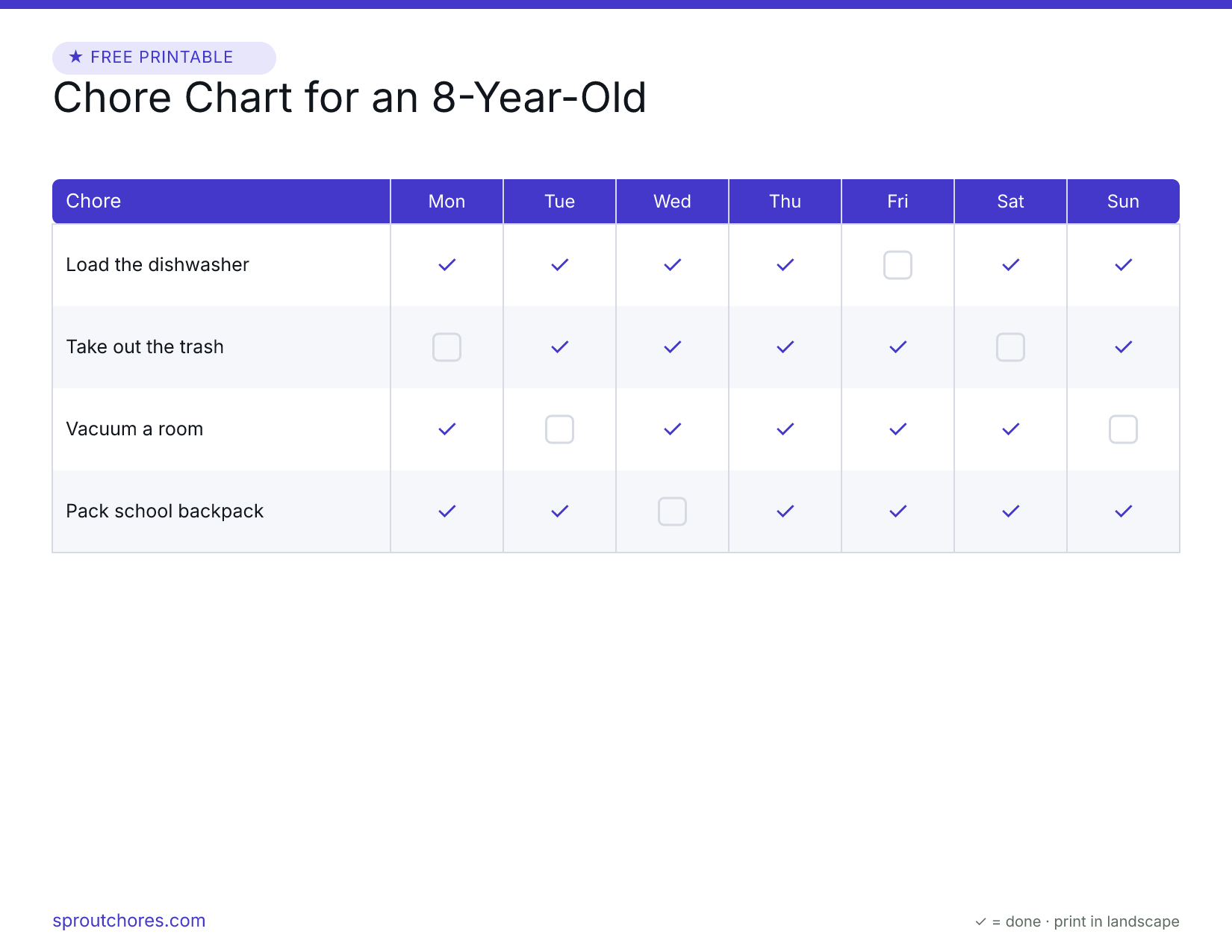
| Chore | Mon | Tue | Wed | Thu | Fri | Sat | Sun | Remove |
|---|---|---|---|---|---|---|---|---|
| Load the dishwasher | ||||||||
| Take out the trash | ||||||||
| Vacuum a room | ||||||||
| Pack school backpack |
Tip: choose Landscape in the print dialog for the best fit.
Print in landscape for the best fit. A few reminders from our family to yours: do it together the first few times, keep the chart somewhere everyone can see it, and reward steady effort over a perfect job. — The SproutChores family
Want every age in one file? Get the free Age-by-Age Pack
Six printable charts (ages 4–10) plus reward and routine sheets, in one tidy PDF — free, straight to your inbox.
We email you new printables now and then — unsubscribe anytime. Privacy.
Something went wrong — please try again in a moment.
✓ Almost there — check your inbox!
We just emailed you a confirmation link. Click it to confirm, and your free Age-by-Age Chore Chart Pack lands in your inbox moments later.
Age-appropriate chores for an 8-Year-Old
Every chore below is pre-loaded in the generator above and is something a child in this age range can realistically manage with a little initial guidance:
- Load the dishwasher
- Take out the trash
- Vacuum a room
- Pack school backpack
What an 8-Year-Old Can Realistically Take On
Eight lands comfortably inside the six-to-ten window, where the bar quietly rises each year and we genuinely expect jobs to get done — not just attempted. An 8-year-old can keep their own room and personal space in order, set and clear the table, feed and water a pet, fold and put away their own laundry, and take on real kitchen help: measuring, mixing, peeling vegetables, loading and unloading the dishwasher. Trash is a great one to hand over around now, and not as a one-off favor — as a standing job they own. Our youngest is proof of where that leads. He didn't always do it, but after years of the same steady expectation, he now grabs a bag, heads upstairs on his own, collects every bin in the house, and brings it all back down without anyone asking. That kind of independence isn't a personality trait you luck into; it's the payoff from showing up to the same small responsibility over and over.
If you have an 8-year-old who's drawn to building, fixing, or being outside, lean into it. One of ours has always loved shadowing his dad through yard work and repairs, peppering him with questions about every tool and why it does what it does. We never made hands-on work a requirement, but when a kid this age is curious about how things actually work, that's worth feeding — those skills stack up for decades. Just keep your expectations honest. At eight you'll still get a lopsided fold and a counter that's clean-ish rather than spotless, and that's normal. Don't quietly redo it behind their back; if something truly needs fixing, fix it together so the lesson is "here's the standard," not "your effort didn't count."
How to Make the Chart Actually Stick
Most charts die around week three, and it's almost never because the chart was badly designed. It's because families expect the chart to do a job it can't: make a kid care. A piece of paper can't generate motivation. What it can do is make the work visible, give you an honest record of who's doing what, and flag when it's time to step in. Once we stopped asking the chart to be a motivator and started treating it as a dashboard for us, the whole thing got easier.
The motivation has to live somewhere else — in the structure of the family. We say it out loud and often: this is a household, and everyone who lives here helps run it. When that expectation genuinely doesn't waver, an 8-year-old doesn't need to be talked into wiping a table. We saw how much this matters during our time fostering. For kids who'd had almost no reliable rhythm before they came to us, a predictable structure they could trust did more for settling in and self-regulating than any prize ever could. We're convinced that without that steady scaffolding, the whole transition would have been far rockier. You don't have to be a foster parent for the takeaway to apply: consistency is what builds trust, and a chart you actually keep up with day after day is consistency a child can see.
Two practical things that have saved us countless standoffs. First, keep the chart on paper and post it where the work happens — on the fridge, a bedroom door, somewhere your 8-year-old physically passes all day. Apps tend to hide on a parent's phone where the kid never looks, which quietly kills their usefulness. Second, give advance notice instead of barking orders cold. "Unload the dishwasher right now" invites a fight; "in about an hour, that dishwasher needs unloading" gives them time to get their head around it. That one small habit has defused more conflicts in our house than any reward system ever did.
Allowance and Money: Why We Keep It Separate From the Chart
Eight sits inside the years where allowance is part of how we operate, but we're deliberate about how it works — and it probably differs from a lot of advice you'll find. We do pay a small weekly amount, which starts back around the time chores begin in earnest, somewhere near five or six years old, at roughly five dollars a week. By eight it's still modest. The part that matters: it is not a price list, and we never pay per task.
What the money is tied to is the whole week's worth of effort — the quality of the work, staying on track without a string of reminders, and the attitude they bring. An 8-year-old who does their jobs but does them sloppily, or only after three nags and a meltdown, hasn't earned it the way a kid who quietly keeps up has. Gating allowance on overall follow-through rather than per-chore pricing keeps a child from treating the house like a vending machine where every task has a quote attached. The deeper reason runs underneath all of this: we don't think of chores as a way to get work done. We think of them as practice for raising a capable adult. An unloaded dishwasher isn't really the point; the point is who your kid becomes by doing it reliably.
We also keep rewards and chores in separate lanes. We don't make our kids earn screen time or fun by working — losing screen time shows up only as a consequence for genuinely poor behavior, never as currency for getting a job done. When ours were right around this age, the main extra reward was a dollar-store "treasure chest" they could pick from once or twice a week when the work was done well and with a good attitude — cheap enough that it stayed about the attitude rather than becoming a bribe. Whether you attach any money to chores at all is entirely your family's call. The chart does its tracking job either way.
Frequently asked questions
- What chores can an 8-year-old do?
- A typical 8-year-old can keep their own room tidy, set and clear the table, feed and water a pet, fold and put away their own laundry, and help in the kitchen with real steps like measuring, mixing, peeling, and loading or unloading the dishwasher. Eight is also a good age to hand over a standing household job — taking out the trash is a favorite of ours — so they're contributing to the whole home, not just their own space. If your child is into it, outdoor work and helping with simple repairs are in range too. The printable and generator on this page are built for exactly this level of responsibility.
- Should I pay my 8-year-old an allowance for chores?
- In our house we do pay a small weekly allowance — around five dollars at this age — but we don't pay per chore. We gate it on the quality of the work, staying on track without constant reminders, and attitude across the whole week, rather than pricing each task. We also keep it separate from screen time and other rewards. The goal is to teach reliable follow-through and treat chores as practice for adulthood, not to turn helping the family into a transaction. Whether you tie money to chores at all is up to you; the chart works the same either way.
- How do I get my 8-year-old to stick with their chore chart?
- Keep the chart on paper and post it where the work actually happens, not buried in an app on your phone, so your child sees it all day. Give advance notice before a task is due — "in an hour we're unloading the dishwasher" lands far better than demanding it on the spot. Most of all, treat the chart as a tracking tool for you, not a motivator for them. The real drive comes from a steady, predictable expectation that everyone in the family contributes. When the novelty fades — and it will — the routine keeps going, because consistency does the work no reward can.
- What's a realistic number of chores for an 8-year-old?
- Fewer, meaningful jobs beat a long wall of tiny ones. We aim for a couple of daily items — self-care plus one household task like dishes or trash — and a small set of weekly jobs. An 8-year-old still benefits from having the standard shown to them rather than a brand-new list piled on, so let complexity rise gradually as they prove they can handle it. A chart with twenty checkboxes overwhelms everyone and gets abandoned; a short, clear one your child can actually own is what sticks.

About the author
More free printables
Get the free Age-by-Age Chore Chart Pack
Six printable charts (ages 4–10) plus reward and routine sheets, in one tidy PDF. We'll also send new printables and the occasional real parenting tip. The charts on this site are always free — no sign-up needed.
We email you new printables now and then — unsubscribe anytime. Privacy.
Something went wrong — please try again in a moment.
✓ Almost there — check your inbox!
We just emailed you a confirmation link. Click it to confirm, and your free Age-by-Age Chore Chart Pack lands in your inbox moments later.