A Free, Editable Chore Chart for Boys — Not Baby-ish, Not Stereotyped
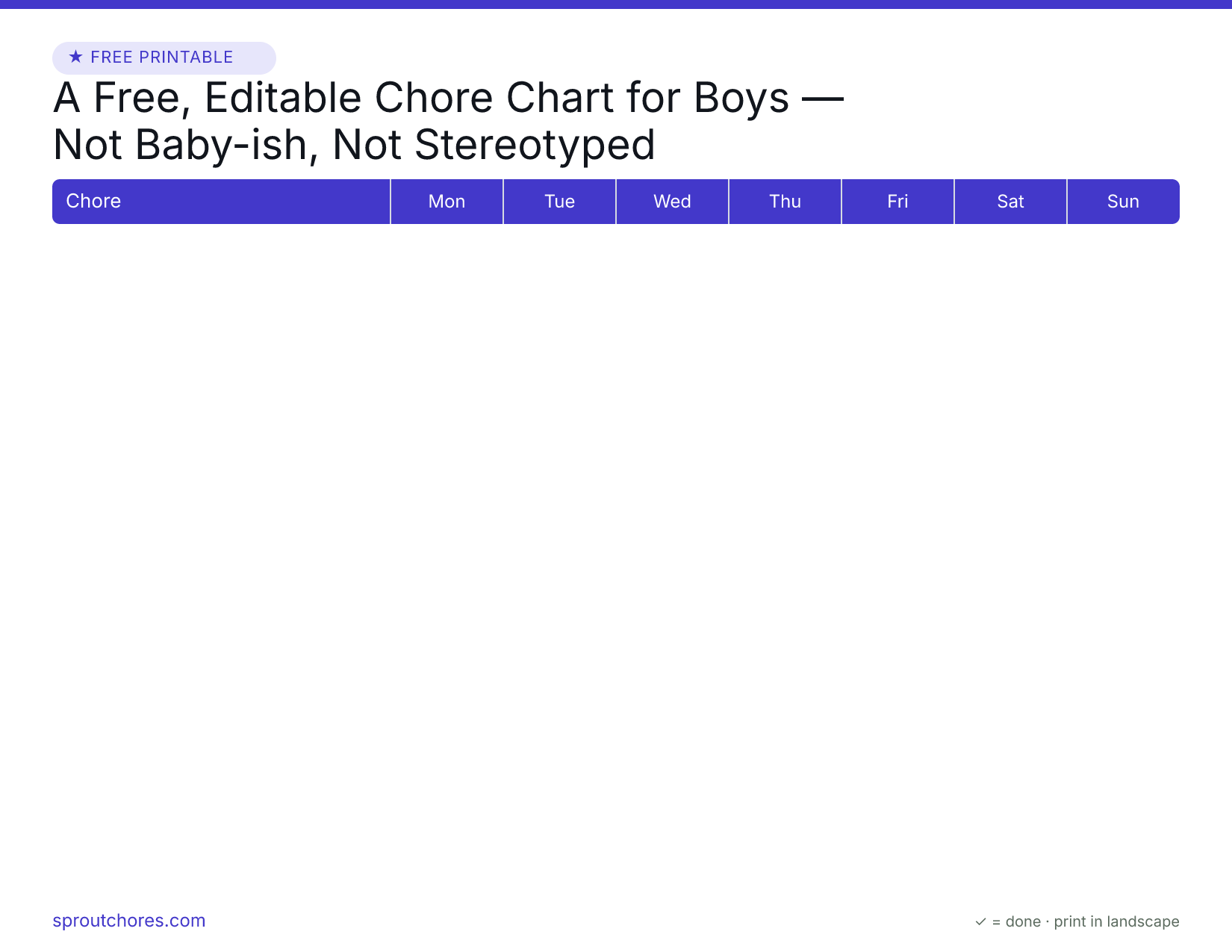
If you typed "chore chart for boys" into a search bar, you've almost certainly scrolled past a pile of templates crawling with monster trucks, dinosaurs, and cartoon robots — the kind of thing that looks great for a four-year-old and earns an eye-roll from a ten-year-old. I'd rather hand you something that actually lasts. The chart on this page is a blank, editable grid you fill in yourself: his jobs listed down one side, the days of the week across the top. Because nothing is pre-printed, it bends to your real son instead of some generic idea of what a "boy's chart" is supposed to look like. I'm Andrew, and my wife and I are the family behind SproutChores. We're raising four kids — a nine-year-old boy and three girls at eleven, fifteen, and eighteen — and we've fostered younger children too, including a little boy. So on the specific question of charts for sons, I'm not guessing. I've got one at home right now, plus years of watching what a boy actually grows into. Here's the honest headline before we start: the best chart for a boy isn't a boy-themed chart at all. It's a chart built around the specific kid in front of you — his age, his energy, and what the man he's becoming will genuinely need to know how to do. Below I'll cover why the "boy chore" lists are worth ignoring, how the chart should shift as he grows from a little kid into a teenager, how to let him make it his own without it feeling babyish, and the reframe that mattered most for us: the chart is there to help you keep track, not to trick him into caring.
| Chore | Mon | Tue | Wed | Thu | Fri | Sat | Sun | Remove |
|---|
Tip: choose Landscape in the print dialog for the best fit.
Print in landscape for the best fit. A few reminders from our family to yours: do it together the first few times, keep the chart somewhere everyone can see it, and reward steady effort over a perfect job. — The SproutChores family
Want every age in one file? Get the free Age-by-Age Pack
Six printable charts (ages 4–10) plus reward and routine sheets, in one tidy PDF — free, straight to your inbox.
We email you new printables now and then — unsubscribe anytime. Privacy.
Something went wrong — please try again in a moment.
✓ Almost there — check your inbox!
We just emailed you a confirmation link. Click it to confirm, and your free Age-by-Age Chore Chart Pack lands in your inbox moments later.
A Chore Chart for a Boy Is Really Just a Chart for Your Boy
The chore lists that get tagged "for boys" tend to funnel every kid into the same handful of jobs — take out the trash, mow the lawn, haul the heavy stuff, help dad in the garage. There's nothing wrong with any of those tasks, but if that's the whole list, you're quietly teaching your son that a narrow slice of the house is "his" and the rest belongs to someone else. I'd skip that framing entirely. In our house the wiring runs opposite the cliche anyway — two of my daughters are the ones who have to understand how a machine works before they'll leave it alone, and my fifteen-year-old is engineering-minded down to the bone. Meanwhile my nine-year-old son's proudest standing job is collecting every bag of trash in the house. Kids don't read the stereotype, so assign the work by what he can actually handle and by what adulthood will ask of him.
That last part is the piece I care about most. I don't picture a chore as a way to get the dishwasher emptied — I picture it as rehearsal for being a capable adult, and a capable man cooks a real meal, runs a load of laundry from hamper to drawer, and cleans a bathroom properly, not just the yard and the trash cans. So put the full range on his chart, not the "guy jobs." A blank grid beats any themed template for exactly this reason: nothing on it has already decided what a boy is or isn't responsible for.
How a Boy's Chart Changes From Little Kid to Teenager
What decides the contents of the chart isn't whether the kid's a boy — it's how old he is. With the little ones, roughly two to five, the whole assignment is self-care he handles himself: clothes on, teeth brushed, his own mess cleaned up, and it works best done shoulder-to-shoulder with you, because at that age copying a parent is most of the appeal. Once he's about five or six you can add a bit of shared-space work, but plan on redoing most of it — the win at that point isn't a clean room, it's the habit forming and the dawning sense that he belongs to a household that depends on everybody. Through the elementary years the jobs get steadily more real: dishes, helping in the kitchen, pets, trash, outdoor work, and this is usually where a small allowance can start.
A word on energy, since it comes up constantly with boys: my nine-year-old runs on a full tank of it — there's a dent in our wall his head is responsible for. For a kid built like that, short, physical, clearly-finishable jobs land far better than something vague and open-ended. Give him a concrete thing he can throw himself at and cross off, and you'll get more out of him than you ever will from "go tidy up."
The teen years are their own animal. By fifteen or sixteen, capability stopped being the question long ago — he already knows how to run the washer. What you're coaching now is following through and holding the standard without three reminders, so make the chart read like a plain list of grown-up responsibilities, not a peppy sticker board he'll roll his eyes at. In our house the teen stage actually shifts toward treating it like a job: a set monthly amount that comes with the expectation he'll take on agreed tasks when asked, and gets trimmed if he lets things slide. The editable grid lets you keep totally separate versions going at once — what's on my nine-year-old's looks almost nothing like a teenager's, and it should.
Let Him Make It His — Without Making It Babyish
The single most dependable trick I know is to let the kid build the chart himself. I've watched it play out with my eleven-year-old: she gets genuinely excited designing and decorating hers, and then she'll actually follow it, because it's a thing she made rather than a thing I imposed. The same works for boys, with one adjustment — watch the babyish factor. A ten-year-old who's into Minecraft, a favorite superhero, or honestly just a plain, no-frills layout will use a chart he picked out; he will not touch one plastered with cartoon dinosaurs he decided he outgrew two years ago. So hand him the blank grid and let him choose the look, the colors, and the theme — including "none," if that's what he wants. Older boys often prefer something that reads more like a checklist than a toy, and that's a feature, not a problem.
Now the honest part, so you don't set yourself up to be let down: ownership raises the odds he'll engage, but it doesn't guarantee he'll love the thing forever. Under one roof I've got both extremes — one of my girls will decorate a chart for the sheer fun of it, while my son barely registers that charts exist. That gap has nothing to do with being a boy or a girl; it's just how each kid is built. Meet the son you actually have, expect to tinker, and if a chart quits working, read that as a cue to change it — not as evidence that boys and charts don't mix.
The Chart Is Your Tracking Tool, Not His Bribe
This is the shift in thinking that made the biggest difference for us. What the chart is actually for is giving me a clear read on where each kid stands, so I can tell when someone needs a nudge — it works as a parent's dashboard, not as a gadget built to manufacture enthusiasm in a nine-year-old. The motivation itself comes from a steady, unglamorous expectation: in this family, everybody pitches in, because that's part of what it means to belong to one. A grid of boxes can't install that; the family does.
So we keep a few lanes deliberately separate. We don't make our kids earn screen time by doing chores, and we don't dock money as a penalty for something unrelated. Allowance exists in our house, but it rides on the whole picture — whether the work held up, whether he stayed dependable without being chased, and the attitude he brought — never a price tag stapled to each box. Two levers do a lot of quiet work here. The first is flagging a job early: letting him know an hour ahead that the dishwasher's coming up defuses far more standoffs than springing it on him the second you want it done, because he gets a runway to shift gears. The second is holding back the instinct to rescue. When you always swoop in, the lesson a boy takes away is that skipping the job works out fine — so let the natural, real-world-shaped consequence land instead. And if you want proof this pays off, here's mine: my nine-year-old now gathers every bag of trash in the house on his own — grabs the bags, heads upstairs, collects them all, comes back, nobody prompting him. That didn't come from a sticker. It came from years of steady, unremarkable consistency, which is the part no template can sell you.
Frequently asked questions
- What are age-appropriate chores for boys?
- There's no boy-specific list — the right chores track his age and skill, not his gender. From about two to five, it's self-care he manages himself: dressing, teeth, cleaning up his own mess, usually done right alongside you. Around five or six you can add small shared-space jobs, treating that stage as habit-building rather than getting the work done well. Through the elementary years the jobs grow into dishes, kitchen help, pets, trash, and outdoor work, with a small allowance often starting somewhere in there. Because the chart on this page is a blank, editable grid, you set his tasks at his level and raise the bar as he proves he can carry more — no template deciding in advance what a boy is supposed to do.
- What chores should a teenage boy do?
- By the teen years, honestly, just about anything in the house — and none of it is a "guy job." A thirteen-to-eighteen-year-old can cook a genuine meal, run his own laundry from hamper to drawer, handle dishes and trash, keep shared spaces livable, look after pets, and pitch in on bigger weekend projects inside and out. He's been physically capable for a while; what you're really coaching now is finishing the job to a real standard without being reminded twice. In our house the teen stage moves toward a job-style setup — a set monthly amount tied to taking on agreed tasks when asked, trimmed if he lets things slide — rather than a childhood sticker chart. Keep the wording plain and adult so it reads like a list of responsibilities, not a toy.
- How do I get my son to do his chores without nagging?
- Two things moved the needle most for us, and neither is a reward chart. The first is advance notice: telling a kid a job is coming up in a little while, instead of springing it on him the instant you want it done, heads off a surprising number of standoffs because he gets a moment to switch gears. The second is not rescuing him — if you always cover for a missed chore, the lesson he learns is that skipping it works out fine, so let the natural consequence land instead. Underneath both, the real driver isn't the chart at all; it's a steady household expectation that everyone contributes because they're part of the family. The chart just helps you keep track of who's keeping up. We deliberately keep screen time and rewards out of the chore equation, so the point stays "this is your part," not "what do I get for it?"

About the author
More free printables
Get the free Age-by-Age Chore Chart Pack
Six printable charts (ages 4–10) plus reward and routine sheets, in one tidy PDF. We'll also send new printables and the occasional real parenting tip. The charts on this site are always free — no sign-up needed.
We email you new printables now and then — unsubscribe anytime. Privacy.
Something went wrong — please try again in a moment.
✓ Almost there — check your inbox!
We just emailed you a confirmation link. Click it to confirm, and your free Age-by-Age Chore Chart Pack lands in your inbox moments later.