Responsibility Chart for Kids: A Free, Editable Printable You Fill In Yourself
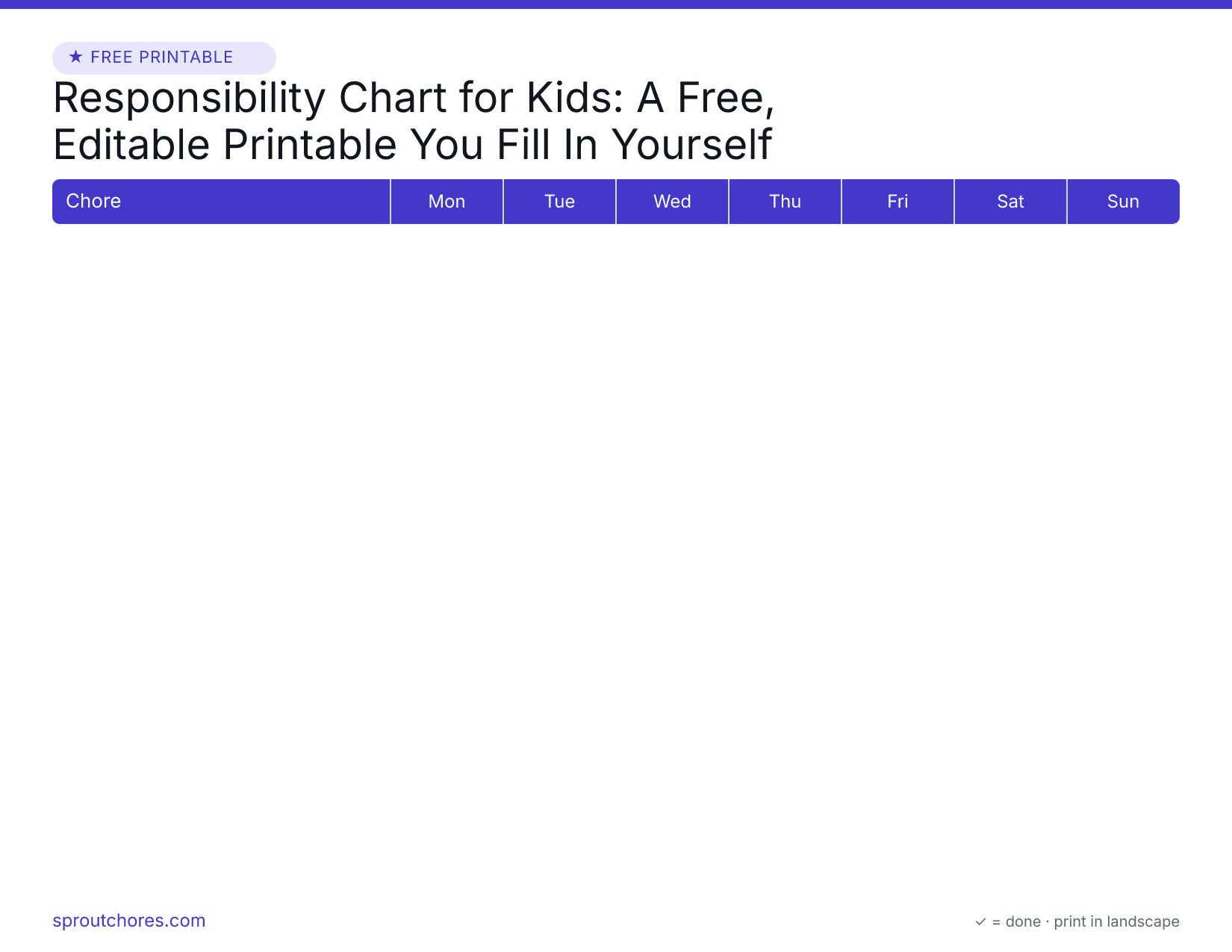
If you searched for a responsibility chart instead of a chore chart, that word choice tells me something. A lot of parents standing where we've stood reach for "responsibility" on purpose, because it points at the thing we actually care about — a kid who takes ownership — rather than just a list of jobs that need doing. I'm Andrew, and my wife and I are the SproutChores family: four kids from nine to eighteen, plus the children we've fostered along the way. The free printable below is a blank, editable chart with room for pictures, and it's blank for a reason. We're not going to hand you a fixed list of tasks, because the responsibilities worth tracking are the ones specific to your child and your home. You fill in the rows; the grid runs across the week. What I want to give you here is the thinking around it — what actually counts as a responsibility (it's a good deal wider than cleaning), how to shape the chart to the real kid in front of you, and the one idea that reset everything for us: this chart is a tool for you to see how each kid is doing, not a gadget for making them care. The caring comes from somewhere else, and I'll get to that.
| Chore | Mon | Tue | Wed | Thu | Fri | Sat | Sun | Remove |
|---|
Tip: choose Landscape in the print dialog for the best fit.
Print in landscape for the best fit. A few reminders from our family to yours: do it together the first few times, keep the chart somewhere everyone can see it, and reward steady effort over a perfect job. — The SproutChores family
Want every age in one file? Get the free Age-by-Age Pack
Six printable charts (ages 4–10) plus reward and routine sheets, in one tidy PDF — free, straight to your inbox.
We email you new printables now and then — unsubscribe anytime. Privacy.
Something went wrong — please try again in a moment.
✓ Almost there — check your inbox!
We just emailed you a confirmation link. Click it to confirm, and your free Age-by-Age Chore Chart Pack lands in your inbox moments later.
What Counts as a Responsibility (It's Wider Than Cleaning)
The reason the "responsibility" framing is worth chasing is that it opens the chart up past the vacuum and the dishes. In our house a responsibility can be self-care — getting dressed without a fight, brushing teeth, keeping a bedroom from becoming a hazard. It can be owning schoolwork, meaning the homework gets done and turned in without a parent hovering over every problem. It can be caring for something outside yourself: a pet, a younger sibling, a shared space everybody uses. And some of the most important ones barely fit in a box at all — telling the truth, being decent to a brother, cleaning up a mess you made before anyone asks. Because the printable is editable, you can mix all of those on one sheet, and mixing them is the whole point. It quietly tells a kid that being responsible isn't a Saturday-morning cleaning event; it's how you carry yourself the other six days too.
The shift that mattered most for me was to stop treating these tasks as a way to get the house clean and start treating them as reps for adult life. A tidy room is a pleasant side effect. The real output is a young person who can run their own life without being managed. That reframe also answers the "why do I even have to" question honestly: nobody in this family gets paid to be family. You pitch in because the people around you are counting on you, and that's simply the price of belonging here.
Shape the Chart to the Kid, Not the Age on the Package
Age is a reasonable starting point, so long as you hold it loosely. For the little ones, roughly two to five, keep the chart to self-care plus one small contribution, and resist grading the quality — at this stage you're building the idea that they're part of something, not a spotless result you'll only end up redoing. From six to ten, real jobs start to land, and the standard rises from "did it" to "did it well and without three reminders." A responsibility chart for teens works best stripped of anything that feels babyish; by then the sheet has quietly become more of a status check for you than a poster on their wall, a fast read on whether they're keeping up so you know when to lean in.
Then there's the truth that no age band prints on the box: the same house can hold opposite kids. One of our daughters lights up designing and decorating her own chart and follows it happily — hand her the pen and she'll own the layout. Another kid barely registers that a chart exists, no matter how it's dressed up. So use the same editable file two different ways. For the chart-lover, let it be hers to build. For the kid a chart doesn't reach, keep it as your private tracking sheet and prompt in real time instead. The job is to progress from where each child actually is, not from where you wish they were.
Why the Chart Tracks Instead of Motivates
It's tempting to turn the chart into a motivation engine — stickers, points, a payout for every row ticked. We deliberately don't, and I'd gently steer you the same direction. Ownership can't be purchased. A kid who only acts for the sticker has learned to negotiate, not to take responsibility, and you'll feel the difference the first time the reward isn't on the table. The pull we rely on instead is the plain, non-negotiable expectation that everyone under this roof carries a share. That's why the chart's real work is showing you, at a glance, who's keeping up and where to step in.
Keep the other levers in their own lanes. We don't make screen time something a kid has to earn by doing their jobs, and we don't dock money as a penalty for unrelated misbehavior — braid those together and every request in the house turns into a bargain. If you use allowance at all, tie it to the whole picture over a stretch of time — how well the work holds up, whether they stay dependable, the attitude they bring — rather than a fee stapled to each checkbox. And here's the part that feels backwards: don't over-rescue. Hand them the tools, make plain where their responsibility starts and stops, help the moment they ask — but don't chase them, and let a real, natural consequence land when they drop the ball. That's where ownership actually gets forged. One free trick that has spared us countless standoffs is a little advance notice: "in about an hour we're going to do X" lands far softer than "do X right now," because it gives a kid time to shift gears.
Build It to Survive a Bad Week (and Restart Easy)
Most chart systems don't die from a flaw in the design; they die from the all-or-nothing trap. You build something perfect, then a vacation or a sick stretch or the holidays blows it up, and you quietly conclude it "didn't work." It worked fine — it just wasn't built to bend. So design for the restart. A chart you can pick back up on a Monday after two weeks off will beat a flawless one you abandoned every single time.
And let me set your expectations, because you will not see this working day to day. Responsibility grows about the way weight comes off — invisible up close, undeniable when you hold today next to a year ago. Our nine-year-old now gathers every bit of trash in the house and hauls it out without a word from anyone; that wasn't a breakthrough, it was years of unglamorous consistency finally surfacing. Fostering taught us the same lesson from the other end. When we took in children who'd never had a predictable rhythm, the routine itself did more than any chart could — the steady, knowable pattern made them feel safe enough to settle, and it was out of that safety that they slowly grew able to handle their own transitions. A posted routine, it turns out, is as much for the adult trying to keep the house sane as it is for the kids. Steady beats perfect, always.
Frequently asked questions
- What age should you start a responsibility chart for kids?
- You can start a light version around two or three with nothing but self-care on it — getting dressed, brushing teeth, cleaning up their own mess — but don't expect quality at that age; you're planting the idea that they're part of a family that pitches in, not chasing a tidy result. A responsibility chart for a 6 year old can carry a handful of real daily habits plus one small shared job, and the standard climbs toward doing it without constant reminders as they grow. Above all, meet the kid you actually have: some six-year-olds adore a chart and some ignore it completely, and both are perfectly normal.
- What's the difference between a chore chart and a responsibility chart?
- Mostly the framing — and the framing genuinely matters. A chore chart tends to read as a list of cleaning tasks, while a responsibility chart points at ownership: self-care, schoolwork, kindness, and looking after the people and things around you, not just tidying up. Because this printable is blank and editable, you decide which one it becomes. Fill it with cleaning jobs and it's a chore chart; blend in homework, getting ready on their own, and how they treat a sibling and it turns into a responsibility chart. We lean toward the wider version, because our goal was never a spotless house — it was a capable kid.
- Should I reward or pay my child for their responsibility chart?
- In our house, not per task. We keep rewards and screen time separate from responsibilities, because the moment a child is doing something only for the payout, you've taught negotiation instead of ownership. Allowance does exist for us, but it rides on the bigger picture over time — the quality of the work, staying dependable, the attitude — rather than a price tag hung on each row. Let the responsibilities themselves stand as a plain expectation of being part of the family, and use the chart to see how it's going, not to bribe cooperation out of them.

About the author
More free printables
Get the free Age-by-Age Chore Chart Pack
Six printable charts (ages 4–10) plus reward and routine sheets, in one tidy PDF. We'll also send new printables and the occasional real parenting tip. The charts on this site are always free — no sign-up needed.
We email you new printables now and then — unsubscribe anytime. Privacy.
Something went wrong — please try again in a moment.
✓ Almost there — check your inbox!
We just emailed you a confirmation link. Click it to confirm, and your free Age-by-Age Chore Chart Pack lands in your inbox moments later.