A Summer Chore Chart for Kids That Keeps the Break From Unraveling
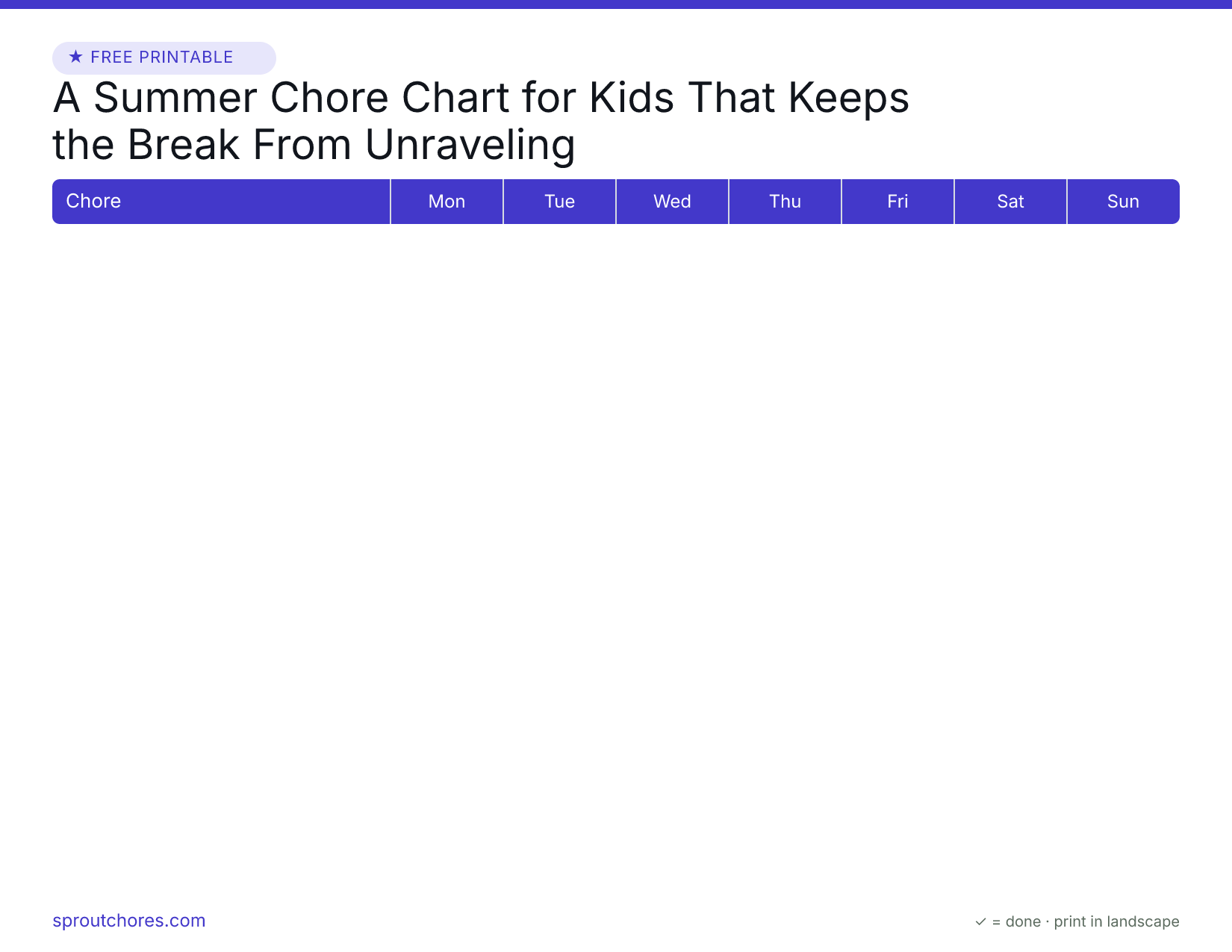
If you're hunting for a summer chore chart for kids, you already know the thing you're really trying to head off: that slow slide where the alarm stops going off, the dishes pile up, and by the second week of July the whole house feels a little feral. I'm Andrew, and my wife and I are the SproutChores family. We're raising four kids between nine and eighteen, we homeschool, and we've fostered along the way too. The chart below is free, printable, and deliberately blank. You fill in your own jobs across the week, because I don't know your kids, your summer, or what your mornings look like, and you do. What I can offer is the part that's harder to print: how to keep a loose summer from unraveling without turning the break into a boot camp. I'll also be straight with you up front about the two things most summer charts get wrong, which are hanging screen time on finished chores, and building a system so rigid it collapses the first week you leave town. The sections below cover keeping just enough structure that everyone stays sane, building a chart that survives camps and travel, where screens actually fit, and where the real motivation comes from. One thing to hold onto from the start: this chart is a tool for you to keep an eye on how each kid is doing, not a gadget for making them care.
| Chore | Mon | Tue | Wed | Thu | Fri | Sat | Sun | Remove |
|---|
Tip: choose Landscape in the print dialog for the best fit.
Print in landscape for the best fit. A few reminders from our family to yours: do it together the first few times, keep the chart somewhere everyone can see it, and reward steady effort over a perfect job. — The SproutChores family
Want every age in one file? Get the free Age-by-Age Pack
Six printable charts (ages 4–10) plus reward and routine sheets, in one tidy PDF — free, straight to your inbox.
We email you new printables now and then — unsubscribe anytime. Privacy.
Something went wrong — please try again in a moment.
✓ Almost there — check your inbox!
We just emailed you a confirmation link. Click it to confirm, and your free Age-by-Age Chore Chart Pack lands in your inbox moments later.
Why a Summer Chart Is Really About Keeping the Days Predictable
The reason summer goes sideways isn't that kids suddenly forget how to help. It's that the scaffolding disappears overnight. During the school year the day has a shape, and chores just slot into it. Pull the school day out and there's nothing holding the hours together, so everything drifts. A summer chart's real job is to put a little of that shape back, and it doesn't take much. A short handful of daily anchors, like a morning reset of their own space, one shared household job, and something outdoors, is usually enough to keep the days from blurring into one long screen-lit afternoon.
I want to be clear that structure and rigidity aren't the same thing. We're not talking about a color-coded hourly schedule. We're talking about a predictable rhythm kids can feel coming. The most convincing lesson I ever got in this came from fostering. The little ones who came to us had lived with almost no routine, and the single biggest thing that settled them wasn't a reward or a rule, it was knowing what came next. Once the day became predictable, the fighting over transitions mostly evaporated, because a lot of what looks like defiance in a kid is really just not knowing what's about to happen to them. Summer is a milder version of that same problem for every kid.
Two habits make the difference in our house. The first is a heads-up: letting a kid know an hour ahead that the kitchen is coming up next lands completely differently than springing a "go do the dishes right now" on them, especially when they're nose-deep in a Lego build or a game. The second is resisting the urge to fill every gap. We've never believed it's our job to keep our kids entertained. We put good things within reach and let them own their free time. A bored kid in July isn't an emergency you have to solve; it's the front edge of them figuring out what to do with themselves, which is its own summer skill.
Build a Summer Chart That Survives Vacation, Camp, and Real Life
Here's the mistake I see most often, and it's the one that quietly kills summer systems. Parents build the perfect plan in early June, it runs beautifully for nine days, then a week at the grandparents' or a stretch of day camp knocks it over, and they decide the whole thing failed. It didn't fail. It was just never built to take a hit. Summer is nothing but hits: travel, houseguests, late nights, a week where everyone's schedule is upside down. So the question isn't whether your chart will get disrupted, because it will. The question is how easily you can start it back up on Monday. Build for the restart, not for a flawless streak.
That's exactly why the printable is blank and editable. You're not locked into someone else's list. You fill in the few jobs that actually fit your summer, and you can quietly redraw it when the season shifts. Keep it short enough that picking it back up after a trip feels like nothing.
The other half of making it work is matching it to the kid in front of you, because a single chart rarely fits a nine-year-old and a sixteen-year-old the same way. Our youngest genuinely can't run a chart on his own yet. For him it isn't a motivator at all, it's a record I keep, and the actual work happens through real-time nudges ("ten minutes, then it's trash duty"). One of our middle girls, on the other hand, lights up designing her own chart and following it to the letter. And for a teenager, a babyish kid's grid usually just gets ignored; a summer chore chart for teens works better framed as a standing set of responsibilities they're trusted to handle without being chased. Same house, four very different wirings, so let the chart flex to each of them rather than forcing everyone onto one identical grid. One small practical thing that matters more than it should: put the chart somewhere they physically walk past it. We always did ours on paper and taped it up, because a chart nobody sees does nothing, which is also the honest knock on most chore apps.
The Summer Screen-Time Question, and Our Honest Take
No summer topic generates more questions on a page like this than screens, so let me give you our honest position, even though it cuts against a lot of the advice out there. We don't make our kids earn screen time by finishing chores. It's tempting, because it feels like a tidy little economy, but in practice it teaches a kid that helping around the house is a toll they pay to get to the thing they actually want, and it turns every request into a negotiation. We'd rather chores stand on their own as part of being in this family, and screens be their own separate conversation.
That doesn't mean screens run wild all summer. We just manage them directly instead of laundering the limit through the chore chart. One thing that made a real difference for us: we noticed screens late in the day were wrecking bedtime for one of our kids, so we drew a plain line, no screens after a certain hour, and the evenings got dramatically calmer. We'll also pull screen time as a consequence when behavior calls for it. But notice the difference. That's a response to how someone is acting, not a coin they buy back by unloading the dishwasher.
If it helps, think of it this way. Chores answer the question, am I a contributing member of this household. Screens answer a different one, which is how we spend downtime in a healthy way. Both are worth getting right, but braiding them together tends to make both worse. Keep the chart about the work, and handle the screen limits as their own honest, out-loud rule.
Where Summer Motivation Actually Comes From
If you're hoping the chart itself will make your kids want to help, I'd gently reset that expectation, because it won't, and it was never going to. In our house the chart is a dashboard for the parents, a quick way to see who's keeping up and who's drifting so I know where to lean in. The motivation lives somewhere else entirely. It comes from the plain, unspoken expectation that everyone here pulls their share, the same way it isn't stickers that get me to cook dinner or keep the lights on. Kids can feel the difference between "do this to earn a prize" and "this is just what we do because we live here together," and the second one is the version that lasts.
We do use allowance, but not as a per-chore payout. For the younger kids it's a small weekly amount, and it rides on the bigger picture, meaning how well the work held up, whether they stayed steady without being reminded, and the attitude they brought to it, rather than a price tag stapled to each job. Our teens work on more of a monthly arrangement that flexes with how the whole stretch went. If you use the chart to track any of that over the summer, read the week as a snapshot of how a kid is doing, not an invoice you owe line by line.
Underneath all of it is the way we think about chores in the first place: they aren't really about getting the house clean, they're rehearsal for being a capable adult. That reframe takes the pressure off a slow summer. You won't see the payoff day to day, since progress at this stuff is almost invisible up close, and then one afternoon you realize your nine-year-old just gathered every trash can in the house without being asked. That didn't come from a perfect chart. It came from years of showing up with the same quiet expectations, summer included.
Frequently asked questions
- How many chores should kids do over the summer?
- Fewer than you'd think. Over the summer we aim for a small set of daily anchors, something for their own space, one shared household job, maybe something outdoors, rather than a long list everyone dreads by the second week. The goal in summer is a predictable rhythm, not sheer volume, and a couple of dependable jobs a day do more to keep the house and everyone's mood steady than an ambitious chart nobody keeps up. Because the printable is blank, you set the number that fits your kids and your summer, and you can scale it up as they prove they can carry it.
- Should kids have to earn screen time by doing chores in the summer?
- In our house, no, and we keep the two apart on purpose. Making a kid earn screens by finishing chores quietly teaches them that helping out is a toll they pay to get to what they actually want, and it turns every chore into a bargaining session. We'd rather chores just be part of belonging to the family, and screen limits be their own straightforward rule we set directly. We do remove screen time as a consequence when behavior calls for it, but that's a response to how a kid is acting, not something they buy back by doing chores.
- How do I keep a summer chore routine going when we travel or have camps?
- Assume it'll get interrupted and build for the restart. Summer is full of trips, camps, guests, and upside-down weeks, so a chart that only works during a perfect uninterrupted streak is going to feel like a failure by mid-July. Keep the list short enough that picking it back up after a week away feels effortless, and treat a disruption as a pause, not a collapse. The families who make this stick aren't the ones who never miss a day, they're the ones who can quietly start again on Monday without any drama about the days they skipped.

About the author
More free printables
Get the free Age-by-Age Chore Chart Pack
Six printable charts (ages 4–10) plus reward and routine sheets, in one tidy PDF. We'll also send new printables and the occasional real parenting tip. The charts on this site are always free — no sign-up needed.
We email you new printables now and then — unsubscribe anytime. Privacy.
Something went wrong — please try again in a moment.
✓ Almost there — check your inbox!
We just emailed you a confirmation link. Click it to confirm, and your free Age-by-Age Chore Chart Pack lands in your inbox moments later.