Chore Chart for Couples
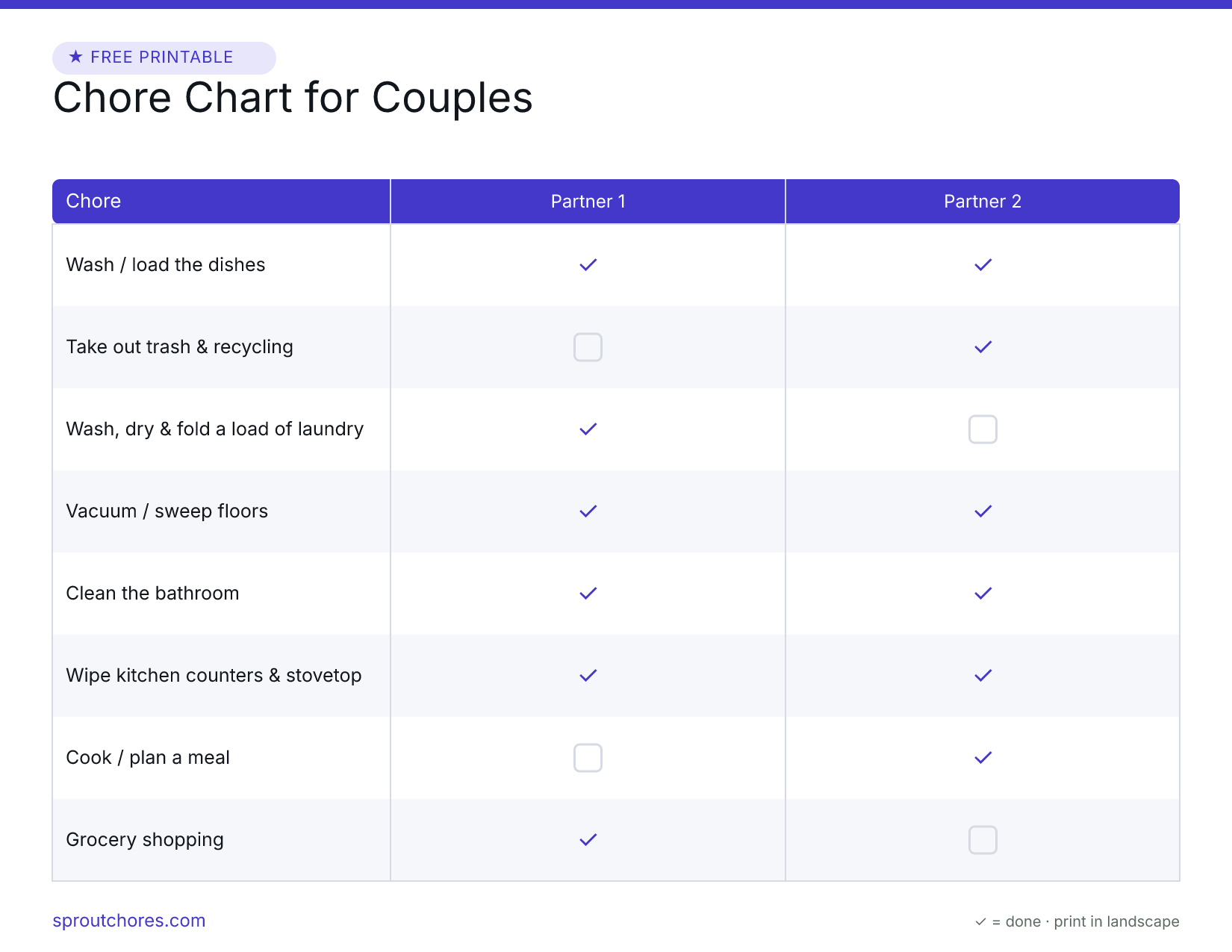
Most fights about housework aren't really about the dishes. They're about one person feeling like they're carrying more than their share — and the other person honestly not seeing it. A chore chart for couples fixes that by putting the whole household on paper, in two columns, where both of you can look at the same thing and agree on what's fair. Use the chart below to build your own: add the jobs that actually run your home, drop the names of both partners, and split it however works for the two of you. I'm Andrew, and while I write here as a dad of four, the principle our family runs on applies just as much to two adults sharing a roof — everybody who lives here helps keep it running, and a chart that everyone can see is what keeps that fair instead of resentful. Edit it, print it, and stick it somewhere you'll both walk past every day.
| Chore | Partner 1 | Partner 2 | Remove |
|---|---|---|---|
| Wash / load the dishes | |||
| Take out trash & recycling | |||
| Wash, dry & fold a load of laundry | |||
| Vacuum / sweep floors | |||
| Clean the bathroom | |||
| Wipe kitchen counters & stovetop | |||
| Cook / plan a meal | |||
| Grocery shopping | |||
| Tidy shared living areas | |||
| Change bed linens |
Tip: choose Landscape in the print dialog for the best fit.
Print in landscape for the best fit. A few reminders from our family to yours: do it together the first few times, keep the chart somewhere everyone can see it, and reward steady effort over a perfect job. — The SproutChores family
Want every age in one file? Get the free Age-by-Age Pack
Six printable charts (ages 4–10) plus reward and routine sheets, in one tidy PDF — free, straight to your inbox.
We email you new printables now and then — unsubscribe anytime. Privacy.
Something went wrong — please try again in a moment.
✓ Almost there — check your inbox!
We just emailed you a confirmation link. Click it to confirm, and your free Age-by-Age Chore Chart Pack lands in your inbox moments later.
Dividing the load so it actually feels fair
A fair split almost never means a 50/50 split, and chasing a perfect even number is how couples end up arguing over who scrubbed the tub more times this month. Fair means each partner owns a set of jobs that adds up to a load you both look at and think, yes, that's reasonable for me.
Start by getting everything visible. Fill the chart with every recurring job your home actually needs — the obvious ones and the invisible ones nobody volunteers for. A lot of the friction in a household comes from work that one person quietly absorbs because it never made it onto any list. Once it's all written down, the conversation changes from a vague sense of imbalance to a concrete thing the two of you can move around.
Then divide along real lines, not assumed ones. Hand jobs to whoever genuinely minds them less, whoever's home when they need doing, or whoever's just better at them — and trade off the ones you both hate. In our family, the way we explain it to the kids is that chores aren't a punishment and they're not a transaction; they're how a household stays standing because the people in it choose to carry it together. That holds for two partners too. The chart isn't there to police each other. It's there so the agreement is written down, the same way you'd write down anything else you both want to honor.
Quieting the mental load and the nagging
There's a particular kind of exhaustion that doesn't show up on any chore list: being the person who has to remember everything. Not the one who takes out the trash, but the one who has to notice the trash is full, decide it's time, and then ask. That noticing-and-tracking job is the mental load, and when it falls on one partner, it wears them down even when the physical work looks evenly split.
A visible chart moves that tracking off one person's shoulders and onto the wall. When the jobs and the owners are written down where both of you can see them, nobody has to be the manager. You don't have to ask whether the bathroom got cleaned — you both already know whose job it was. That single shift quietly ends a huge amount of the nagging, because nagging is usually just the tracking partner trying to outsource a reminder they're tired of holding.
One small habit we lean on at home is giving a heads-up before a job needs doing rather than springing it on someone in the moment. There's a real difference between "can you handle the kitchen right now" and "the kitchen's on the list for after dinner" — the second gives a person room to get ready for it, and it heads off a surprising number of flare-ups. Build that into how you use the chart, and it stops feeling like one of you is bossing the other around.
Making both partners' contributions visible
When work is invisible, it's easy to undercount your partner and overcount yourself — not out of selfishness, just because you feel your own effort and only see theirs. A shared chart fixes the accounting. Both columns are right there, so each of you can actually see what the other is carrying, and the resentment that grows in the dark tends to fade when the load is out in the open.
Visibility also makes ownership real. A job that has your name next to it on the wall is yours in a way a vague "we should both pitch in" never is. That clarity is the whole point — not so you can keep score, but so neither partner is left guessing where their responsibility starts and stops.
I'll be honest about what a chart is and isn't, because it's the same advice I'd give about any system. The best ones survive real life — a sick week, travel, a stretch where everything falls apart. If yours collapses the first time the routine breaks, it wasn't built to be restarted easily, and that's a design problem, not a willpower problem. Keep your chart simple enough that either of you can pick it back up after a rough patch without a big reset. A fair split you can both return to beats an elaborate one that shames you the moment life gets in the way.
Frequently asked questions
- How do you split chores fairly between partners?
- Start by writing down every recurring job your home needs — including the invisible work one of you tends to absorb without noticing. Then assign jobs by who minds them least, who's around when they need doing, and who's genuinely better at them, trading off the ones you both dislike. Fair rarely means a perfect 50/50 count; it means each of you looks at your column and agrees the load is reasonable. The chart above lets you list your real jobs and both names, so the split is something you decided together rather than one person assuming.
- What is the mental load, and can a chore chart help with it?
- The mental load is the unseen job of noticing what needs doing, deciding when, and remembering to follow through — separate from the physical work itself. When it lands on one partner, they burn out even if the chores look evenly divided. A visible chart helps because it moves that tracking from one person's head onto the wall: both of you can see what's due and whose job it is, so nobody has to play household manager and the constant reminding tends to stop.
- Will a chore chart for couples just feel like one partner nagging the other?
- It shouldn't, if you build it as a shared agreement rather than a checklist one of you enforces. The point of putting jobs on the wall is that the reminder lives on the chart, not in one partner's mouth — you both already know whose job it was without anyone having to ask. It also helps to give each other a heads-up before a task rather than springing it in the moment. Used that way, the chart actually removes most of the friction that turns into nagging in the first place.

About the author
More free printables
Get the free Age-by-Age Chore Chart Pack
Six printable charts (ages 4–10) plus reward and routine sheets, in one tidy PDF. We'll also send new printables and the occasional real parenting tip. The charts on this site are always free — no sign-up needed.
We email you new printables now and then — unsubscribe anytime. Privacy.
Something went wrong — please try again in a moment.
✓ Almost there — check your inbox!
We just emailed you a confirmation link. Click it to confirm, and your free Age-by-Age Chore Chart Pack lands in your inbox moments later.