Chore Chart for Multiple Kids: One Chart, a Column Per Child
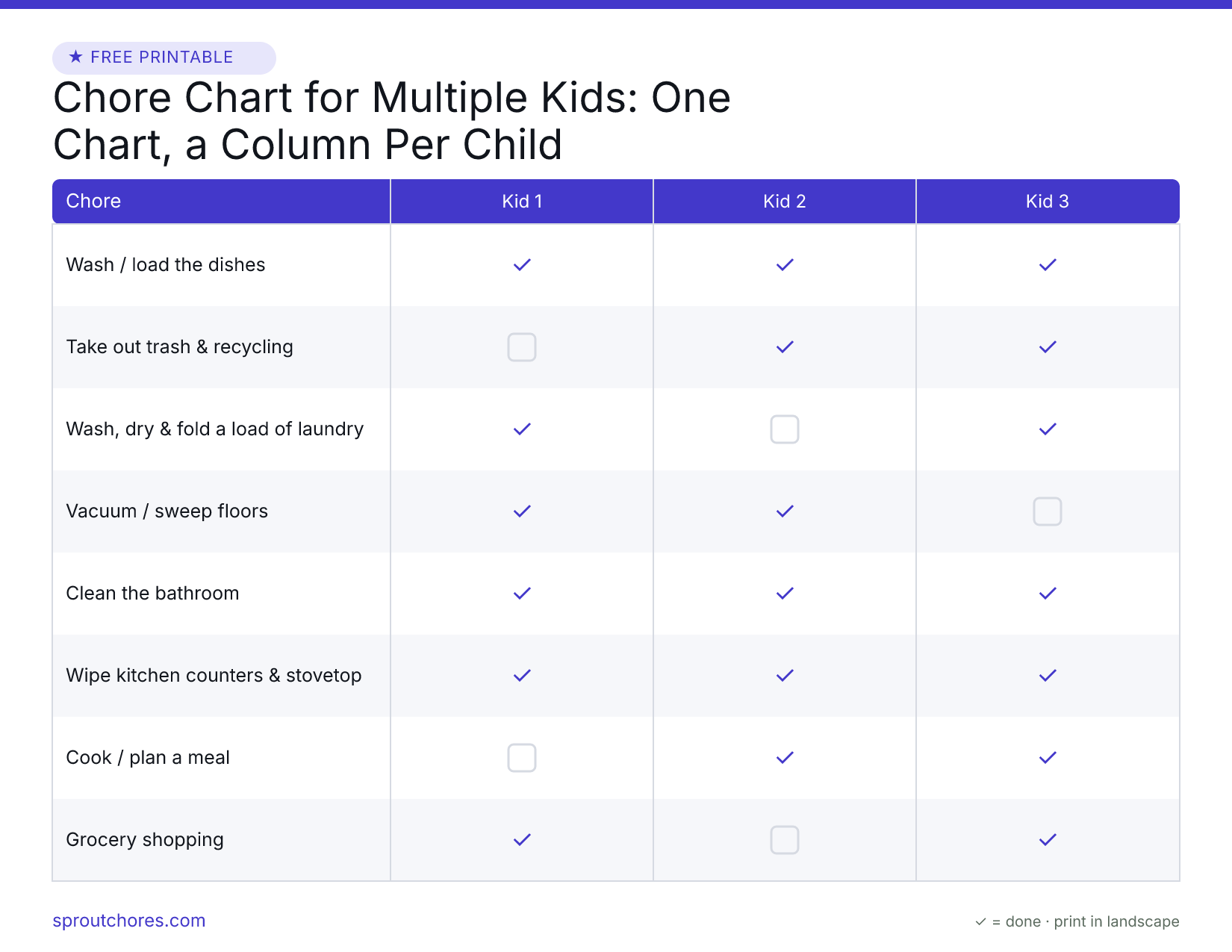
Running separate charts for each kid is how you end up with four pieces of paper, none of them current, and a fridge that looks like a ransom note. The fix is one shared chart with a column for every child and a few jobs that rotate so nobody feels stuck with the bathroom forever. The generator below builds exactly that: tell it how many kids you have, add their names and the jobs your household actually needs, and it lays out a single weekly grid with a column per child. I'm Andrew, and my wife and I are the SproutChores family. Between our own four (currently nine through eighteen) and the foster kids we've cared for, our house has rarely had fewer than a handful of people who needed to know what was theirs to do. A single visible chart was the thing that finally made the workload feel even, and it cut down the daily round of reminders more than any pep talk ever did. One note before you build it: this chart is a tracking tool for us as parents, not a bribe to get the kids moving. What gets them moving is the plain fact that a household runs on everybody pitching in.
| Chore | Kid 1 | Kid 2 | Kid 3 | Remove |
|---|---|---|---|---|
| Wash / load the dishes | ||||
| Take out trash & recycling | ||||
| Wash, dry & fold a load of laundry | ||||
| Vacuum / sweep floors | ||||
| Clean the bathroom | ||||
| Wipe kitchen counters & stovetop | ||||
| Cook / plan a meal | ||||
| Grocery shopping | ||||
| Tidy shared living areas | ||||
| Change bed linens |
Tip: choose Landscape in the print dialog for the best fit.
Print in landscape for the best fit. A few reminders from our family to yours: do it together the first few times, keep the chart somewhere everyone can see it, and reward steady effort over a perfect job. — The SproutChores family
Want every age in one file? Get the free Age-by-Age Pack
Six printable charts (ages 4–10) plus reward and routine sheets, in one tidy PDF — free, straight to your inbox.
We email you new printables now and then — unsubscribe anytime. Privacy.
Something went wrong — please try again in a moment.
✓ Almost there — check your inbox!
We just emailed you a confirmation link. Click it to confirm, and your free Age-by-Age Chore Chart Pack lands in your inbox moments later.
Dividing the Load So It Actually Feels Fair
With more than one kid, the loudest complaint in any house isn't "I don't want to work," it's "why do I always get the worst job?" A shared chart with a column per child answers that out in the open, where everyone can see the same thing at the same time.
Two design choices make the split land as fair instead of arbitrary:
- Rotate the jobs nobody loves. Trash, bathrooms, and dishes are the usual flashpoints, so put those on a rotation that moves down a column each week. When kids can look at the grid and see that today's bad draw becomes someone else's next week, the sense of being singled out mostly evaporates. The generator has a rotation option built in for exactly this.
- Match the rung to the kid, not the calendar. Fair doesn't mean identical. A nine-year-old and a fifteen-year-old shouldn't carry the same load, and pretending they should just teaches the older one that effort gets punished. We assign by what each child can genuinely handle and do well, then raise the bar as they grow into it. The columns can hold different jobs for different kids without anyone feeling shortchanged, because the standard is contribution, not a perfectly equal tally.
One thing we learned the hard way: build the chart to survive a bad week. Vacations, sick days, and the random chaos of a full house will knock any system sideways. The charts that last are the ones you can pick back up on a Monday without a ceremony, so don't engineer something so elaborate that one missed week convinces everyone it failed.
Cutting the Nagging (and the Mental Load on You)
The hidden cost of multiple kids isn't the chores themselves, it's the part where one parent has to remember who owes what and chase each of them about it. That running tally in your head is the mental load, and a chart's real job is to get it out of your head and onto the wall.
Once the grid is posted where everyone passes it, the answer to "what am I supposed to do?" stops being you and starts being the chart. That single shift takes you out of the role of nag and turns the paper into the thing kids check, which is far less likely to start an argument than a parent's voice mid-afternoon.
The other lever that quietly ended a lot of conflict in our house costs nothing: warn them before the work, not at the moment of it. Springing "do the dishes right now" on a kid who's mid-task practically guarantees a fight. Telling them an hour ahead that dishes are coming after lunch gives their brain time to file it away, and they meet it with a lot less resistance. With several kids that small habit compounds, because you're heading off four potential standoffs instead of one.
A couple more things that keep the load off you:
- Let the chart do the reminding. If a job didn't get done, point at the grid rather than relitigating it verbally. The paper is neutral; your tone at 5pm isn't.
- Keep your standards consistent across kids. The fastest way to reintroduce nagging is to enforce the chart for one child and let another slide. When the rules are the same for everyone, kids stop testing whether today is a day you'll actually mean it.
Making Everyone's Contribution Visible
When work happens invisibly, the kid who does a lot and the kid who coasts look identical, and both quietly resent it. A shared chart fixes that by putting every column side by side, so contribution becomes something the whole household can see rather than something only the parents keep score of.
That visibility does a few things at once. The kid pulling their weight gets to feel it acknowledged without you having to make a speech. The one slacking can't hide behind the noise of a busy house. And the family conversation shifts from "why won't you help" to a simple, shared picture of how the week is going. In our home the guiding idea is that everyone who lives here helps run the place, and a chart everyone can read makes that idea concrete instead of a thing parents just say.
We saw the power of a visible, predictable chart most clearly with the foster children we cared for. They'd arrived from homes with almost no reliable structure, and the steady, posted rhythm of who does what gave them something to trust. Knowing what was expected, and that it wouldn't shift on them from one day to the next, helped them settle and begin to feel like part of the family far faster than I'd have guessed. The lesson carried over to our own kids: the chart's deepest value isn't tracking output, it's the predictability that lets kids relax into belonging here.
A word on how we don't use the chart: we keep rewards and screen time out of it. We don't pay our kids by the task or make them earn fun by working, because the moment a chore becomes a transaction, you've taught a child to ask what's in it for them. Allowance exists in our house, but it's tied to whether a kid showed up reliably, did the work properly, and brought a workable attitude over time, not billed out row by row. The chart simply keeps an honest record of who's contributing, so the conversation can stay about being part of the family rather than a negotiation.
Frequently asked questions
- How do I make one chore chart for multiple kids?
- Use a single weekly grid with a column for each child and a row for each job, rather than printing a separate chart per kid. The generator on this page does this automatically: enter how many children you have, add their names and your household's actual chores, and it builds one shared chart. Put the rotating jobs nobody enjoys on a rotation so the assignments shift each week, and post the whole thing somewhere everyone walks past.
- Should all my kids have the same chores?
- No, and trying to force it usually backfires. Fair doesn't mean identical. We assign jobs by what each child can actually handle well, so a nine-year-old and a teenager carry different loads. What stays the same across every kid is the expectation that they contribute. The chart can hold different jobs in each child's column while keeping that standard consistent, which feels fairer to kids than an artificially equal split that ignores age and ability.
- How do I stop fights over who got the worst chore?
- Rotate the unpopular jobs and make the rotation visible. When trash and bathroom duty move down a column each week, a kid can see on the chart that today's bad draw becomes someone else's next week, which takes most of the sting out of it. It also helps to give advance notice before work starts and to enforce the chart evenly for every child, so no one feels singled out. The paper, not your voice, becomes the thing they argue with.

About the author
More free printables
Get the free Age-by-Age Chore Chart Pack
Six printable charts (ages 4–10) plus reward and routine sheets, in one tidy PDF. We'll also send new printables and the occasional real parenting tip. The charts on this site are always free — no sign-up needed.
We email you new printables now and then — unsubscribe anytime. Privacy.
Something went wrong — please try again in a moment.
✓ Almost there — check your inbox!
We just emailed you a confirmation link. Click it to confirm, and your free Age-by-Age Chore Chart Pack lands in your inbox moments later.