Chore Chart for Preschoolers (Ages 3–5): Small Real Jobs, All in Pictures
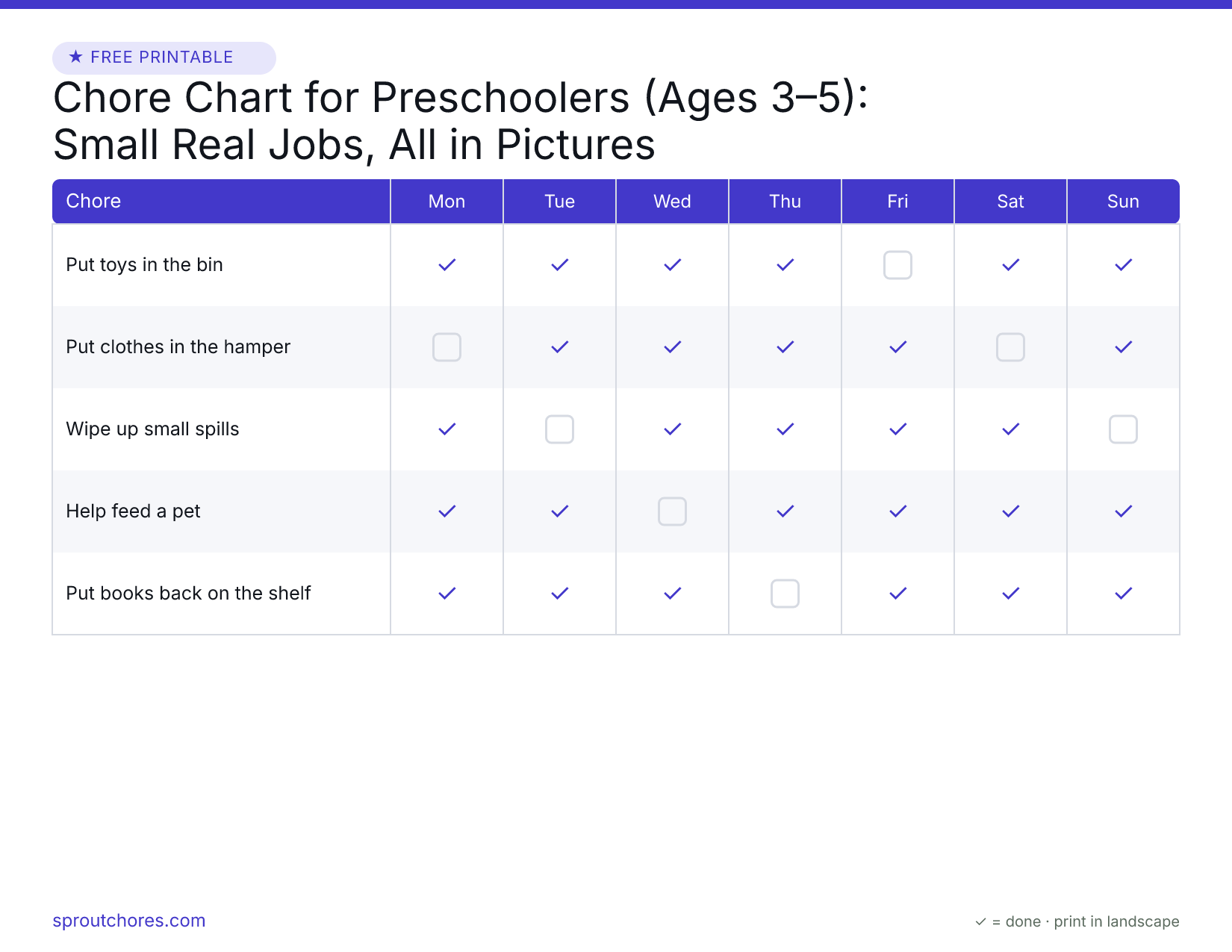
Preschool is the stretch where a child stops being a toddler who mostly needs looking after and starts becoming someone who can genuinely help. Between three and five, that shift happens in small, uneven steps, and a chore chart is a nice way to make it visible. The one above runs on pictures instead of words, because most preschoolers are somewhere between not reading at all and just sounding out letters — an icon they can recognize on sight beats a sentence they'd have to decode. I'm Andrew. My wife and I are raising four kids, now nine through eighteen, and over the years we've also fostered three little ones who landed with us right in this age range. What we took away from watching all seven of them is that a preschool chart isn't really about a spotless house. It's about handing a young child a couple of jobs that are actually theirs and letting them feel what it's like to be counted on. You can print the chart as it stands or swap the jobs to fit your own three-, four-, or five-year-old in a minute. Below is what's realistic across these years, how to keep the chart going when life gets messy, and where we land on rewards and money.
| Chore | Mon | Tue | Wed | Thu | Fri | Sat | Sun | Remove |
|---|---|---|---|---|---|---|---|---|
| Put toys in the bin | ||||||||
| Put clothes in the hamper | ||||||||
| Wipe up small spills | ||||||||
| Help feed a pet | ||||||||
| Put books back on the shelf |
Tip: choose Landscape in the print dialog for the best fit.
Print in landscape for the best fit. A few reminders from our family to yours: do it together the first few times, keep the chart somewhere everyone can see it, and reward steady effort over a perfect job. — The SproutChores family
Want every age in one file? Get the free Age-by-Age Pack
Six printable charts (ages 4–10) plus reward and routine sheets, in one tidy PDF — free, straight to your inbox.
We email you new printables now and then — unsubscribe anytime. Privacy.
Something went wrong — please try again in a moment.
✓ Almost there — check your inbox!
We just emailed you a confirmation link. Click it to confirm, and your free Age-by-Age Chore Chart Pack lands in your inbox moments later.
Age-appropriate chores for Preschoolers
Every chore below is pre-loaded in the generator above and is something a child in this age range can realistically manage with a little initial guidance:
- Put toys in the bin
- Put clothes in the hamper
- Wipe up small spills
- Help feed a pet
- Put books back on the shelf
What a Preschooler Can Really Handle From 3 to 5
The fastest way to get a preschool chart wrong is to treat three and five as the same age. They're worlds apart. A brand-new three-year-old is still mostly working on themselves — getting dressed, having a go at their teeth, herding their own toys back into a bin — and a lot of that gets learned by simply copying whatever grown-up is nearby. But somewhere around four and five, a child can take on jobs that genuinely serve the household, not just themselves. That's the leap this chart is built to capture. The small, real jobs we've leaned on at this stage are the ones a preschooler can see the point of: laying out forks and napkins before dinner, tipping food into the dog's bowl, parking shoes and coats where they belong by the door, carrying their own plate to the sink, or pairing up socks from a laundry pile.
Here's the honest part. None of it will be done the way you'd do it. Forks will land crooked, socks will get mismatched, and you'll quietly redo half of it once they're in bed. That's fine. A clean kitchen was never the assignment at this age. My own view, shaped by how I was raised and a lot of trial and error, is that chores aren't a way to squeeze work out of a child — they're rehearsal for being a capable adult. Look at it that way and a wobbly table setting is a four-year-old succeeding, because the thing you're actually growing is competence and the quiet confidence that rides along with it. Expect a little more each year as they get steadier, and let the jobs grow with the kid rather than freezing the chart at whatever they could manage at three.
How to Keep a Preschool Chart Going When Life Gets Messy
The charts that survive aren't the perfect ones — they're the ones you can pick back up after a bad week. Most parents build a beautiful system, then a holiday or a stomach bug or one chaotic Tuesday knocks it over, and they decide the whole thing failed. It didn't; it just wasn't built to bend. So keep yours simple enough that after three days off the rails you can restart it without a production. Two habits did the heavy lifting for us here. First, give the chart a fixed home in the day instead of firing off demands at random — in our house chores come after the morning's schoolwork, so there's a rhythm a young child can lean on rather than a surprise. Second, warn them before a transition. 'Right now' is a fight waiting to happen with a preschooler; 'in a few minutes we're going to set the table' gives a small brain time to change gears, and that one move headed off more meltdowns than any prize ever did.
The other thing I'd tell any parent is that at the youngest end, the printed chart often does more for the adults than for the child. We saw this most clearly with the three-year-old twins we fostered. They came to us from a home with almost no structure, and a chart was never going to teach them a task — but a predictable pattern they could feel coming did enormous work. Once the same sequence played out every day, they stopped bracing against every change and began to trust it, and you could watch it steady their whole mood. The printable's job in a house like ours was to keep every grown-up running that pattern the same way, so that when one of us had to step out, the other could take over mid-stream without the kids losing their footing. Even for a typical preschooler, that's the real value: a routine steady enough that the child can slowly learn to run it without you narrating every step. And when a week goes sideways, don't grade yourself on perfection — just get back to steady.
Rewards, Allowance, and Why We Keep Them Off the Chart
This is where we head a different direction from most chore-chart advice, so I'll be plain about it. For us, the chart is a way for the parents to keep tabs — a quick glance that tells us how each kid is actually doing and whether anyone needs a nudge. It was never meant to be a machine that bribes a preschooler into helping. The pull to do the work should grow out of something steadier: this is our family, and everyone in it has a part to play. Teach a four-year-old that helping only counts when a prize is dangling, and you've signed on for a long, tiring negotiation that runs all the way through the teen years.
That said, we're not sticker purists. The one reward we did use with the little ones was a cheap treasure chest from the dollar store — when a child had worked hard and kept a good attitude about it, they'd pick something out once or twice a week. Because the items cost next to nothing, we never had to be stingy, and, crucially, it was tied to real effort rather than to whether every box on the chart got filled in. Actual allowance doesn't enter the picture until kids are pitching into the family in earnest, around five or six, and even then it's a small weekly amount that rides on how well and how reliably they work and the attitude behind it — never a set price per job. We also keep screen time entirely out of the deal. Our kids have never had to earn their shows by doing chores; losing screen time was only ever a response to genuine misbehavior. Keep the money, the treats, and the chart in separate lanes, and the chart stays honest about what it's really for.
Frequently asked questions
- What chores can a preschooler do?
- It depends a lot on where they are in the three-to-five range. A young three-year-old is mostly working on themselves — dressing, brushing teeth, cleaning up their own toys — usually by copying a parent. By four and five, most preschoolers can take on a few small jobs that genuinely help the household: setting out forks and napkins, feeding a pet, putting shoes and coats away, carrying a plate to the sink, or matching socks. Don't expect any of it done to an adult standard. You're building competence and the habit of contributing, not getting your house cleaned.
- How is a preschooler chore chart different from a toddler chore chart?
- A toddler chart is almost entirely self-care — getting dressed, teeth, tidying their own mess — because a two-year-old can't really do a job that serves anyone but themselves. A preschool chart, especially at four and five, starts layering a small set of real contributions to the household on top of that self-care. Both lean on pictures instead of words, since most kids this age can't read yet, but the preschool version is where a child begins to help the family, not just look after themselves.
- Should I pay or reward a preschooler for chores?
- We'd hold off on paying per chore at any age, and there's no allowance in our house until kids are contributing in a real way around five or six. Even then it's a small weekly amount tied to how well and how consistently they work, not a price list per task. The one reward we used with little ones was an occasional pick from a dollar-store treasure chest for good effort and a good attitude — kept deliberately separate from the chart itself. We also never make kids earn screen time with chores. The motivation you want comes from the expectation that everyone in the family helps, not from a payout.
- Do picture charts really work for preschoolers who can't read yet?
- Yes — that's exactly why this one leads with icons. A preschooler who can't read a word can still recognize a picture of a job and work through a short row of them in order. Just keep your expectations honest: at the youngest end, the chart often helps the grown-ups stay consistent as much as it guides the child. What makes it stick is a steady daily rhythm the child can feel coming, plus a heads-up before each transition, so over time the chart becomes something they can run with less and less help from you.

About the author
More free printables
Get the free Age-by-Age Chore Chart Pack
Six printable charts (ages 4–10) plus reward and routine sheets, in one tidy PDF. We'll also send new printables and the occasional real parenting tip. The charts on this site are always free — no sign-up needed.
We email you new printables now and then — unsubscribe anytime. Privacy.
Something went wrong — please try again in a moment.
✓ Almost there — check your inbox!
We just emailed you a confirmation link. Click it to confirm, and your free Age-by-Age Chore Chart Pack lands in your inbox moments later.