Chore Chart for a Special Needs Child (Free Printable Visual Chart)
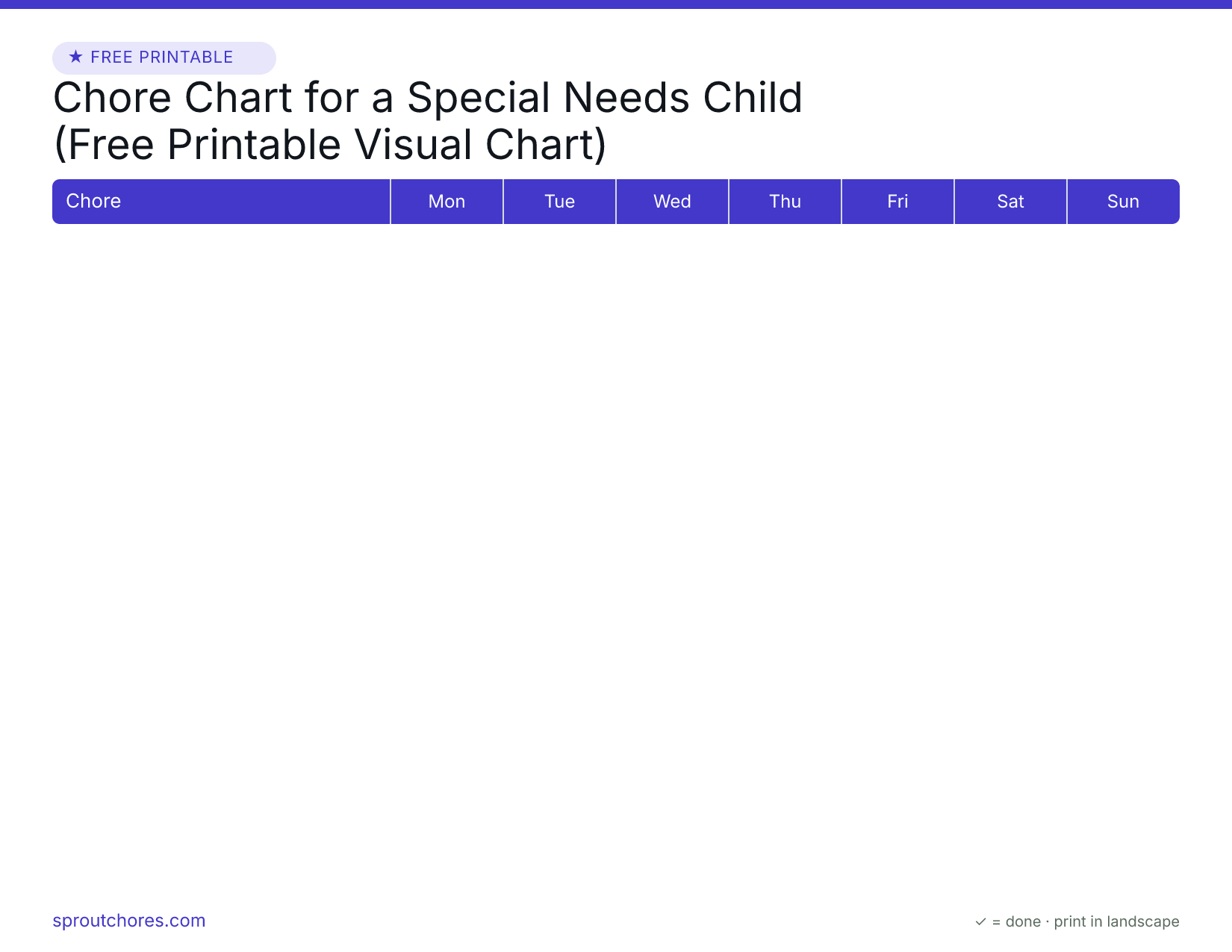
If you searched for a chore chart for a special needs child, I'd bet you've already tried a few of the tidy printable grids floating around and watched them fall flat. I'm Andrew, writing for the SproutChores family. My wife and I are raising four kids between nine and eighteen, and over the years we've fostered several young children, including boy-girl twins who arrived at three years old, both on the spectrum — one diagnosed, the other suspected. A couple of us in this house are wired in ways nobody named clinically until we recognized the patterns in ourselves as grown men. So this isn't advice I read in a book; it's what we've had to work out at our own kitchen table. Here's the honest catch, though: \"special needs\" covers an enormous range, and I can't know your particular child from a web page. What I can hand you is the chart maker above — it opens completely blank, so you write in your own short list of jobs and attach a picture to each, with no account and no email. Around it I'll share the part most printables skip: how to use a chart so it fits a child the standard version was never built for. Everything here is our lived experience, not a diagnosis and not medical advice — anything clinical belongs with a professional who actually knows your child. And if your child's needs point in a clear direction, I'll steer you toward the right chart as we go.
| Chore | Mon | Tue | Wed | Thu | Fri | Sat | Sun | Remove |
|---|
Tip: choose Landscape in the print dialog for the best fit.
Print in landscape for the best fit. A few reminders from our family to yours: do it together the first few times, keep the chart somewhere everyone can see it, and reward steady effort over a perfect job. — The SproutChores family
Want every age in one file? Get the free Age-by-Age Pack
Six printable charts (ages 4–10) plus reward and routine sheets, in one tidy PDF — free, straight to your inbox.
We email you new printables now and then — unsubscribe anytime. Privacy.
Something went wrong — please try again in a moment.
✓ Almost there — check your inbox!
We just emailed you a confirmation link. Click it to confirm, and your free Age-by-Age Chore Chart Pack lands in your inbox moments later.
"Special needs" is a wide umbrella — start with your child, then pick the right chart
The phrase covers so much ground that no single sheet could ever be the right answer for every family. A child with attention-wired tendencies, a child on the spectrum, a child with a sensory difference or a physical challenge, a child with a learning difference — the day-to-day looks completely different in each case. Under our own roof we've watched kids wired in opposite directions respond to the exact same chart in opposite ways, so I've stopped believing there's one template that fits every special needs child. The one thing that holds true no matter the child is simple: build the chart around the kid you actually have, not around a label or somebody else's list. The principle stays put; how you carry it out shifts from child to child.
That's also why this page is a doorway more than a destination. If your child leans toward the spectrum, we've written a visual chore chart for an autistic child that goes deeper on routine and communication. If attention is the sticking point — a mind that runs fast and won't settle on a list — the chart we built for kids with ADHD tendencies will fit better. And if the real struggle is holding the order of the day in their head, a picture-based visual schedule for kids does more of that specific work. Use the blank generator above as your starting point, then follow whichever door matches your child. I'll be honest where our firsthand experience runs out and point you to reputable sources rather than pretend we've lived every version of this.
Keep it visual and keep it short: a low-demand chart your child can finish
Whatever your child's specific needs, two moves help most: make the chart visual, and make it small. This is the heart of why a visual chore chart for special needs kids tends to stick when a plain grid doesn't. A crowded grid reads as a pile of demands, and a lot of kids — especially those who already find daily tasks effortful — will simply look away from it. A short chart with a couple of jobs a child can genuinely see through beats a full page that turns into wallpaper by Thursday. Lean on pictures rather than words, and hang each one right where the job actually happens instead of parking the whole chart by the front door. When the reminder sits at the spot the action takes place, it cues the next move on its own and saves you from repeating yourself all day.
Two more things worth building in. First, shrink big jobs into small, finishable pieces. "Clean your room" is a wall a kid bounces off; "books on the shelf," then "clothes in the basket" is a set of steps someone can actually complete and feel good about. Second, respect transitions, because for a lot of these kids the hard part isn't the task itself — it's the jolt of stopping one thing to start another. A chart that shows what's coming next, paired with a quiet heads-up before it's time, gives a child a running start at that shift and heads off more standoffs than any prize ever will. And if your first version flops, don't read it as failure. That's just the chart telling you to adjust — and because it's fully editable, you can trim the list, swap the images, or move where it lives and print a fresh copy in minutes.
The chart is a tracking tool for you — and safety comes before compliance
Here's the stance that runs through everything we make, and it cuts against most chore-chart advice: the chart isn't there to motivate your child. It's a tracking tool for you, a way to glance over, read how things are going, and decide when to lean in. The motivation has to come from something sturdier than a sheet of paper. In our house that's the plain, unargued expectation that being part of this family means sharing the load — nobody earns their keep task by task. We do keep a small weekly allowance going for the younger kids, but it's tied to the overall picture over time — how steady they've been, how much care they put in, how they carried themselves — never priced out chore by chore. Rewards and screen time sit in their own separate lane, so chores never curdle into a bargain your kid learns to haggle over.
The other half of this is regulation, and it matters even more when a child carries extra challenges. You cannot reason with a child who's flooded and overwhelmed; the body has already made its decision, and a worked-up kid will often pin that bad feeling on whoever's closest, usually the parent trying to help. So the order is calm first, conversation second — a chart only does anything once a child is settled enough to take it in. We saw this most clearly while fostering. For children who'd never had a household they could count on, a steady, predictable rhythm did more good than any reward we could have dangled; a lot of what first looked like defiance turned out to be a child simply not knowing what came next. Structure, it turns out, is mostly about safety, not obedience. And one gentle caution: try not to rescue too fast. If stepping in and finishing the job becomes automatic every time, that quietly becomes the lesson — so where it's safe, let an ordinary, real-world-shaped consequence do some of the teaching instead.
Give it time, and measure from your child's own starting line
Change here is slow, and knowing that in advance will save you a lot of discouragement. With our fostered twins it took somewhere between a couple of weeks and a full month before a daily pattern even seemed to register, and longer still before it truly settled. It can feel like nothing is working right up until the quiet moment it starts to. Run the same sequence every day — busy day or lazy one — and build a little slack into the schedule so a rough morning has somewhere to go instead of slamming into the clock. One of our twins found even getting dressed genuinely hard because of a physical condition, and that taught me not to grade a child against a task that was never fair to them in the first place.
Expect real life to knock the system over, too — a holiday, a sick week, a stretch of chaos. That isn't the chart failing; it just means the plan met the real world. The setups that last are the ones you can pick back up easily after a bad week, so aim for something restartable rather than something perfect. And when you're judging how it's going, measure the distance your child has traveled from where they personally began, not the gap between them and some other kid or some ideal on a printable. A child who once needed a prompt for every step and now handles one small job start to finish has come a long way, even if a neighbor's kid does more. That's the win worth watching for. As always, this is our family's experience and not medical advice — if questions come up about your child's development or care, a professional who knows them is the right person to ask.
Frequently asked questions
- Do chore charts work for children with special needs?
- It depends a lot on the child and the stage, so I'll be straight with you. For some kids a chart on the wall genuinely helps them see and sequence their day; for others — especially younger ones who can't yet hold a list of steps in their head — the chart mostly works as a tracking tool for you while you prompt them through tasks one at a time. Neither is a failure; they're just different starting points. What helps across the board is keeping the chart short, making it visual, and treating it as something you adjust to your child rather than a fixed prescription. This is our lived family experience, not medical advice, and every child is different — for anything clinical, lean on a professional who knows yours.
- How do I make a chore chart for a special needs child?
- Start with the blank, editable generator above and resist the urge to fill it. Pick just a few jobs your child can realistically finish, put a clear picture on each one rather than relying on words, and post each reminder right where the job happens instead of in one spot by the door. Break any big task into small, completable steps, keep the order the same every day, and give a quiet heads-up before it's time to switch tasks. If a version isn't landing, shorten it, change the pictures, or move it, and print a fresh copy — reworking it is expected, not a sign you got it wrong.
- My child is autistic or has attention-wired tendencies — is this the right chart, or is there a better one?
- This page is a broad starting point on purpose, and there's a good chance a more specific chart will serve you better. If your child is on the spectrum, our visual chore chart for an autistic child goes deeper on routine, communication, and regulation. If attention is the real hurdle, the chart we built for kids with ADHD tendencies is shaped around the way those minds actually work. And if the core struggle is keeping the order of the day straight, a picture-based visual schedule handles that specific job. The blank generator here works for any of them — I'd just pair it with whichever of those guides matches your child most closely.

About the author
More free printables
Get the free Age-by-Age Chore Chart Pack
Six printable charts (ages 4–10) plus reward and routine sheets, in one tidy PDF. We'll also send new printables and the occasional real parenting tip. The charts on this site are always free — no sign-up needed.
We email you new printables now and then — unsubscribe anytime. Privacy.
Something went wrong — please try again in a moment.
✓ Almost there — check your inbox!
We just emailed you a confirmation link. Click it to confirm, and your free Age-by-Age Chore Chart Pack lands in your inbox moments later.