Family Chore Chart: One Printable for the Whole Household
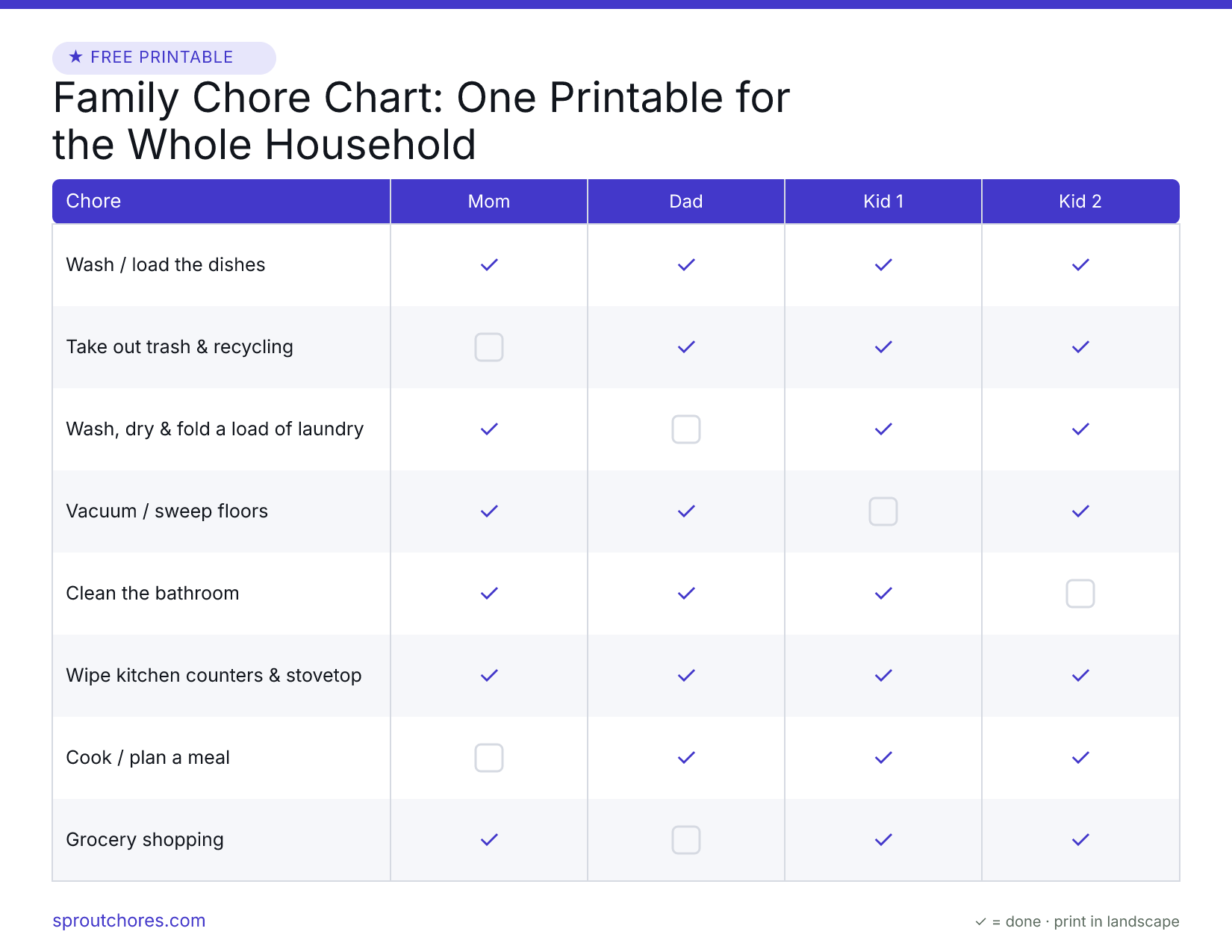
Most chore charts only cover the kids, which quietly sends the message that running the house is somebody else's job. This one is built differently. The generator below puts every member of your household — the nine-year-old, the teenager, and yes, the grown-ups — onto a single grid you can fill in, print, and stick on the fridge. I'm Andrew, and my wife and I are the SproutChores family: four kids between nine and eighteen, plus the foster children we've cared for over the years. With a house that full, we learned fast that a chore chart isn't really a behavior tool for the kids — it's a way for the adults to see, at a glance, who's carrying what so the load lands fairly. The whole thing rests on one idea we say out loud all the time: this is a shared home, and everyone in it pitches in. Add your people, assign the jobs, and print a chart that reflects how your household actually runs.
| Chore | Mom | Dad | Kid 1 | Kid 2 | Remove |
|---|---|---|---|---|---|
| Wash / load the dishes | |||||
| Take out trash & recycling | |||||
| Wash, dry & fold a load of laundry | |||||
| Vacuum / sweep floors | |||||
| Clean the bathroom | |||||
| Wipe kitchen counters & stovetop | |||||
| Cook / plan a meal | |||||
| Grocery shopping | |||||
| Tidy shared living areas | |||||
| Change bed linens |
Tip: choose Landscape in the print dialog for the best fit.
Print in landscape for the best fit. A few reminders from our family to yours: do it together the first few times, keep the chart somewhere everyone can see it, and reward steady effort over a perfect job. — The SproutChores family
Want every age in one file? Get the free Age-by-Age Pack
Six printable charts (ages 4–10) plus reward and routine sheets, in one tidy PDF — free, straight to your inbox.
We email you new printables now and then — unsubscribe anytime. Privacy.
Something went wrong — please try again in a moment.
✓ Almost there — check your inbox!
We just emailed you a confirmation link. Click it to confirm, and your free Age-by-Age Chore Chart Pack lands in your inbox moments later.
Dividing the Household Load So It Actually Feels Fair
Fairness in a busy house almost never means everyone does an identical amount. A four-year-old wiping down a sink and a parent handling the grocery run are not the same job, and pretending they are just frustrates everyone. What fairness really means is that nobody can look at the chart and honestly say their share is invisible or that they got skipped.
That's the quiet superpower of putting the adults on the chart too. When the grown-ups' responsibilities sit right there in the same grid as the kids' — same paper, same fridge — it stops feeling like a list the bosses hand down and starts feeling like a map of how the household keeps itself running. In our home that framing matters more than the exact tasks. The point we keep coming back to is that living here comes with belonging, and belonging comes with pitching in.
A few things we'd suggest as you fill in the grid:
- Match the weight of a job to what each person can genuinely handle, then let it grow over time. A young kid's slot might be one small daily thing; an older teen can own a whole zone. The grid stretches to fit any spread of ages.
- Spread the jobs nobody loves rather than parking them on one person forever. Rotating the truly dreaded tasks keeps quiet resentment from building.
- Leave the adult rows honestly full. If the chart shows the parents doing real work alongside the kids, the kids stop seeing chores as a punishment and start seeing them as simply what people in a household do.
Don't aim for a perfectly equal split. Aim for a chart where every person can point to their part and feel like they're genuinely in it together.
Cutting the Mental Load (and the Nagging) With a Visible Chart
In a lot of homes, one person ends up as the household's air traffic controller — the one tracking who needs to do what, when, and whether it actually got done. That invisible job is exhausting, and it's usually the real reason chore systems feel like more work than they save. A chart on the wall exists to take that weight off a single set of shoulders and hand it to the grid instead.
The shift is simple: instead of you remembering and reminding, the chart remembers. When a kid asks what they're supposed to be doing, the answer is 'go check the fridge,' not another lecture from you. We saw this clearly with our youngest kids — a job written and posted where they could see it carried far more weight than the same instruction said out loud, because the wall wasn't nagging anyone, it was just telling the truth.
One lever that killed more conflict in our house than anything else: advance warning. Springing a chore on someone in the middle of what they're doing reliably gets you pushback. Letting them know it's coming in a little while — a heads-up that the kitchen needs doing before dinner — gives everyone time to mentally shift gears. The chart does this work for you, because the day's jobs are already visible long before they're due.
A word on keeping it sustainable: don't build a system so elaborate that one chaotic week takes it down for good. The honest truth is that vacations, sick days, and busy stretches will blow up your routine, and the chart you want is the one that's easy to dust off and restart on Monday rather than the perfect one that quietly dies the first time real life interferes.
Making Everyone's Contribution Visible — and Why That Beats Bribery
When contributions are out in the open, something shifts in how a household relates to its own work. A kid who can see that Mom and Dad have a full set of rows too is far less likely to argue that chores are unfair. And there's a real pride in finishing your part and seeing the whole chart filled in — a sense that the house ran today partly because of you.
That's exactly why we treat the chart as a tracking tool for the parents rather than a motivation machine for the kids. Its honest job is to let the adults see how everyone's doing and decide where to step in, not to bribe anyone into cooperating. When motivation dips, our answer isn't a shinier reward — it's quietly reinforcing the expectation that this is a home where everyone helps.
So we deliberately keep a few wires from crossing:
- Rewards and screen time stay in their own lane, separate from the chart. We don't make our kids earn fun by working, and we don't pay out cash chore by chore.
- Allowance exists in our house, but it's tied to how reliably and how well a kid shows up over time, plus the attitude they bring — not billed task by task like a vending machine.
- The chart's value is the visibility itself. We learned this most sharply as foster parents: for kids who'd never had a household they could predict, a steady, visible structure mattered more than anything riding on top of it. Knowing what was expected, and trusting that the rules wouldn't shift overnight, was what helped them settle and begin to relax into the family.
Ultimately, a chore is practice for being a capable adult, and a contribution everyone can see is how a household teaches that lesson without ever turning it into a transaction.
Frequently asked questions
- Should parents be on the family chore chart too?
- Yes, and in our experience it's the single thing that makes a whole-household chart work. When the adults' responsibilities sit on the same grid as the kids', chores stop reading as a punishment handed down from above and start looking like what everyone in the house simply does. It also makes fairness obvious: a kid is far less likely to argue their share is unfair when they can see the grown-ups carrying a full load right beside them. The generator above gives every person their own column so the adult rows are right there alongside the kids'.
- How do I divide chores fairly across a whole family?
- Fair rarely means identical. A four-year-old and a teenager can't do the same work, so we match each job to what a person can genuinely handle and let their share grow as they grow. The bigger moves that actually keep it feeling fair: rotate the tasks nobody enjoys instead of parking them on one person, keep the adult rows honestly full, and make sure every member can point to their own contribution. Aim for a chart where nobody feels invisible or skipped, not for a perfectly equal split that real life will never honor anyway.
- How do I get my family to stick to the chore chart?
- Two things helped us most. First, give advance notice instead of springing chores on people mid-task — a heads-up that the kitchen needs doing before dinner heads off most of the resistance, and a posted chart does that warning for you. Second, build a chart that's easy to restart. Vacations and busy weeks will derail any routine; the version that survives is the one you can dust off and pick back up on Monday, not the elaborate one that collapses the first time life gets messy. We also keep the chart as a tracking tool rather than leaning on bribes, so the expectation that everyone pitches in is what carries it.

About the author
More free printables
Get the free Age-by-Age Chore Chart Pack
Six printable charts (ages 4–10) plus reward and routine sheets, in one tidy PDF. We'll also send new printables and the occasional real parenting tip. The charts on this site are always free — no sign-up needed.
We email you new printables now and then — unsubscribe anytime. Privacy.
Something went wrong — please try again in a moment.
✓ Almost there — check your inbox!
We just emailed you a confirmation link. Click it to confirm, and your free Age-by-Age Chore Chart Pack lands in your inbox moments later.