Homework Routine Chart (Free Printable Study Schedule for Kids)
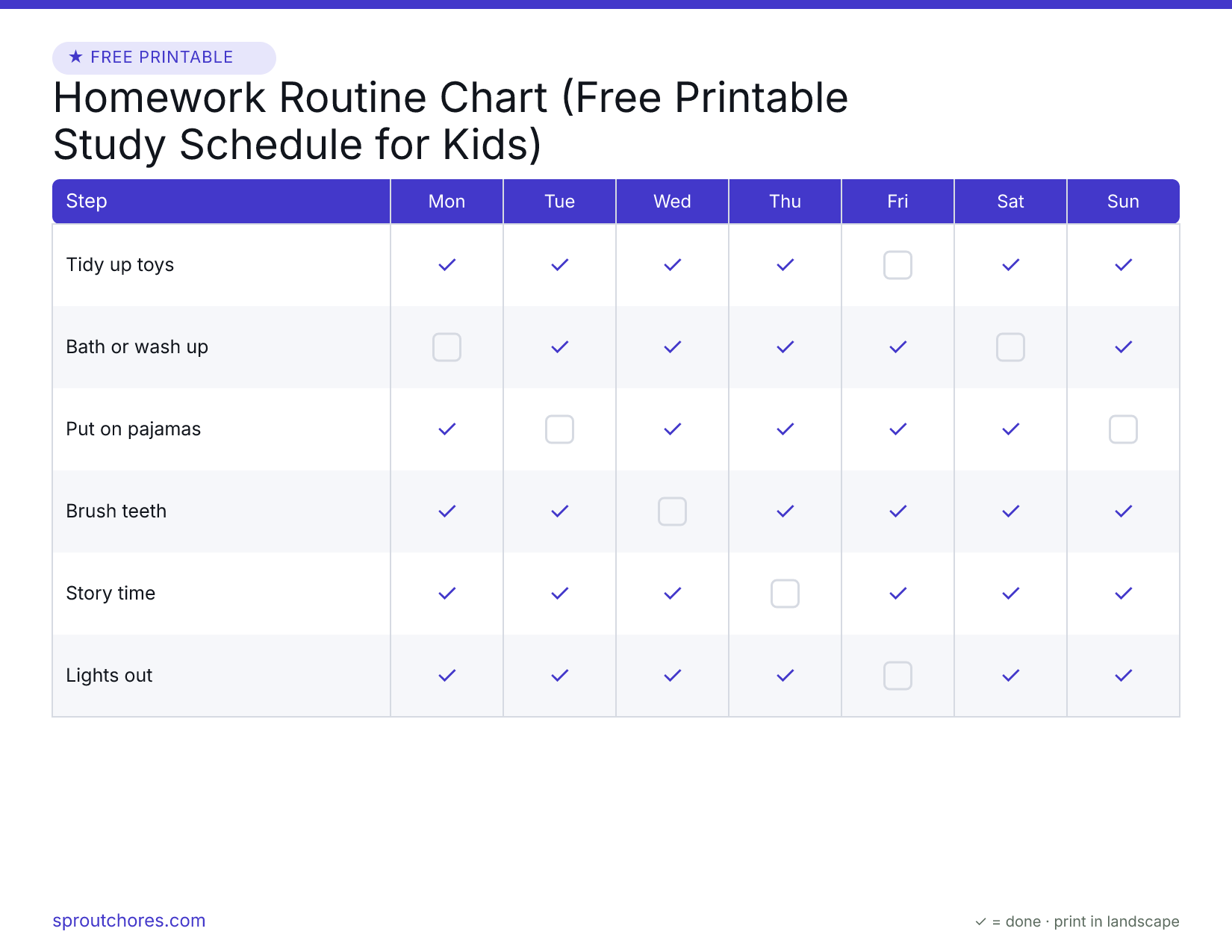
The stretch between "how was school?" and a finished worksheet is where a lot of afternoons go sideways — the stalling, the sudden urgent need for a snack, the "I don't even have homework" that turns out to be untrue around 8pm. The chart on this page is built to give that window a shape you can count on. In the maker above you set a short study sequence — a spot to settle, one subject at a time, a check that it's actually done, then it's put away — drop a simple picture beside each step for a younger kid who isn't reading yet, lay it across the week, and print it for free. I'm Andrew, dad to four kids from 9 to 18; my wife (a former teacher who now runs our homeschool) and I have also cared for younger children through foster care over the years. The single most useful thing we've learned about homework isn't a productivity trick — it's that when the work lands at the same time, in the same place, in the same order every day, the negotiation mostly disappears. A predictable routine does the arguing so you don't have to.
| Step | Mon | Tue | Wed | Thu | Fri | Sat | Sun | Remove |
|---|---|---|---|---|---|---|---|---|
| Tidy up toys | ||||||||
| Bath or wash up | ||||||||
| Put on pajamas | ||||||||
| Brush teeth | ||||||||
| Story time | ||||||||
| Lights out |
Tip: choose Landscape in the print dialog for the best fit.
Print in landscape for the best fit. A few reminders from our family to yours: do it together the first few times, keep the chart somewhere everyone can see it, and reward steady effort over a perfect job. — The SproutChores family
Want every age in one file? Get the free Age-by-Age Pack
Six printable charts (ages 4–10) plus reward and routine sheets, in one tidy PDF — free, straight to your inbox.
We email you new printables now and then — unsubscribe anytime. Privacy.
Something went wrong — please try again in a moment.
✓ Almost there — check your inbox!
We just emailed you a confirmation link. Click it to confirm, and your free Age-by-Age Chore Chart Pack lands in your inbox moments later.
Why a predictable homework routine ends the daily battle
Most homework fights aren't really about the homework. A kid comes home emptied out from holding it together all day, and the last thing a depleted brain wants is to start the least interesting task in front of it. When the afternoon has no fixed shape, every day becomes a fresh negotiation — when, where, how much, and whether it's happening at all — and that negotiation is exhausting for everyone. A steady sequence removes the argument at its root: the question stops being "are we doing homework?" and becomes simply "it's the next thing on the chart."
We saw how far steadiness carries during our hardest and most rewarding season, welcoming young children through foster care. Some arrived with almost no rhythm to their days, and what settled them wasn't a clever incentive — it was a dependable pattern they could finally lean on and anticipate. Once the day stopped being a guessing game, a striking amount of what had looked like resistance simply eased. That reframed how we read every kid in our house, homework included: a child melting down at the study table is usually one who's frayed and unsure what's coming, not one who's being difficult. And that leads to the one rule we won't skip — a wound-up kid can't focus, and no chart fixes that. A snack and a few unhurried minutes to land come before the first problem gets attempted, because you can't reason a dysregulated child into concentrating. Let them settle first; the work goes far easier after.
One of our daughters taught us a concrete, homework-specific version of this. Screens in the late afternoon quietly wrecked her focus and mood for the rest of the day. Once we drew a clean line and moved the screens earlier, her ability to sit down and actually work improved almost on its own. So if your study routine keeps collapsing no matter how good the chart looks, I'd examine when the screens are coming on before I'd blame the chart.
How to set up the chart so the work actually gets started
Build your steps in the maker above and keep them few — the whole point is a runway into the work, not a second school day taped to the wall. A sequence that holds up in most homes moves from "get to your spot and clear it," to "open just the first thing," to working one subject at a time, to a quick check that it's genuinely finished, to packing it back in the bag for tomorrow. Then think hard about where the chart lives, because a page a kid walks straight past does nothing.
With our youngest, a printed sheet was only the beginning. We'd cut the steps into separate little picture cards and set each one right at the spot where that part of the routine happens — a card where they sit to work, a card by the bag it all goes back into. The cue waits for the child where the action is instead of on a distant wall, so they glance over, see what's next, and move along without anyone narrating it. An older kid who reads well usually just needs the printed weekly version to pace themselves down the column.
Two things matter more than the chart's design. First, give a heads-up before the shift — cutting a kid off mid-game with "homework, now" almost guarantees a fight, so we hand them a runway instead, a warning a while out and another a few minutes ahead, so starting never lands as an ambush. This one free lever has settled more standoffs in our house than any reward ever did. Second, clear the field. My own attention wanders easily, and the thing that reliably helps me is stripping away the visual noise — a bare desk, only the one thing I'm working on in front of me, everything else out of sight. The same works for kids who stall: one worksheet on the table, not the whole folder; one subject open, not a pile. A brain that can't jump from tab to tab is a brain that gets the first problem done.
And a reframe on what this chart is really for. In our home it isn't a scoreboard meant to motivate the kids — it's a quiet tracking tool for us, the parents. Glancing back over the week tells me whether the afternoons are holding together or starting to slide, and where a particular kid might need a nudge. The willingness to sit down and work doesn't come from a sticker at the bottom of the page; it comes from this simply being how our afternoons run.
Meet the kid in front of you — homework by age and wiring
We've never believed one rigid script fits every child. The principle holds — same time, same place, same order — but how you run it bends to the kid you actually have. Charts land completely differently even under one roof. One of mine loves designing her own and following it to the letter; another barely registers that a chart exists, so for him it functions purely as a tracker for us while we prompt each step in real time. Same house, opposite wiring.
For the youngest, roughly preschool and early grade school, don't expect self-management — it's off the table for a few years yet. A kid this age often can't sequence tasks on their own, so you're the reminder: tell them the next step as it comes, work shoulder to shoulder, and let the picture cards carry the load since the words mean little. The goal isn't a flawless assignment; it's the habit of sitting down and starting.
Older grade-schoolers can begin owning the sequence with you nearby rather than directing every move. This is where breaking work into small, finishable chunks pays off. A big "do your homework" makes a wandering brain go "don't think about that"; "just this one page, then you're done for the night" is something a kid can actually walk into. I lean on the same trick as an adult — I let myself feel finished once I hit a defined chunk, and that sense of completion is what keeps me coming back to the desk. Give a kid a clear, small finish line and the same thing happens.
Teens are a different animal, and honestly the family chart tends to fall away here. With our older kids the message shifts to responsibility they own: you're the one accountable for passing your classes, I'll always help the moment you ask, and I won't chase you. I hand them tools and information and let them decide to use them — teaching, not nagging. And I let real consequences land. One of mine dropped the ball on something that mattered, waved off the help I offered, and ended up missing an event she'd badly wanted to attend. It stung to hold the line, but it was the deal, and she rallied and figured it out the next time. Consequences that mirror the working world — miss something important, lose the thing you wanted — sink in far deeper than a lecture ever will.
Keep rewards and pay separate from the homework
It's tempting to bolt a prize onto the end of the routine — finish your homework, earn the tablet. We steer clear, and there's a reason. The moment screen time or a payout becomes the wage for doing schoolwork, the schoolwork turns into a transaction to haggle over, and you've quietly taught a kid to do the least they can get away with rather than to own their work. In our house, homework isn't paid or rewarded; it's simply part of contributing to a family, the same way chores are — practice for the capable adult we're raising, not a job we're purchasing.
We do have an allowance, but it's deliberately kept apart from any single task. It's tied to the bigger picture — the overall quality of the effort, the consistency of showing up, the attitude behind it — never doled out per worksheet or per chore. Motivation, in our experience, comes from the plain expectation that this is how our family operates, not from a treat waiting at the finish line.
One last honest note about pace. Real change here is almost invisible day to day — you don't see it in an afternoon or even a month; you see it when you compare now to where you started. One of my sons went from needing supervision for every small task to handling the whole household trash run on his own, start to finish, unsupervised. That didn't appear one morning. It came from years of the same steady expectation. Homework is the same slow curve: aim for progress from where your kid actually is, not where you wish they were, and the routine will carry them there long before you notice it working.
Frequently asked questions
- What should a homework routine for kids include?
- A short, repeatable sequence beats a long one. The version that works in most homes is: get to a set spot and clear it, open just the first assignment, work through one subject at a time, do a quick check that it's genuinely finished, then pack it back into the bag for tomorrow. Build exactly those steps in the maker above, add a simple picture to each so a younger child can follow along, and keep it lean so the afternoon feels like a runway into the work rather than a second school day. The steady order is what does the work — same time, same place, same steps.
- My child stalls or melts down instead of starting homework — what helps?
- Often it isn't defiance, it's a kid who's depleted from holding it together all day and can't face the least interesting task in front of them. Build a real pause into the afternoon first — a snack and a few unhurried minutes — because you can't reason a wound-up child into focusing. Then reduce the friction of starting: clear the desk, put just one worksheet in front of them instead of the whole folder, and give a small, clear finish line ("just this one page, then you're done") rather than a vague "do your homework." A tiny, obvious starting point is far easier for a stalling brain to walk into than a mountain.
- Should I pay my kid or give screen time for finishing homework?
- We keep homework clear of both. The moment a payout or the tablet becomes the wage for doing schoolwork, the schoolwork turns into something to bargain over, and kids learn to do the bare minimum. In our house homework is simply part of contributing to the family — practice for adulthood, not a purchase. We do have an allowance, but it's tied to the overall pattern of showing up, doing good work, and having a decent attitude, never handed out per assignment. Cooperation grows from the plain expectation that this is how the family runs, not from a prize at the end.
- How do I get a free printable homework routine chart?
- Use the editable maker on this page: set your study steps, add a simple picture to each so a younger child can follow it, lay them out across the week, and print at home. There's no signup and nothing to pay. Keep it to a handful of steps, post it (or the individual picture cards) where the homework actually happens rather than on a far-off wall, and keep the order the same day after day — that steadiness, plus a heads-up before you shift into it, is what finally makes homework time run on its own.

About the author
More free printables
Get the free Age-by-Age Chore Chart Pack
Six printable charts (ages 4–10) plus reward and routine sheets, in one tidy PDF. We'll also send new printables and the occasional real parenting tip. The charts on this site are always free — no sign-up needed.
We email you new printables now and then — unsubscribe anytime. Privacy.
Something went wrong — please try again in a moment.
✓ Almost there — check your inbox!
We just emailed you a confirmation link. Click it to confirm, and your free Age-by-Age Chore Chart Pack lands in your inbox moments later.