Morning Routine Chart for Kids (Free Printable Get-Ready Chart)
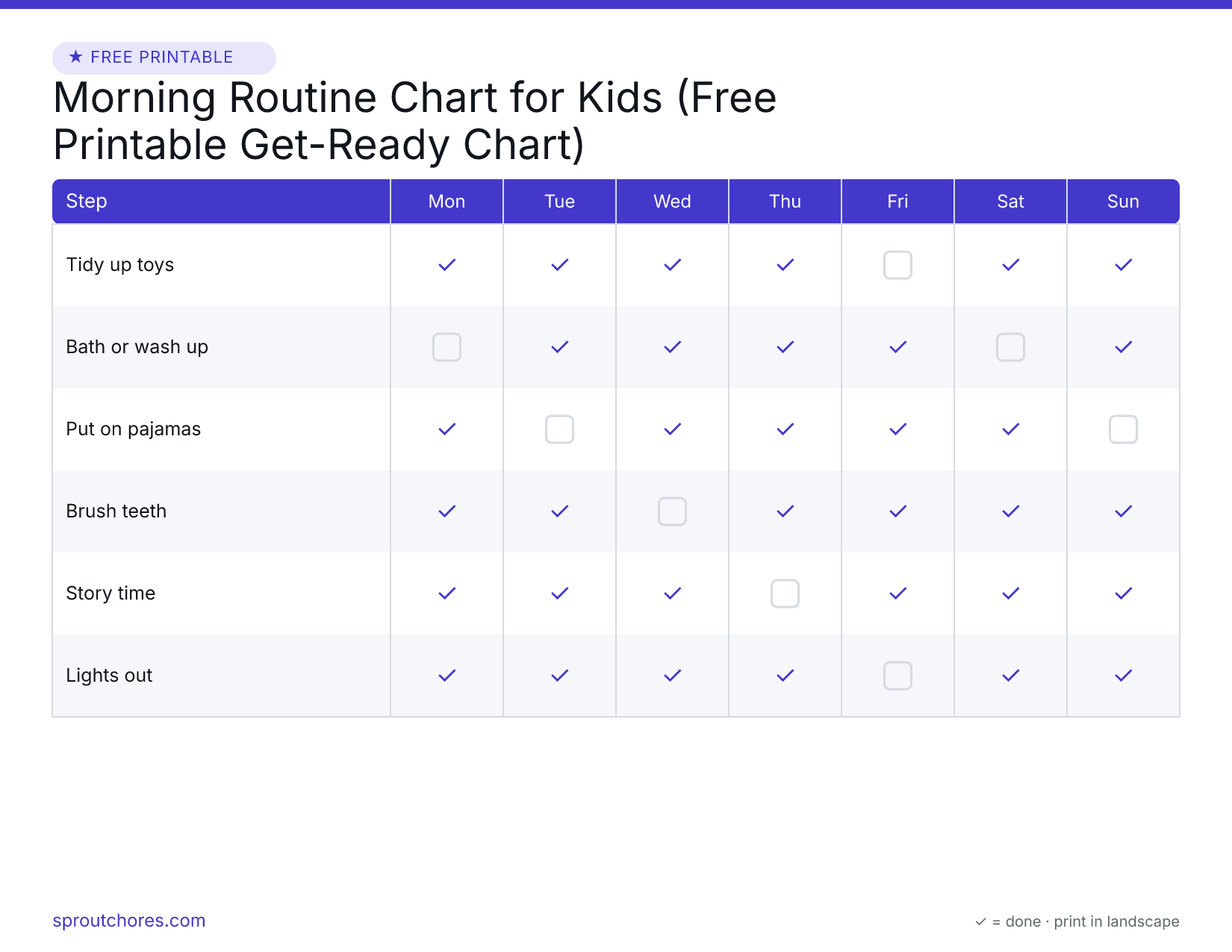
Mornings have a way of turning into a relay of reminders — get dressed, did you eat, where are your shoes, we're late. The chart on this page is built to take you out of that loop. In the maker above you set a short get-ready sequence that runs from the moment a child wakes to the second they head out the door, add a simple picture beside each step so a kid who isn't reading yet can still follow it, spread the steps across the week, and print it for free. I'm Andrew. Between our four kids, ages 9 to 18, and the little ones we've cared for through foster care, I've watched plenty of frantic mornings, and the fix was never a clever new trick. It was letting a child glance at the same handful of pictures, in the same order, every single day, so the path from bed to backpack stops needing a parent narrating it. If our calmer bedtime is the wind-down at one end of the day, this is the unhurried version of getting going at the other. Build yours below, then read on for what actually makes a morning chart stick at different ages.
| Step | Mon | Tue | Wed | Thu | Fri | Sat | Sun | Remove |
|---|---|---|---|---|---|---|---|---|
| Tidy up toys | ||||||||
| Bath or wash up | ||||||||
| Put on pajamas | ||||||||
| Brush teeth | ||||||||
| Story time | ||||||||
| Lights out |
Tip: choose Landscape in the print dialog for the best fit.
Print in landscape for the best fit. A few reminders from our family to yours: do it together the first few times, keep the chart somewhere everyone can see it, and reward steady effort over a perfect job. — The SproutChores family
Want every age in one file? Get the free Age-by-Age Pack
Six printable charts (ages 4–10) plus reward and routine sheets, in one tidy PDF — free, straight to your inbox.
We email you new printables now and then — unsubscribe anytime. Privacy.
Something went wrong — please try again in a moment.
✓ Almost there — check your inbox!
We just emailed you a confirmation link. Click it to confirm, and your free Age-by-Age Chore Chart Pack lands in your inbox moments later.
Why a visual morning sequence ends the nagging
Most morning chaos isn't defiance — it's a kid who genuinely can't hold a five-step plan in their head while half-asleep, and a parent who ends up being the plan. A picture-based chart hands that job to the wall instead of to you. When the same steps land in the same order every day, getting ready stops being a fresh negotiation each morning and starts feeling like a path your child already knows by heart, which is exactly when the back-and-forth quiets down.
We learned how much steadiness matters during our years as foster parents. Some of the little ones who came to us had no real shape to their days — meals and sleep happened whenever, and mornings were anyone's guess. The thing that helped most wasn't a reward or a stern talk; it was simply giving the day a dependable rhythm and holding it steady, morning after morning, until they could feel what came next before we said it. There was resistance at first, and then there wasn't, because so much of what looks like a kid digging in is really a kid who isn't sure what's about to happen to them. That lesson shapes how we run every morning in our house now: when a child can predict the day, the friction mostly takes care of itself. A printed chart is just a way to keep that order from drifting on the mornings you're rushed and tempted to wing it.
The pictures do more than decorate. A four-year-old who can't read a single word still recognizes a little drawing of a shirt, a bowl, or a pair of shoes — and that image quietly answers the question every distracted kid is silently asking, which is some version of "okay, now what," without you having to be the answer for the tenth time.
How to use the chart so mornings actually move
Build your steps in the maker above and resist the urge to cram. For a young child, four or five steps is usually the ceiling — a long chart just gets abandoned halfway. Print it, and then think hard about where it goes, because a sheet stuck somewhere a kid never looks is a sheet that does nothing.
With our youngest, one chart on the fridge was never the real trick. We'd cut the sequence into separate little picture cards and post each one in the exact spot that step happens — a get-dressed card by the dresser, a card for teeth at the bathroom mirror, a shoes card waiting by the door. The cue meets the child where the action is, so they look up, see the next move, and keep going without a grown-up steering every turn. If your kid is a bit older and reading, the single printed weekly chart usually does the job on its own — they can run a finger down the column and pace themselves.
The other lever that has saved us more morning meltdowns than anything else costs nothing: give a runway before any transition. "Out the door right now" springs the worst out of a kid mid-cartoon or mid-Lego. So we flag it ahead — a heads-up well before, another at the halfway mark, a last call at a few minutes out — and the shift never lands as an ambush. Paired with a chart they recognize, the move from breakfast to backpack gets noticeably smoother. And I'd gently reset what the chart is really for: in our home it's far less a scoreboard for the kid and more a quiet check for us, a way to glance across the week and notice whether the mornings are holding together or quietly coming apart. Nobody in our house gets ready because a sticker is waiting at the end of the row. They get ready because mornings happen, everyone has a part in keeping the household moving, and this is simply how ours goes.
What a smooth morning looks like, toddler through grade school
We've never bought into one fixed script for every child — the principle holds (same steps, same order, every day), but how you run it bends to the kid in front of you, and we've seen the full range under one roof.
Toddlers, roughly 2 to 3: keep it tiny and do it shoulder to shoulder. The "steps" here are really self-care wearing a fancy name — wrestling into clothes, a quick face and teeth, sitting for a few bites — and a toddler learns by mirroring you, so moving through it together beats calling instructions from the hallway. The picture cards carry nearly everything at this age, since the words are just shapes to them. A morning routine chart for a toddler works best as something they see, not something they read.
Three to five: a 4- or 5-year-old can start working down the sequence with more independence, though don't expect it to run clean — they'll get lost staring at a sock or skip a step entirely, and that's fine. You're building a habit, not grading a performance. This is a good stretch to let them point to or tick off each picture as they finish, which makes the progress feel like theirs. We've also seen wildly different wiring at the same age: one of ours got a real kick out of designing her own chart and following it, while another barely registered a chart existed and needed us to call the next step out loud in the moment. Same house, opposite kids — so if the chart alone isn't landing, that's information, not failure.
Grade school, roughly 6 and up: most kids this age can own the morning with you nearby instead of hovering, and the printed weekly chart really earns its place — they recognize the steps and keep their own pace through dressing, eating, and heading out. One honest, morning-specific fix worth passing along: watch the screen. A show or a tablet first thing reliably swallows the clock and stalls everything behind it. In our experience, mornings smooth out fast when the screen simply isn't an option until the get-ready list is done and they're out the door. If your mornings keep falling apart no matter how good the chart looks, that's the first place I'd look.
Frequently asked questions
- What age is a morning routine chart for kids good for?
- It earns its keep from toddlerhood up through the early school years, but how you lean on it shifts with age. For a 2- or 3-year-old who can't read, a picture-based chart carries the morning — and individual picture cards posted at the spot each step happens, like a shoes card by the door, work even better — while you move through most of it alongside them. By 5 or 6, kids can recognize the steps and pace themselves down the printed weekly chart with you nearby rather than running every move for them.
- My child can't read yet — does a printable morning chart still work?
- That's exactly where the pictures pay off. A clear little image of a shirt, a bowl, or a pair of shoes tells a pre-reader what's next without a single word. We took it further with our youngest: we cut the sequence into separate picture cards and posted each one in the place it actually happens — get dressed by the dresser, teeth at the mirror, shoes by the door — so the cue shows up right where the child needs it instead of on a far-off fridge. The visual order becomes a quiet, hands-off reminder of what to do and when.
- Should I reward my child for finishing the morning routine?
- We keep mornings clear of rewards. The chart isn't a prize machine — it's there to make the shape of the morning visible and to help us, as parents, see whether things are holding steady or slipping. Cooperation grows out of the plain expectation that this is how our mornings run and that everyone has a part in keeping the house moving, not from a treat at the end of the row. Dangling a reward over getting dressed tends to turn an ordinary morning into one more thing to bargain over, which is the opposite of what a rushed morning needs.
- How do I get a free printable morning routine chart for kids?
- Use the editable maker on this page: set your get-ready steps from wake-up to out-the-door, add a simple picture to each so a young child can follow it, lay them out across the week, and print at home. There's no signup and nothing to pay. Start with just four or five steps for a little one so the morning feels doable rather than long, and keep the order the same day after day — that steadiness is what actually takes the rush out of mornings.

About the author
More free printables
Get the free Age-by-Age Chore Chart Pack
Six printable charts (ages 4–10) plus reward and routine sheets, in one tidy PDF. We'll also send new printables and the occasional real parenting tip. The charts on this site are always free — no sign-up needed.
We email you new printables now and then — unsubscribe anytime. Privacy.
Something went wrong — please try again in a moment.
✓ Almost there — check your inbox!
We just emailed you a confirmation link. Click it to confirm, and your free Age-by-Age Chore Chart Pack lands in your inbox moments later.