Toddler Routine Chart: Free Printable Picture Schedule for Morning & Night
A toddler can't read a to-do list, but they can absolutely read a picture. That's the whole idea behind the chart on this page: you build a short set of steps for the morning and another for the night, drop a simple icon beside each one, and print it free — no words required, so a two-, three-, or four-year-old can follow along on their own. I'm Andrew. Between our own four kids, now spanning 9 to 18, and the little ones my wife and I have cared for as foster parents, I've watched plenty of toddler mornings and bedtimes go sideways — and the thing that reliably smooths them isn't a clever reward. It's letting a child see the same few steps land in the same order, day after day, until the day stops catching them off guard. Build your morning and night steps in the maker above, then read on for how to make a picture routine genuinely stick at this age.
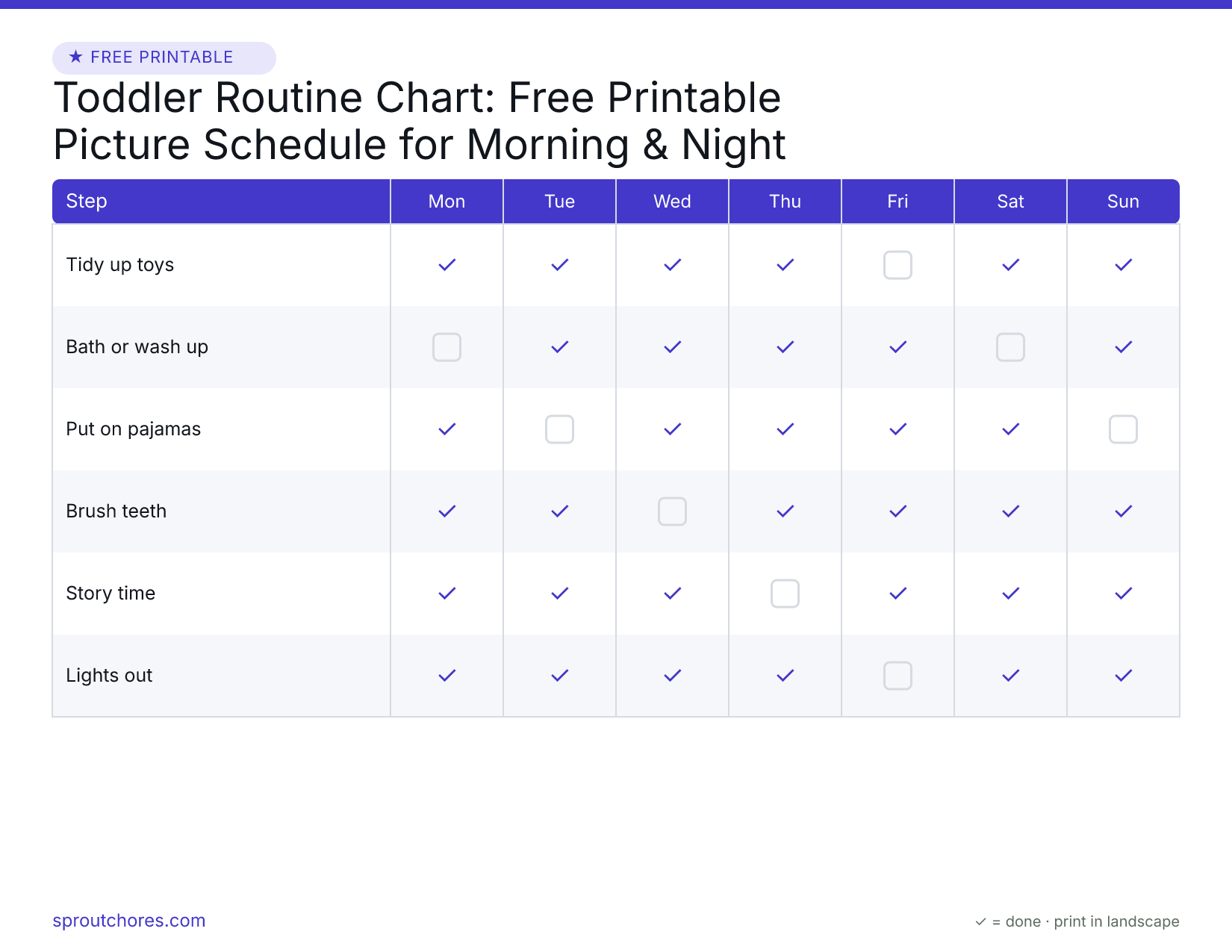
| Step | Mon | Tue | Wed | Thu | Fri | Sat | Sun | Remove |
|---|---|---|---|---|---|---|---|---|
| Tidy up toys | ||||||||
| Bath or wash up | ||||||||
| Put on pajamas | ||||||||
| Brush teeth | ||||||||
| Story time | ||||||||
| Lights out |
Tip: choose Landscape in the print dialog for the best fit.
Print in landscape for the best fit. A few reminders from our family to yours: do it together the first few times, keep the chart somewhere everyone can see it, and reward steady effort over a perfect job. — The SproutChores family
Want every age in one file? Get the free Age-by-Age Pack
Six printable charts (ages 4–10) plus reward and routine sheets, in one tidy PDF — free, straight to your inbox.
We email you new printables now and then — unsubscribe anytime. Privacy.
Something went wrong — please try again in a moment.
✓ Almost there — check your inbox!
We just emailed you a confirmation link. Click it to confirm, and your free Age-by-Age Chore Chart Pack lands in your inbox moments later.
Why pictures work before a toddler can read
At two and three, most of a child's frustration with a daily routine comes down to not knowing what's coming. A picture answers that quietly. A small drawing of a bath or a coat means nothing has to be spelled out loud — the child glances at it, sees what's next, and moves without you narrating each step. That's why a toddler routine chart leans entirely on icons instead of words: the point isn't for them to read the plan, it's for them to recognize it on sight.
Predictability is what turns that recognition into cooperation. When the order never changes, the routine stops feeling like a string of demands and starts feeling like a path the child already knows by heart. We saw this most clearly during our years as foster parents. A couple of very young children came to us with almost no rhythm to their days — meals and sleep happened whenever, and nearly every transition became a battle. So we gave the whole day a dependable shape and simply held it steady. The pushback didn't vanish in a week, but as they came to trust what came next, something shifted: they began anticipating each step rather than fighting it, sometimes even lighting up for the part they liked best. A lot of what had looked like defiance turned out to be a child who just didn't feel sure of the ground under them.
One reframe worth holding onto: a printed routine does as much for the grown-ups as for the toddler. When the sequence lives on the wall, any adult in the house can run the morning or the night the same way, and you can hand off to a partner mid-routine without the whole thing collapsing. For a child this small, that identical-every-time consistency is the real engine. The chart is just how you keep it visible.
Setting up the morning and the night
The maker above gives you two short sequences — one for waking up and getting going, one for winding down — because those are the two stretches of a toddler's day that most need a rail to hold. Keep each set lean. Four or five steps is plenty; a long chart just gets abandoned, and a two-year-old's attention runs out fast. Pick the handful of things that actually anchor each end of the day and leave the rest off.
Work through the steps beside your toddler rather than calling them out from across the room. Kids this age learn by copying, so brushing teeth next to them or pulling on shoes together carries far more than any set of instructions. Where you put the chart matters just as much as what's on it. With our youngest ones, a single sheet on the fridge was never quite enough — the cues did the most work when we split them apart and posted each little picture right in the spot where that step happens, so the reminder is already waiting for the child at the sink, by the door, near the bed, exactly when they need it.
The other move that spared us countless standoffs costs nothing: give warning before a transition. Pulling a toddler off the floor with "we're leaving now" or "bedtime, right this second" almost guarantees tears. A little runway instead — a heads-up a while out, then another as it gets close — lets a small child finish the thought they're in the middle of and turn toward the next step on their own. Pair that with a picture they already recognize, and the shift from playing into the routine stops arriving as an ambush.
Tuning it for a 2, 3, or 4 year old
The steps can stay the same across these years; what changes is how much you carry versus how much they carry.
At two, plan to move through nearly all of it together. The pictures are doing the heavy lifting because the words mean nothing yet, and your role is mostly to model each step and keep the order steady. Don't measure success by how much your two-year-old manages alone — measure it by whether the routine is becoming familiar. A routine chart for a 2 year old is really a shared map you follow side by side.
By three, a lot of kids can start working down the sequence with a bit more independence, though it won't run clean — they'll stall on one step and skip another, and that's exactly what you'd expect. This is a nice age to let them point to or tap each picture as they finish it, which makes the progress feel real and their own. Count on still being nearby, nudging things along.
At four, many kids can carry most of the routine with you in the room rather than hovering over them. They recognize the icons instantly and can pace themselves through the morning and the night, so you're supervising now more than steering. Across all three ages, the honest truth is that this takes a while to take hold — often a couple of weeks before a new routine even registers, and longer still to settle in. It can feel like nothing's working right up until the day you notice it quietly is.
What the chart is for (and what it isn't)
It's worth being clear about the job this chart is doing, because it's easy to turn it into something it shouldn't be. In our house, a routine chart is a tracking tool for the parents far more than a motivator for the kid. It lets us glance back and see whether the mornings and nights are holding together or quietly coming apart, so we know when to step in. The willingness to follow along doesn't come from a prize at the end of the row — at this age it grows out of the routine simply being how the day goes, and out of a child living somewhere everyone pitches in.
So I'd steer away from wiring a toddler routine chart up as a sticker economy. You can mark a step if your child enjoys the ritual of it, but keep any celebration aimed at the effort and the good attitude, not at whether every box got filled. We also keep rewards and screen time on an entirely separate track — a toddler shouldn't have to earn breakfast or a bath. Let the chart stay honest about what it really is: a calm, visible guide through the two ends of the day, and a quiet read for you on how your child is coming along.
Frequently asked questions
- Is this a Montessori toddler routine chart?
- Not in a formal sense — we've never followed a strict Montessori method ourselves, and I wouldn't want to claim otherwise. But a lot of what people are after when they search for a "Montessori" routine chart lines up with how this one works anyway: real, recognizable pictures instead of text, steps a child can follow without being led through them, and cues placed low enough for a toddler to see and act on. If you want to lean further that way, use simple photos of the actual step, hang everything at your child's eye level, and let them do as much of each step themselves as they safely can.
- Does a routine chart actually work for a 2 year old?
- It does, as long as your expectations fit a two-year-old. At this age the chart isn't something they run solo — it's a picture map you follow together, over and over, until the order becomes second nature. You're not looking for a toddler who checks off tasks on their own; you're looking for one who starts to recognize what comes next and pushes back less because of it. Give it a couple of weeks before you decide whether it's landing. The steadiness is the point, not the independence.
- How do I get the free printable toddler routine chart?
- Use the editable maker on this page: set your morning steps and your bedtime steps, keep the icons switched on so a pre-reader can follow them, and print or save the PDF at home. There's no signup and nothing to pay. Start with just four or five steps per block so the routine feels doable for a little one, and once you land on an order that works, keep it the same from one day to the next — that consistency is what makes it stick.

About the author
More free printables
Get the free Age-by-Age Chore Chart Pack
Six printable charts (ages 4–10) plus reward and routine sheets, in one tidy PDF. We'll also send new printables and the occasional real parenting tip. The charts on this site are always free — no sign-up needed.
We email you new printables now and then — unsubscribe anytime. Privacy.
Something went wrong — please try again in a moment.
✓ Almost there — check your inbox!
We just emailed you a confirmation link. Click it to confirm, and your free Age-by-Age Chore Chart Pack lands in your inbox moments later.