Toddler Chore Chart with Pictures (Free Printable, No Reading Required)
Hand a two-year-old a chart full of written words and you've handed them a list of instructions they have no way to read. That's exactly why this one runs on pictures: each task appears as an image your toddler can spot and understand without anyone reading it aloud, with icons switched on by default and a free print or PDF waiting at the end. I'm Andrew — a dad of four, and with my wife a foster parent to three little ones over the years — and what surprised us early on is that a chart for the very youngest kids barely has anything to do with getting work done. It's a visual map of what happens next, and just as much, it's a way for us as parents to keep an eye on how each child is coming along. Once you frame it that way, a toddler chart stops feeling silly and starts being genuinely useful. Build yours below, then read on for what's actually realistic at two.
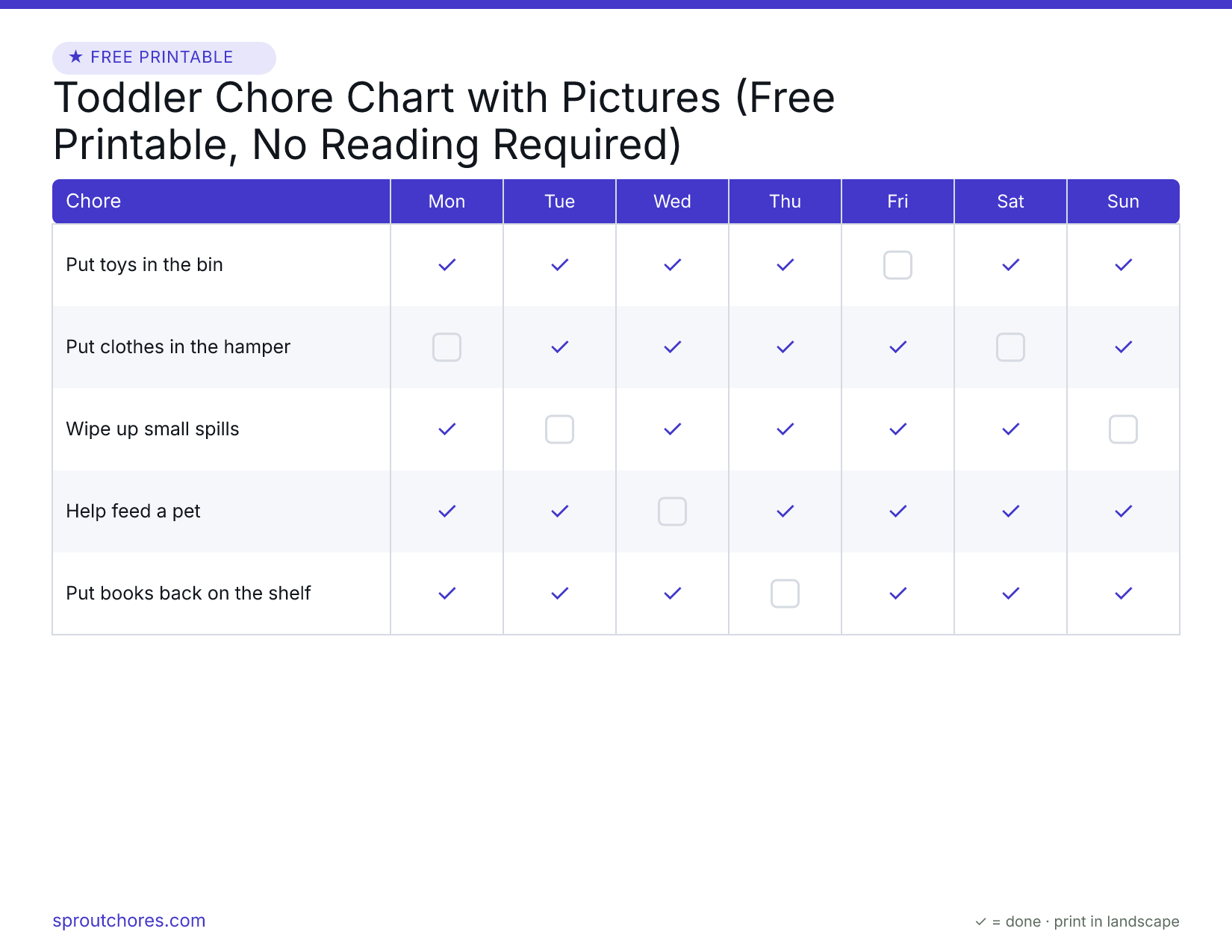
| Chore | Mon | Tue | Wed | Thu | Fri | Sat | Sun | Remove |
|---|---|---|---|---|---|---|---|---|
| Put toys in the bin | ||||||||
| Put clothes in the hamper | ||||||||
| Wipe up small spills | ||||||||
| Help feed a pet | ||||||||
| Put books back on the shelf |
Tip: choose Landscape in the print dialog for the best fit.
Print in landscape for the best fit. A few reminders from our family to yours: do it together the first few times, keep the chart somewhere everyone can see it, and reward steady effort over a perfect job. — The SproutChores family
Want every age in one file? Get the free Age-by-Age Pack
Six printable charts (ages 4–10) plus reward and routine sheets, in one tidy PDF — free, straight to your inbox.
We email you new printables now and then — unsubscribe anytime. Privacy.
Something went wrong — please try again in a moment.
✓ Almost there — check your inbox!
We just emailed you a confirmation link. Click it to confirm, and your free Age-by-Age Chore Chart Pack lands in your inbox moments later.
Age-appropriate chores for Toddler Chore Chart with Pictures
Every chore below is pre-loaded in the generator above and is something a child in this age range can realistically manage with a little initial guidance:
- Put toys in the bin
- Put clothes in the hamper
- Wipe up small spills
- Help feed a pet
- Put books back on the shelf
What's Realistic for a 2-Year-Old
Drop the adult definition of "chores" for now. At two, the wins worth charting are the things that already revolve around your toddler: getting dressed, having a go at their own teeth, and cleaning up the trail they just left across the living room. What made the difference for our youngest was simply doing these things at the same time they did — me brushing my teeth right next to them, both of us scooping toys into the bin together. Two-year-olds are wired to mirror their parents, and that copying instinct does most of the heavy lifting for you.
The other piece is inviting them to pitch in without ever making it mandatory. If you're running the vacuum and your toddler reaches for it, let them have a turn and show them a single small thing — say, just how far you guide it out and back. Don't pile on more than that. A short stretch of trying, a few minutes at most, is the whole point. You won't end up with a cleaner floor; you'll end up with a kid who's comfortable around the task, which is what makes it feel ordinary when it becomes a real responsibility a few years on. The chart simply puts a familiar picture beside each of these so your toddler recognizes the activity on sight, no reading involved.
Making a Picture Chart Actually Stick
The change that mattered most for us with the little ones was scattering the pictures around the house rather than parking them all on one chart by the fridge. We stuck a small image card right where each thing happens — a picture for teeth at the bathroom mirror, one for the potty beside it, one for hand-washing at the sink. From there a toddler can glance at the wall and figure out both the step and what follows it, instead of waiting for a grown-up to walk them through it line by line. A printed sheet does the same job; what really counts is that the pictures are visible and live where the action does.
That same logic is why we never reached for an app with kids this young. The app sits in your phone, tucked in a pocket where a two-year-old will never see it — so it can't prompt them to do anything. A sheet taped at their eye level can. And honestly, this kind of steady, in-plain-sight routine paid off most with the children we fostered. Giving them the identical picture cues in the identical spots day after day handed them something they could count on, and that dependability did more for bedtime and for settling in than any treat we could have offered. The same thing is true for any toddler: a stable routine they can read off the wall themselves is what carries it from one day to the next.
Stickers, Allowance, and Keeping Them Out of the Way
There's a strong pull to turn a toddler chart into a sticker contest, and you certainly can — but I'd nudge you to think twice before leaning on it as a motivator. In our house the chart earns its keep as something parents use to track, not as a carrot for the kid. A quick look tells us how a child is really doing and whether it's time to step in. Even at two, the drive to participate comes from it just being expected, and from growing up somewhere everyone has a part to play — not from a reward stuck to each box.
So we keep rewards on one track and chores on another. There's no allowance in the picture at this age at all; money doesn't show up until kids are pitching into the family in a real way around five or six, and even then it hangs on how well and how willingly they work rather than a payout per job. We also never turned screen time into something a child had to earn through chores — losing screen time was strictly a response to behavior, never the price of a task. If you do want to mark a little win, keep it small and aim it at the effort and the good attitude behind the work, not at whether every square got filled. That keeps the chart honest about the job it's really doing.
Frequently asked questions
- Can a 2-year-old actually do chores?
- Not in the way adults picture chores. At two, the realistic aim is self-care and copying you — getting dressed, having a try at their teeth, and gathering up their own toys, ideally right alongside a parent. You can let them "help" with something bigger like vacuuming for a couple of minutes to build their comfort, but don't expect a real result or a tidy outcome. You're laying down habits, not finishing a to-do list.
- Why use pictures instead of words on a toddler chore chart?
- A two-year-old can't read, so a word-based chart asks them to follow steps they can't actually make sense of. Picture icons let a toddler recognize each task and even work out the order on their own. What worked best for us was taping those icons right where each thing happens — a teeth picture by the bathroom mirror, for instance — so the chart becomes a visible cue your child can follow instead of something you have to narrate every time.
- Should I give my toddler a sticker or reward for finishing the chart?
- You can, but I'd keep it light. For us the chart is mainly a parent's tracking tool, and the motivation should come from it simply being part of how the family runs, not from a prize on every square. We hold off on any allowance until around five or six, and we keep rewards and screen time well clear of chores. If you do celebrate, point it at the effort and attitude rather than at checking off boxes.
- Where should I put a toddler's picture chore chart?
- Right where each task actually happens, not all in one place on the fridge. We had the most success splitting the icons up and taping each one at the spot it belongs — the teeth picture at the mirror, hand-washing by the sink — so a toddler can look up, see what's next, and do it without a grown-up talking them through it. Hang everything at their eye level so it's genuinely in their line of sight.

About the author
More free printables
Get the free Age-by-Age Chore Chart Pack
Six printable charts (ages 4–10) plus reward and routine sheets, in one tidy PDF. We'll also send new printables and the occasional real parenting tip. The charts on this site are always free — no sign-up needed.
We email you new printables now and then — unsubscribe anytime. Privacy.
Something went wrong — please try again in a moment.
✓ Almost there — check your inbox!
We just emailed you a confirmation link. Click it to confirm, and your free Age-by-Age Chore Chart Pack lands in your inbox moments later.