Bathroom Cleaning Checklist (Free, Printable & Editable)
The bathroom is the room everyone uses and nobody volunteers for. I'm Andrew — a dad of four, ages nine to eighteen, and along with my wife a foster parent — and I gave up fighting that fact a long time ago in favor of the thing that actually works: making the job small and predictable instead of big and dreaded. That's what this printable is. It's one editable bathroom cleaning checklist that runs at three speeds — a quick daily wipe-down, a proper weekly clean, and the occasional deep clean — so the sink and mirror stay livable through the week and the heavy scrub never piles up into an all-day ordeal. Print it as a PDF, adjust it to your home, tape it up where the work happens, and use the kid-friendly version too — a checklist like this is one of the simplest ways to actually teach a child to clean a room.
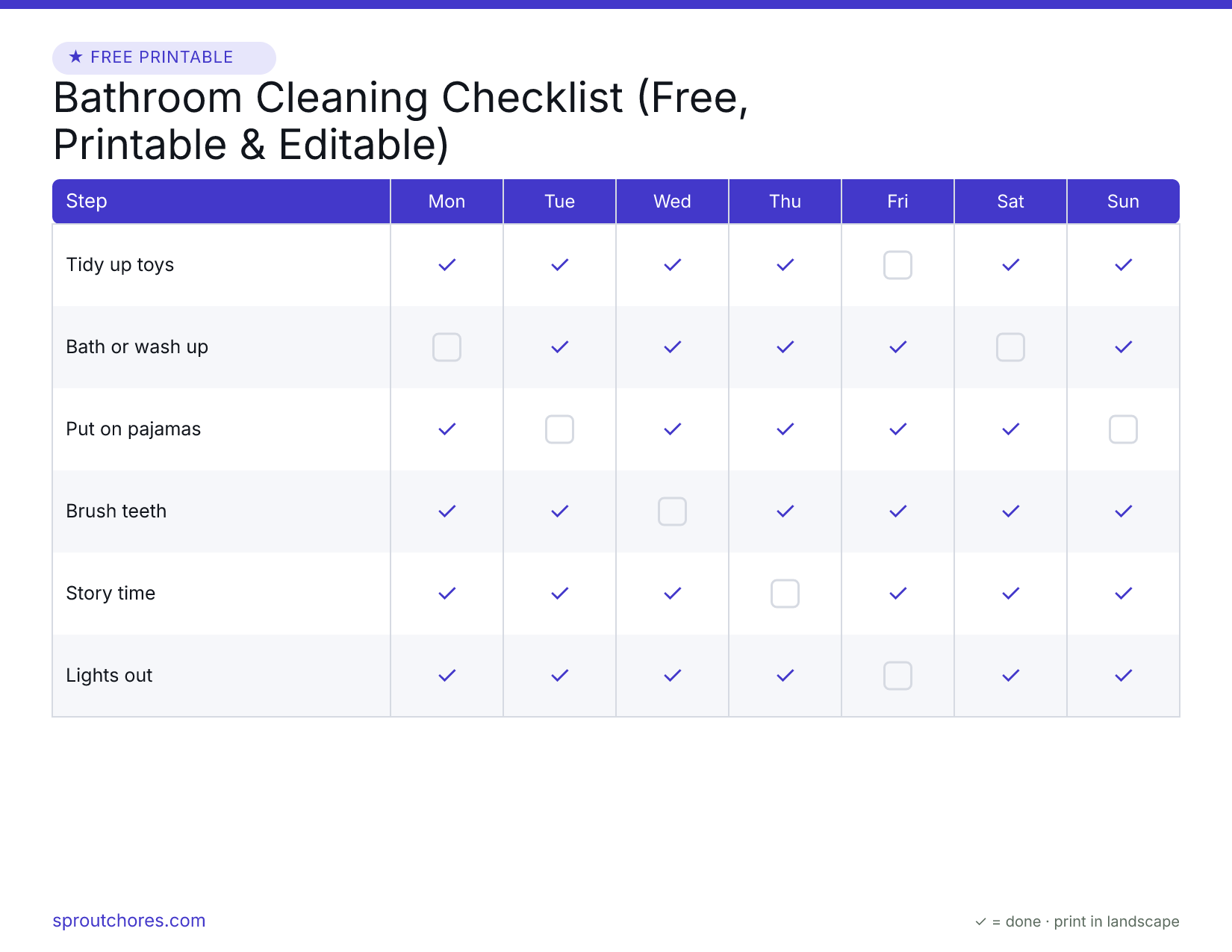
| Step | Mon | Tue | Wed | Thu | Fri | Sat | Sun | Remove |
|---|---|---|---|---|---|---|---|---|
| Tidy up toys | ||||||||
| Bath or wash up | ||||||||
| Put on pajamas | ||||||||
| Brush teeth | ||||||||
| Story time | ||||||||
| Lights out |
Tip: choose Landscape in the print dialog for the best fit.
Print in landscape for the best fit. A few reminders from our family to yours: do it together the first few times, keep the chart somewhere everyone can see it, and reward steady effort over a perfect job. — The SproutChores family
Want every age in one file? Get the free Age-by-Age Pack
Six printable charts (ages 4–10) plus reward and routine sheets, in one tidy PDF — free, straight to your inbox.
We email you new printables now and then — unsubscribe anytime. Privacy.
Something went wrong — please try again in a moment.
✓ Almost there — check your inbox!
We just emailed you a confirmation link. Click it to confirm, and your free Age-by-Age Chore Chart Pack lands in your inbox moments later.
One checklist, three speeds: daily, weekly, and deep clean
The grid on this page builds your list across three columns so you're never staring down the whole bathroom at once. There's a reason for that. A full top-to-bottom deep clean is exactly the kind of job the brain quietly files under "not today" — big, effortful, and easy to keep pushing off. I know that firsthand; large, open-ended tasks are where I stall too. The fix that works for me at work is the same one that works on a bathroom: break the big thing into pieces small enough that you can't talk yourself out of them.
So the daily column is a two-minute pass that keeps everyday grime from ever settling in. The weekly column is a longer, more thorough clean. And the deep clean — the one that gets the spots you don't reach every week — drops to once a month or so, because the daily and weekly habits keep it from becoming a rescue mission. Set whatever cadence fits how hard each bathroom actually gets used; a busy family bath needs the weekly clean more often than a guest bath nobody touches. The whole point is that maintenance stays boring, and boring is what keeps a bathroom clean.
How to use it (and make it yours)
It's editable, so change the tasks, rename the columns, and put names next to jobs. Two habits made it actually stick in our house.
First, put it where the work happens. We've always run chores on paper and posted them in the actual room — a sheet taped inside the vanity door or on the wall gets seen every day, while a reminder buried in an app quietly disappears. Second, give a heads-up. "Go clean the bathroom right now" invites a standoff; "after lunch the bathroom's yours" gives a kid time to shift gears. That small advance-notice habit has ended more arguments in our home than any consequence ever did.
And here's the honest part: every system breaks. A vacation, a sick week, a stretch where everyone's slammed — something always knocks it off the rails. The real mistake is deciding it "didn't work" and scrapping it. A good checklist is one you can restart on any random Tuesday without ceremony. When we were fostering, the biggest thing a posted routine did wasn't motivate the kids — it kept us, the adults, consistent, so the children could trust what came next. A cleaning checklist does the same quiet job: its first purpose is keeping you steady.
The kid and teen version: a checklist that teaches
This is where the kid-friendly variant earns its keep, because what a bathroom checklist really trains is the ability to look after a space you share — rehearsal for running their own place one day, not just getting the sink clean tonight.
For little ones, around four, keep it visual and simple and stand right beside them the first many times. Hand a young child a spray bottle of plain water and a cloth and let them "clean" the mirror next to you. Expect to quietly go back over their work — at this age you're not buying a spotless bathroom, you're building the habit and the sense that this home belongs to all of them to care for. Grade-schoolers can own a real piece of it and be expected to do it without a running reminder. Teens get more independence and less oversight, handled a lot like a job.
The stance underneath all of it: this chart is a tracking tool for us as parents — a way to see how each kid is doing and when to step in — not a sticker machine for bribing them. The motivation we're after comes from being part of a household everyone helps run, not from a prize attached to each task. We deliberately keep allowance and screen time out of it. Allowance exists, but it's tied to the bigger picture — whether a kid is dependable and pitches in with a good spirit — rather than paid out per scrubbed sink. And screen time isn't something they earn by cleaning.
The part no printable shows: patience
Change here is slow, and you won't see it week to week. You rarely catch it happening; then you look back to where a kid started and the difference is obvious. Our nine-year-old now gathers every trash can in the house on his own — start to finish, no one hovering — and that didn't come from a clever chart. It came from years of the same steady expectation. A bathroom checklist works the same way.
Some weeks it'll look like nothing's landing. Keep it visible, keep it low-drama, and restart it the moment it slips. One day you'll notice the sink's been getting wiped without you asking. Start from where your kid actually is, not where you wish they were, and aim for steady progress rather than a perfect bathroom.
Frequently asked questions
- How often should you clean a bathroom?
- Most homes do well on three rhythms, which is exactly how this checklist is built. A quick daily wipe-down keeps everyday grime from settling in. A more thorough weekly clean handles the toilet, the tub or shower, and the floor. And a deep clean every month or two gets the spots you skip weekly — grout, the exhaust fan, under the sink, behind the toilet. A busy family bathroom needs the weekly clean more often than a rarely-used guest bath, so adjust the cadence in the editable version to match how hard each room actually gets used.
- What order should you clean a bathroom in?
- Work top to bottom and save the dirtiest things for last. Start high — mirror, light fixtures, shelves — then the sink and counter, then the tub or shower, and do the toilet and the floor at the very end. That way you're not dragging toilet germs onto surfaces you just wiped, and anything that drips lands on the floor you haven't cleaned yet. Let sprays sit a minute or two while you work elsewhere so they actually do their job. This order is also the easiest to teach a kid, because it's the same predictable sequence every single time.
- At what age can kids help clean the bathroom, and is it safe?
- Around four, kids can start helping in small, supervised ways — mostly wiping and tidying right alongside you. The safety piece matters: skip the harsh chemicals for young ones. Give them a spray bottle of plain water or a mild, kid-safe solution and a cloth for the mirror and counter, and keep the strong disinfectants and anything for the toilet as an adult job until they're older and you've shown them how to use it properly. Don't expect a professional result early on. At this age the real win is the habit and the understanding that keeping a shared space nice is everyone's job.

About the author
More free printables
Get the free Age-by-Age Chore Chart Pack
Six printable charts (ages 4–10) plus reward and routine sheets, in one tidy PDF. We'll also send new printables and the occasional real parenting tip. The charts on this site are always free — no sign-up needed.
We email you new printables now and then — unsubscribe anytime. Privacy.
Something went wrong — please try again in a moment.
✓ Almost there — check your inbox!
We just emailed you a confirmation link. Click it to confirm, and your free Age-by-Age Chore Chart Pack lands in your inbox moments later.