Cleaning Schedule for ADHD: Flexible, Low-Overwhelm, and Built to Restart
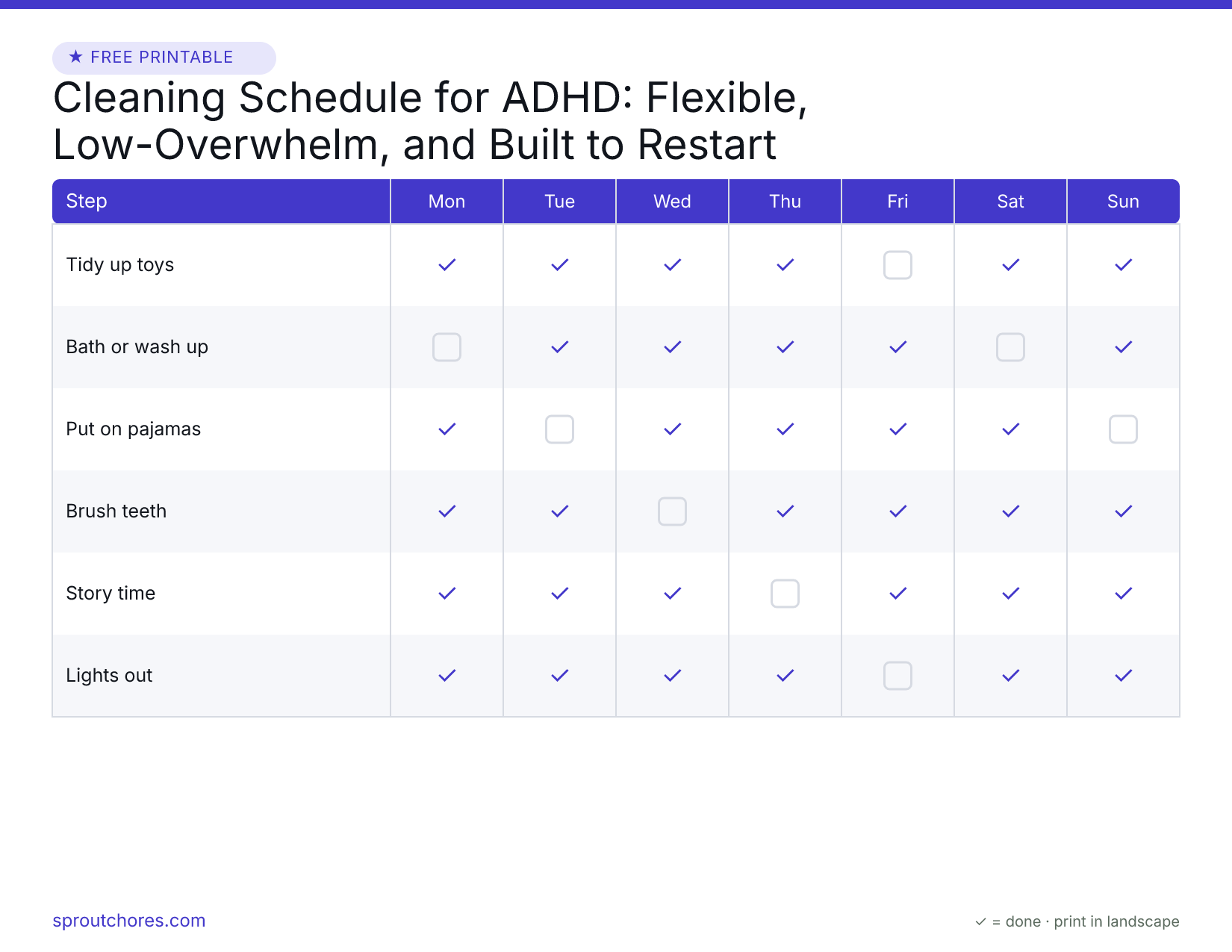
If color-coded charts that pin a specific chore to every single day of the week have only ever left you feeling behind, this one is put together differently. I'm Andrew, a dad of four and a foster parent, and my own attention runs the way a lot of you will recognize: I drift and zone out rather than bounce off the walls, and a task I meant to start can quietly slip away while I chase a tab I opened twenty minutes ago. A cleaning schedule for ADHD can't be a rigid grid you're forever failing at. The maker on this page builds an editable, printable schedule you fill in yourself, and it's meant to work as a loose rotation of small jobs you move through at your own pace rather than a fixed timetable you fall off by Tuesday. It won't dictate what a clean enough home should look like or shame you for the week that got away from you. It's a frame you bend around how your attention actually behaves, drawn from the tools I lean on myself, not handed down by someone who finds any of this easy. One thing up front: this is our family's lived experience, not medical advice.

| Step | Mon | Tue | Wed | Thu | Fri | Sat | Sun | Remove |
|---|---|---|---|---|---|---|---|---|
| Tidy up toys | ||||||||
| Bath or wash up | ||||||||
| Put on pajamas | ||||||||
| Brush teeth | ||||||||
| Story time | ||||||||
| Lights out |
Tip: choose Landscape in the print dialog for the best fit.
Print in landscape for the best fit. A few reminders from our family to yours: do it together the first few times, keep the chart somewhere everyone can see it, and reward steady effort over a perfect job. — The SproutChores family
Want every age in one file? Get the free Age-by-Age Pack
Six printable charts (ages 4–10) plus reward and routine sheets, in one tidy PDF — free, straight to your inbox.
We email you new printables now and then — unsubscribe anytime. Privacy.
Something went wrong — please try again in a moment.
✓ Almost there — check your inbox!
We just emailed you a confirmation link. Click it to confirm, and your free Age-by-Age Chore Chart Pack lands in your inbox moments later.
Why rigid, day-of-the-week schedules fall apart for an ADHD brain
Picture the standard plan: bathrooms on Monday, floors on Tuesday, kitchen deep-clean on Wednesday. It looks tidy on paper, but it hides a trap. The first hard day comes (and one always does), Monday's bathrooms don't happen, and now they're spilling into an ever-growing pile of jobs you're officially late on. For a brain that instinctively steers away from whatever feels unpleasant in the moment, a visible backlog is precisely the thing it will refuse to look at, and the avoidance snowballs until you decide keeping a house is just something you can't do.
I've watched this all-or-nothing pattern wreck good intentions in every corner of life, not just cleaning. Someone designs a flawless system, runs it perfectly for a week, then real life shows up (a trip, an illness, a stretch where everything is on fire), the plan breaks for a few days, and they quietly write the whole thing off as a failure. It didn't fail. It just wasn't built to bend. A flexible rotation sidesteps the trap entirely, because there are no assigned days left to miss.
There's a deeper reason a dependable rhythm helps, and it's the one I trust most. The calmest our home has ever been, including the season we fostered children who'd never had a predictable pattern to lean on, came from a rhythm people could count on. Once the little ones knew roughly what came next, a lot of what had looked like defiance turned out to be plain uncertainty, and the daily fights over transitions simply faded. The same steadiness that let them stop bracing for the unknown is what takes the edge off the overwhelm for an ADHD brain, only here you get the predictability without the punishing deadlines.
How the flexible rotation actually works
Instead of dates, think of a pool of small jobs you cycle through. When you land a pocket of time and a bit of energy, you pull the next thing off the rotation and do just that one thing. Nothing is ever late, because nothing was due at a fixed hour. Miss a day and there's no catch-up penalty waiting for you; you just pick up wherever the rotation left off.
The trick is to keep every item genuinely small and obviously finishable. A line like deep clean the kitchen reads as a vague, open-ended threat, and the honest response of a distractible brain is to look away from it. So write the smallest slice with a clear finish line instead: wipe the counters, or move the wash to the dryer. You want to be able to glance at a row and know, without any internal debate, that it's unmistakably done, and then let yourself actually register that as finished before you move on. That small, deliberate hit of completion does far more for momentum than any reward ever could.
Fill the maker with your real rooms and jobs, keep the list shorter than feels responsible, and then print it and tape it somewhere you physically walk past. A plan you can't see may as well not exist, especially for a brain that won't hold it in memory. The whole point of putting it on the wall is that the page remembers so you don't have to, which frees up the attention you were burning just trying not to forget. And because it's editable, you can shrink any chunk down to whatever size your brain will actually agree to start.
Make starting easier: body doubling, a cleared field, and your own clock
For most of us the hard part was never the scrubbing. It's the starting. A few levers reliably lower that first hurdle.
Body doubling. A job that feels impossible to begin alone often unlocks the moment another person is simply present. A partner folding laundry in the same room, a friend on a video call, even a podcast that makes the space feel less solitary can be enough. I've seen this over and over in our house: doing something alongside someone drops the barrier to starting, which is the same reason a toddler will happily push a vacuum around the second a parent picks one up. Slot your rotation jobs into that shared company whenever you can.
Clear the field. Before you start, get both the space and your head down to this single job. Hide the phone, shut the extra tabs, and resist the urge to quick-clean three rooms at once. A brain that can't see the next shiny distraction has a far easier time staying put. (The companion ADHD chore chart page goes deeper on setting up that single-task view.)
Work with your clock. I'm sharp before the rest of the world is awake and running on empty by evening; my wife is the reverse. Aim the demanding jobs at your genuine good hours instead of pretending you'll rally at a low point. And add a short daily reset, a few minutes to return one room to its baseline at a consistent moment, so the rotation never quietly builds into a mountain.
The schedule is a tool for you, not a scoreboard
This is not a sticker chart to guilt yourself with. Its real job is to lift the running list out of your head and park it somewhere visible, so your mind isn't quietly spending energy just holding it all. If you're the person who silently keeps track of everything the household needs (a weight a lot of moms carry alone), a rotation everyone can see shares that load: anyone can glance at it and grab the next job, and the work stops living inside one person's memory.
In our family the framing was never reward-for-work. Keeping our place up is simply part of belonging to a household that holds itself together, and we deliberately keep money and screen time out of it so the cleaning isn't a transaction anyone bargains over. For you as an adult, the equivalent is dropping the moral scoring altogether. You're not good because you cleaned or lazy because a week slipped. The schedule is just a quiet instrument that makes picking back up painless.
Which is the whole philosophy in one line: the systems that survive real life aren't the strict, thorough ones, they're the ones you can walk away from and restart without drama. When the rotation slips, and it will, don't torch the approach. Print a fresh page, start with one easy win, and let the momentum rebuild from there.
Frequently asked questions
- How do I make a cleaning schedule that actually works with ADHD?
- Build it as a flexible rotation rather than a fixed timetable. Instead of assigning bathrooms to Monday and floors to Tuesday, keep a pool of small, clearly finishable jobs and do the next one whenever you have a pocket of time and energy. Nothing is ever late, so a missed day never turns into a shameful backlog. Keep each item tiny (wipe the counters beats clean the kitchen), print the editable schedule from the maker above, and tape it somewhere you pass constantly so your brain doesn't have to hold it. Most importantly, treat it as something you restart, not something you keep flawlessly.
- Why don't normal cleaning schedules work for people with ADHD?
- Because a rigid day-of-the-week plan quietly punishes the first hard day. Miss the job that was assigned to today and it rolls into a growing pile you're officially behind on, and a brain that instinctively avoids whatever feels bad in the moment will steer away from that pile until the whole system gets abandoned. It's the classic all-or-nothing spiral: build a perfect plan, break it once when real life hits, then decide it failed. A flexible rotation removes the trap entirely, because there are no fixed deadlines left to fall off of.
- What is body doubling, and does it really help with cleaning?
- Body doubling just means doing a task while another person is present, even if they're not helping. A partner working nearby, a friend on a video call, or a group cleaning session can make it far easier to start a job that feels impossible to begin alone. In our house I've seen again and again that doing something alongside someone lowers the barrier to starting. It's not a cure, but for a lot of ADHD adults it's one of the most reliable ways to get moving, so pair it with your rotation whenever you can.
- Is this cleaning schedule medical advice for ADHD?
- No. Everything here comes from our own family's lived experience with how attention works for us, framed as tendencies and personal strategy rather than diagnosis or treatment. I'm writing as a parent and an adult who navigates this day to day, not as a clinician, and nothing here is guidance for or against medication, which is a personal decision. If you have questions about diagnosis or treatment, please talk with a qualified professional.

About the author
More free printables
Get the free Age-by-Age Chore Chart Pack
Six printable charts (ages 4–10) plus reward and routine sheets, in one tidy PDF. We'll also send new printables and the occasional real parenting tip. The charts on this site are always free — no sign-up needed.
We email you new printables now and then — unsubscribe anytime. Privacy.
Something went wrong — please try again in a moment.
✓ Almost there — check your inbox!
We just emailed you a confirmation link. Click it to confirm, and your free Age-by-Age Chore Chart Pack lands in your inbox moments later.