Cleaning Schedule for Working Moms (Free Printable, Realistic Weeknight Plan)
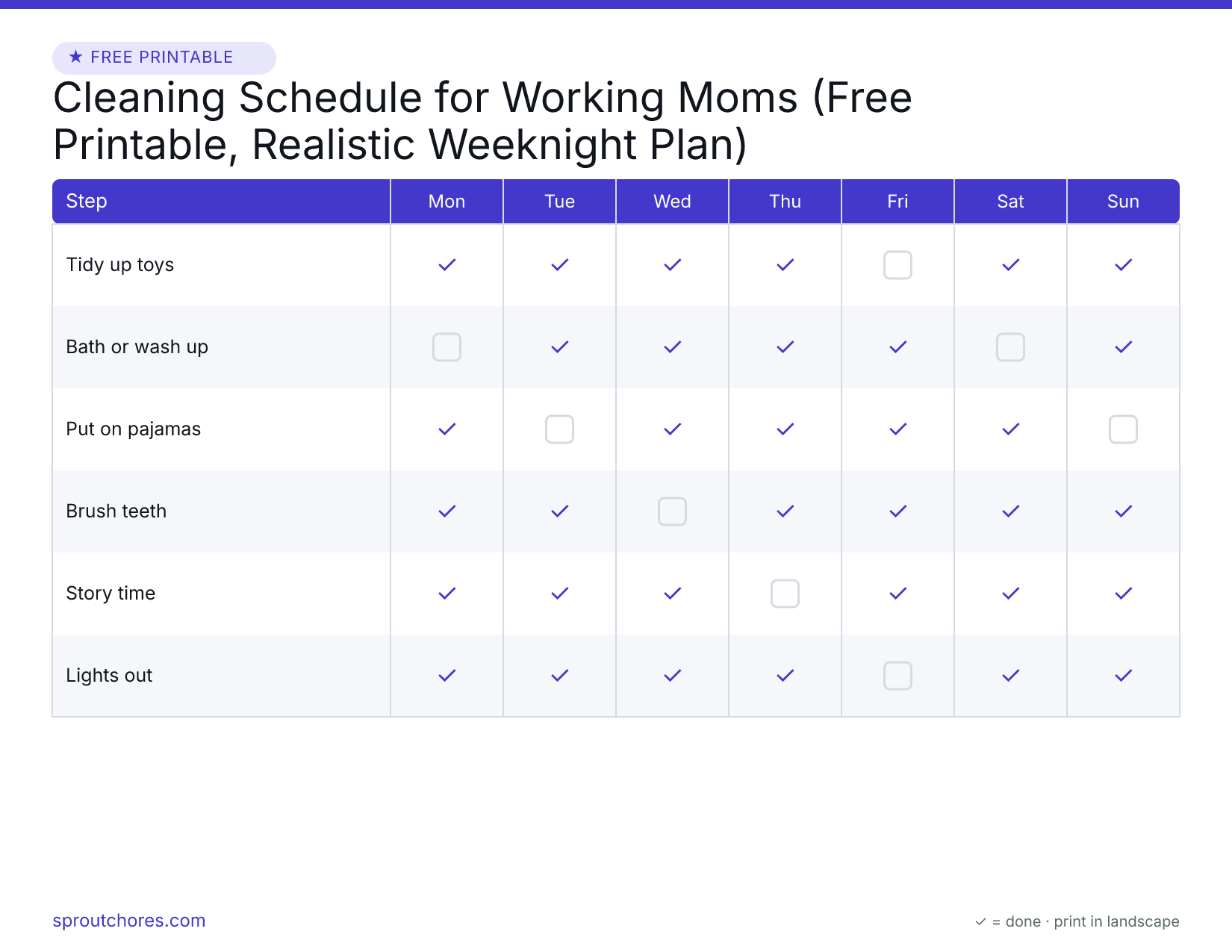
If you're searching for a cleaning schedule as a working mom, you almost certainly don't have a spare hour to give it — and any plan that assumes you do is going to let you down by Wednesday. So this one is built the other way around: a light weeknight rhythm of roughly fifteen minutes, plus one short block on the weekend, sized for a life that's already full. Build yours in the maker above — set the tasks that matter in your home, spread the light stuff across weeknights, park the bigger jobs in the weekend block, then print it for free with no signup. I'm Andrew, a dad of four in a busy, blended household of six, and I'll be straight about our setup: I'm out the door early most mornings and my wife's days are full running our homeschool, so by evening nobody has the appetite for a big clean. What's kept our home livable isn't cleaning harder on the good days — it's a plan small enough to survive the bad ones, and shared out so it never sits on one person's shoulders.

| Step | Mon | Tue | Wed | Thu | Fri | Sat | Sun | Remove |
|---|---|---|---|---|---|---|---|---|
| Tidy up toys | ||||||||
| Bath or wash up | ||||||||
| Put on pajamas | ||||||||
| Brush teeth | ||||||||
| Story time | ||||||||
| Lights out |
Tip: choose Landscape in the print dialog for the best fit.
Print in landscape for the best fit. A few reminders from our family to yours: do it together the first few times, keep the chart somewhere everyone can see it, and reward steady effort over a perfect job. — The SproutChores family
Want every age in one file? Get the free Age-by-Age Pack
Six printable charts (ages 4–10) plus reward and routine sheets, in one tidy PDF — free, straight to your inbox.
We email you new printables now and then — unsubscribe anytime. Privacy.
Something went wrong — please try again in a moment.
✓ Almost there — check your inbox!
We just emailed you a confirmation link. Click it to confirm, and your free Age-by-Age Chore Chart Pack lands in your inbox moments later.
A schedule sized to the time you actually have
The reason most cleaning schedules collapse isn't laziness — it's that they're written for a week that doesn't actually exist. They assume a free afternoon, a calm evening, a Saturday with nothing on it. Flip it around and build the plan on the hours you genuinely have, and it suddenly holds up. On a work night that means a short reset: the few things that snowball overnight if you leave them, like the kitchen and the day's scattered clutter, kept deliberately brief so finishing is realistic instead of one more thing to dread. The heavier jobs — the ones that only really need attention once a week — go into a single weekend block where there's a bit more breathing room.
The key is matching each task to how fast it comes back: a counter earns a nightly wipe, floors and bathrooms are fine on a weekly pass, and the deep, occasional jobs shouldn't be cluttering up a Tuesday at all. Keep the everyday load light and pen the big load into one window, and no evening ever balloons into a two-hour catch-up — the house just hovers near clean instead of lurching between spotless and a wreck.
How to use the printable at home
Start in the maker above and make it yours: type in the tasks that genuinely matter in your home — not a generic list copied off the internet — and drop the light ones onto weeknights and the bigger ones into the weekend block. Then guard the weeknight side jealously. If your evening reset creeps much past fifteen minutes, it won't survive a hard day, and a schedule that only works when you're well-rested isn't much of a schedule. Keep weeknights genuinely short, let the weekend block carry the real maintenance, and leave the rare deep-clean jobs off the weekly rhythm entirely.
Then print it and — this matters more than people expect — put it somewhere you physically pass, like the fridge or the inside of a cabinet door. A schedule stuffed in a drawer may as well not exist; one you brush past constantly slowly becomes the way the house actually runs. There's no signup and nothing to pay, so when a week proves the plan wrong, edit it and print a fresh copy. And if you share a home with a partner, a posted schedule pulls its weight in a way a mental list never can — either of you can glance at it and take whatever's due, so nothing stalls the moment one of you is slammed or away.
Share the load — it was never meant to be all yours
If you're the one who went looking for this, odds are the whole house has quietly become your job — both the cleaning and the remembering of the cleaning. The most useful thing a written schedule does is break that. In our home the ground rule is that keeping the place up belongs to everyone under the roof; it's part of being a family, not a favor somebody does for mom. Once the jobs are on paper and pinned to days, they stop being a running tally in one person's head and turn into plain, visible work anyone can pick up.
Kids included — and not as a feel-good idea, but for real. It arrives slowly: I can point to my nine-year-old, who now rounds up every bag of trash in the house on his own, start to finish, with nobody standing over him. That didn't come from a speech; it came from years of the same quiet expectation. One small habit smooths the buy-in more than anything else — give people a heads-up before a job instead of springing it on them. "Bathrooms are on the plan after lunch" lands completely differently than "go clean the bathroom right now," and it heads off a surprising amount of resistance.
We do tie a modest allowance to how the kids show up over the long run — effort, reliability, and attitude together — but we keep it well clear of any single task and separate from screens and treats, so the reason the house gets cleaned is that we all live here, not that anyone's being paid by the job.
Build a plan that survives a bad week
Here's the trap I watch people fall into, and it has almost nothing to do with cleaning: they design an ambitious, perfect system, run it flawlessly for a week, and then a sick kid or a brutal stretch at work knocks it flat for a few days — and they quietly conclude the whole thing failed. But it didn't fail; it was just never built to flex. The schedules that actually last aren't the most thorough ones — they're the ones you can walk away from and restart with no penalty.
So build in slack on purpose: if a weeknight gets away from you, the reset should be quick enough to catch up on tomorrow, and shifting the weekend block to Sunday because Saturday evaporated should cost you nothing. Settle ahead of time on what "good enough" looks like on a rough week, because a plan that only works when life is calm doesn't really work at all.
And it helps to remember who the schedule is really for. I've come to see one of these less as a scoreboard and more as an instrument panel for whoever's running the house — a way to glance at the week and tell whether things are holding together, without keeping every detail in your head. That offloading from your brain is honestly half the win. When the plan lives on the wall instead of circling in your mind, the nagging background thought of "I still need to deal with that" fades a long way — which, on a full week, is worth about as much as the clean floors.
Frequently asked questions
- What's a realistic cleaning schedule for a working mom?
- A realistic one is built around the time you actually have rather than the time a spotless house would demand. In practice that's a light weeknight rhythm — around fifteen minutes on the jobs that snowball if ignored, like the kitchen and the day's clutter — plus one short weekend block for the heavier weekly work such as floors and bathrooms. Match each task to how fast it truly gets dirty so you're not deep-cleaning things that don't need it, keep the weeknight side genuinely short so it survives a bad day, and use the editable maker above to shape it around your own home.
- How do working moms keep the house clean when they have no time?
- Two moves do most of the work. First, trade marathon cleans for small, repeatable resets so the house never hits crisis in the first place — a few minutes most evenings beats a lost Saturday every time. Second, stop carrying it solo: once the jobs are written on a schedule and posted somewhere visible, they become shared, ownable work instead of a list living in your head, and a partner or the kids can grab whatever's due. In our house even the youngest handles real jobs unsupervised now — it built up slowly, but it genuinely lifts load off the adults.
- How do I get my family to actually help with the cleaning?
- Make the work visible and shared instead of something you hand out in the heat of the moment. Post the schedule where everyone passes it, frame the cleaning as something the whole household owns because you all live there, and — the quiet game-changer — give people advance notice rather than springing a job on them; "bathrooms after lunch" draws far less resistance than "do it now." We link a small allowance to how our kids show up over time rather than paying them per task, and we keep it separate from screens and rewards, so the point stays that everyone pitches in, not that chores are for sale.

About the author
More free printables
Get the free Age-by-Age Chore Chart Pack
Six printable charts (ages 4–10) plus reward and routine sheets, in one tidy PDF. We'll also send new printables and the occasional real parenting tip. The charts on this site are always free — no sign-up needed.
We email you new printables now and then — unsubscribe anytime. Privacy.
Something went wrong — please try again in a moment.
✓ Almost there — check your inbox!
We just emailed you a confirmation link. Click it to confirm, and your free Age-by-Age Chore Chart Pack lands in your inbox moments later.