Bedroom Cleaning Checklist for Teens (Free, Printable & Editable)
If \"clean your room\" has ever turned into a half-hour standoff at your house, you're in good company. I'm Andrew — a dad of four kids between nine and eighteen, and with my wife a foster parent — and I've learned that a messy teen bedroom rarely stays messy because a kid is lazy. It stays messy because the job has no shape: \"clean your room\" isn't one task, it's twenty, and to a brain that already feels swamped, twenty invisible tasks are easy to shove off to \"later.\" This printable fixes the shapeless part. It's an editable bedroom cleaning checklist for teens that turns that dreaded, open-ended chore into a short, ordered list of small steps — do this, then this, then this — so a teenager (including a kid whose attention tends to wander) can actually see a start, a middle, and a finish. Build your list in the tool on this page, print it as a PDF or edit it to fit your teen's room, and tape it up where the mess actually is.
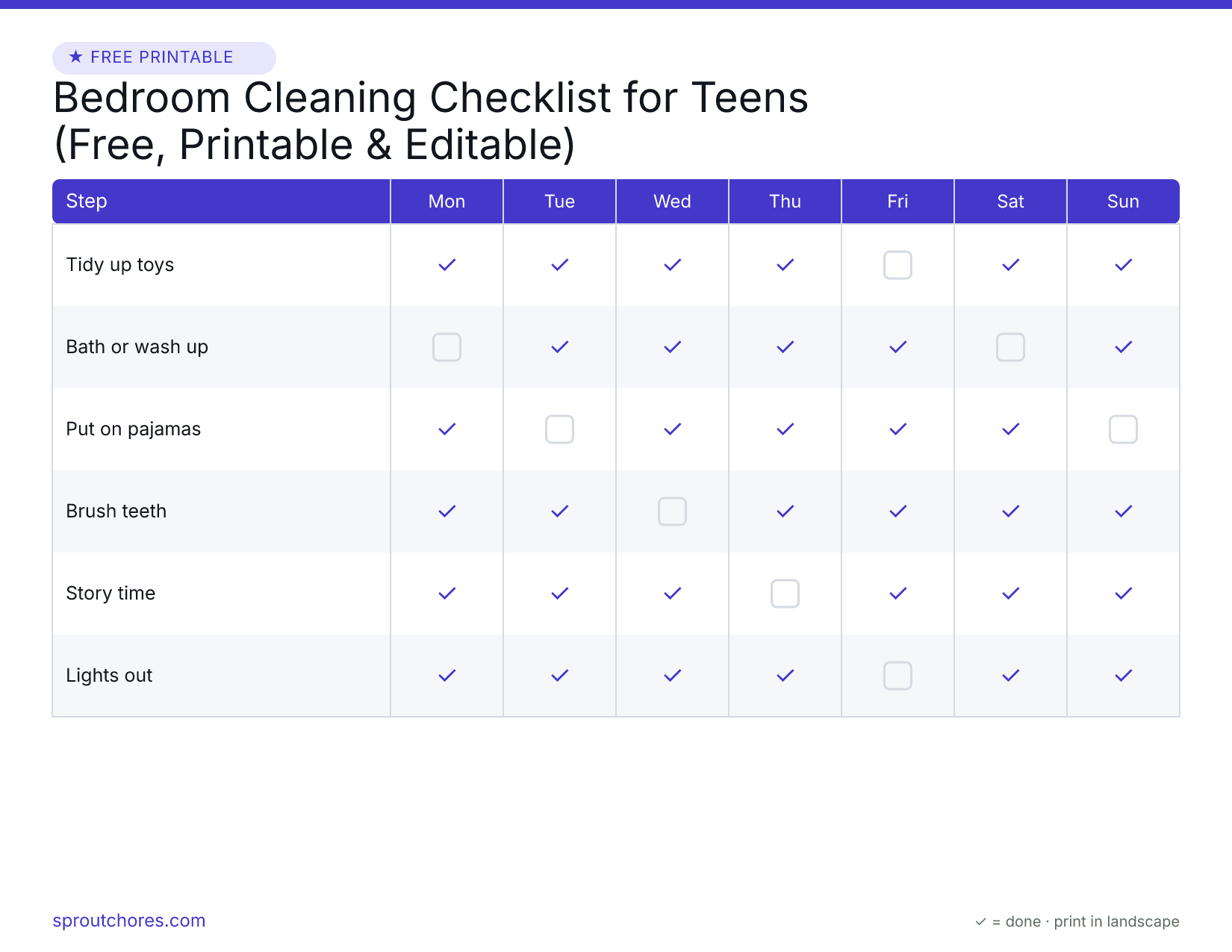
| Step | Mon | Tue | Wed | Thu | Fri | Sat | Sun | Remove |
|---|---|---|---|---|---|---|---|---|
| Tidy up toys | ||||||||
| Bath or wash up | ||||||||
| Put on pajamas | ||||||||
| Brush teeth | ||||||||
| Story time | ||||||||
| Lights out |
Tip: choose Landscape in the print dialog for the best fit.
Print in landscape for the best fit. A few reminders from our family to yours: do it together the first few times, keep the chart somewhere everyone can see it, and reward steady effort over a perfect job. — The SproutChores family
Want every age in one file? Get the free Age-by-Age Pack
Six printable charts (ages 4–10) plus reward and routine sheets, in one tidy PDF — free, straight to your inbox.
We email you new printables now and then — unsubscribe anytime. Privacy.
Something went wrong — please try again in a moment.
✓ Almost there — check your inbox!
We just emailed you a confirmation link. Click it to confirm, and your free Age-by-Age Chore Chart Pack lands in your inbox moments later.
Why "clean your room" becomes a standoff — and why ordered steps work
Here's the honest mechanism behind the eye-rolling. A room that's gotten out of hand is a wall of visual noise, and a wall of visual noise is exactly the kind of big, undefined project a lot of us quietly dodge — I do it myself. Faced with something huge and open-ended, my brain quietly labels it "not now" and moves on, because even starting feels like signing up for hours. Kids who lean toward distractibility (something I've lived with, and see in one of my daughters) feel that even more sharply: in the moment they gravitate toward whatever's easiest to face right now, and standing in the middle of a disaster room deciding where to begin is not easy to face. So they don't begin.
An ordered checklist takes the deciding off their plate. Instead of one enormous "clean your room," they get a handful of small, concrete moves in a sensible sequence, each one finishable in a few minutes. That does two things that matter. It gets the plan out of their head and onto paper — the list remembers the steps so the teen doesn't have to, which is exactly where good intentions usually evaporate. And it hands out small wins: crossing off one line and watching the pile shrink is a real hit of "I'm actually getting somewhere," and that momentum is often what carries a kid through the rest.
One trap to sidestep, especially if you're the organized one in the family: don't turn it into an interrogation. When a naturally tidy parent asks a spaced-out kid "why would you just leave it like this?", there usually isn't an answer — no one consciously decided to let the room rot. The lecture doesn't teach anything; it just becomes one more unpleasant thing to tune out. Hand them the tool instead of the speech.
How to use it (and make it your teen's)
The tool builds the steps in order, and the order does most of the heavy lifting, so keep it roughly biggest-impact-first. Clearing the field comes before detailing — hauling out trash, stray dishes, and dirty laundry empties most of the visible chaos in a few minutes, and suddenly the room looks half-done, which makes the fiddlier stuff (surfaces, then the floor, then the little organizing) feel worth doing. I lean on the same principle at my own desk: clear the clutter first so what's left is actually workable.
A few habits make it stick. Edit it to their real room — a teen with a desk and a gaming setup needs different lines than a kid with a bunk and a sports bag, and letting them tweak their own list buys you genuine buy-in. One of my daughters is happiest when she gets to design her own version and then run it; another kid in the same house would ignore a chart entirely, so match the tool to the teen in front of you rather than the one you wish you had. Post the printout in the room itself, not on a shared fridge or buried in an app — a list you walk past gets used, while a reminder you have to go open mostly disappears. And give a heads-up instead of a cold command: "sometime before dinner your room needs to get done" lands far better than "go clean your room right now," because it gives them a beat to shift gears instead of digging in.
Finally, expect it to fall apart sometimes, and don't read that as failure. A busy week, a trip, a stretch of exams — something always knocks the routine off track. The mistake is deciding it "didn't work" and quitting; the win is being able to restart on any ordinary day without a big reset. A checklist you can pick back up cold is worth ten perfect systems that shatter the first time real life gets in the way.
Kids vs. teens: how much to scaffold
This list covers a wide stretch — a ten-year-old and a seventeen-year-old are not the same animal — so dial the support to the age.
For the younger end, roughly ten to twelve, plan to stay involved. Walk through the first several cleanings with them, work a step or two alongside them, and expect to circle back on the parts they rushed. At this age you're not buying a magazine-perfect bedroom; you're building the muscle memory and the idea that taking care of your own space is simply part of being here. A kid this age often genuinely enjoys the checklist itself — ticking boxes feels a little like a game — so let them own it and lean into that.
With actual teenagers, the shift is from supervising the task to handing over the responsibility. Honestly, by the mid-teens we mostly stopped policing a daily chore chart — it's nearly impossible to enforce, and it turns into a fight nobody wins. What works better is treating the room as theirs to manage and giving them the tool to do it, then stepping back. I'll tell a teenager plainly: keeping your room livable is on you, I'll help the second you ask, but I'm not going to hound you about it. Then I let the real-world cost do the teaching — a friend can't come over to a room like that, you can't find the thing you need, the clean laundry you left in a heap has to be washed again. Consequences that mirror how the actual world works land in a way nagging never does; a kid hears a lecture as parent-anger, but reads a real cost as, well, reality. That's the difference between a teen who cleans because you're standing there and one who's slowly learning to keep their own space without being told.
A tracking tool, not a bribe (and why it's really about adulthood)
I want to be straight about one thing, because it shapes how we use every chart in our house: this checklist is a tool for keeping track and for teaching — it is not a payout machine. We don't tape a prize to each finished step, and we deliberately keep screen time out of the deal entirely; time on devices isn't something our kids earn by cleaning, and it isn't yanked to punish a messy room. Our kids do get an allowance, but it's tied to the whole picture — whether someone is dependable, does things reasonably well, and pitches in with a decent attitude — not handed out task by task like piecework. The pull we actually want them to feel comes from being part of a household everyone helps run, not from a sticker.
And the real reason we bother isn't tonight's clean floor. I've never seen chores as a way to get work out of my kids; they're a dress rehearsal for living on their own. A teenager who can look at a wrecked room, break it into steps, and grind through it is practicing the exact skill they'll need the first time they have their own place and nobody around to nag them. That's the payoff.
So be patient with it. This kind of change is almost invisible week to week — you rarely catch it happening. Then you look back to where your kid started and the gap is obvious. Our nine-year-old now rounds up every trash can in the house on his own, start to finish, and that came from years of the same steady expectation, not from a clever chart. A bedroom checklist works the same slow way. Keep it visible, keep it low-drama, restart it whenever it slips, and aim for steady progress instead of a perfect room.
Frequently asked questions
- How do I get my teenager to clean their room without a fight?
- Two moves cut the friction more than anything else for us. First, give advance notice instead of a cold order — "your room needs doing before you head out later" lets a kid finish what they're on and shift gears, where "go clean it now" basically invites a standoff. Second, stop owning the outcome for them. With teens I hand over the responsibility out loud — the room is yours to keep livable, I'll help if you ask, but I won't chase you — and then I let the natural cost land when it doesn't get done, whether that's not being able to have a friend over or losing something in the mess. A real-world consequence teaches; a lecture just becomes noise they wait out. The checklist helps because it removes the "I don't even know where to start" excuse: it's right there, in order, on the wall.
- What's the best order for a teen to clean their room?
- Go biggest-impact first and save the fiddly stuff for last. The fastest way to make a room feel under control is to clear the field — pull out the trash, round up dishes and cups, and get the laundry into a basket. That alone usually erases most of the visible mess in a few minutes and makes the room feel half-clean, which is exactly the momentum a reluctant teen needs. From there it's surfaces (desk, nightstand, dresser top), then the floor, then the smaller organizing — putting things back where they belong. Working in that order matters because each step makes the next one look easier, and because running the same sequence every time means they eventually stop having to think about it. The tool on this page builds the steps in that kind of order so your teen isn't the one deciding where to begin.
- Is a cleaning checklist good for a teen with ADHD?
- In our experience, yes — an ordered, broken-down list is one of the most useful things you can hand a kid whose attention tends to wander. (I'll say up front that this is our family's lived experience, not medical advice; every kid is different, and anything clinical is a conversation for a professional.) A messy room is a big, shapeless, overwhelming task, and that's precisely the kind of thing a distractible brain avoids. Breaking it into small, concrete steps in a fixed order does the planning for them, so they aren't burning their limited focus just deciding what to do next — the list holds the plan instead of their head. It also delivers frequent, visible wins as each line gets checked off, which keeps momentum going. Keep the steps short, keep the list posted where they'll actually see it, and expect to prompt and encourage more than you would with another kid — that's normal, not a sign the system is failing.

About the author
More free printables
Get the free Age-by-Age Chore Chart Pack
Six printable charts (ages 4–10) plus reward and routine sheets, in one tidy PDF. We'll also send new printables and the occasional real parenting tip. The charts on this site are always free — no sign-up needed.
We email you new printables now and then — unsubscribe anytime. Privacy.
Something went wrong — please try again in a moment.
✓ Almost there — check your inbox!
We just emailed you a confirmation link. Click it to confirm, and your free Age-by-Age Chore Chart Pack lands in your inbox moments later.