Bedtime Routine Chart (Free Printable Visual Schedule)
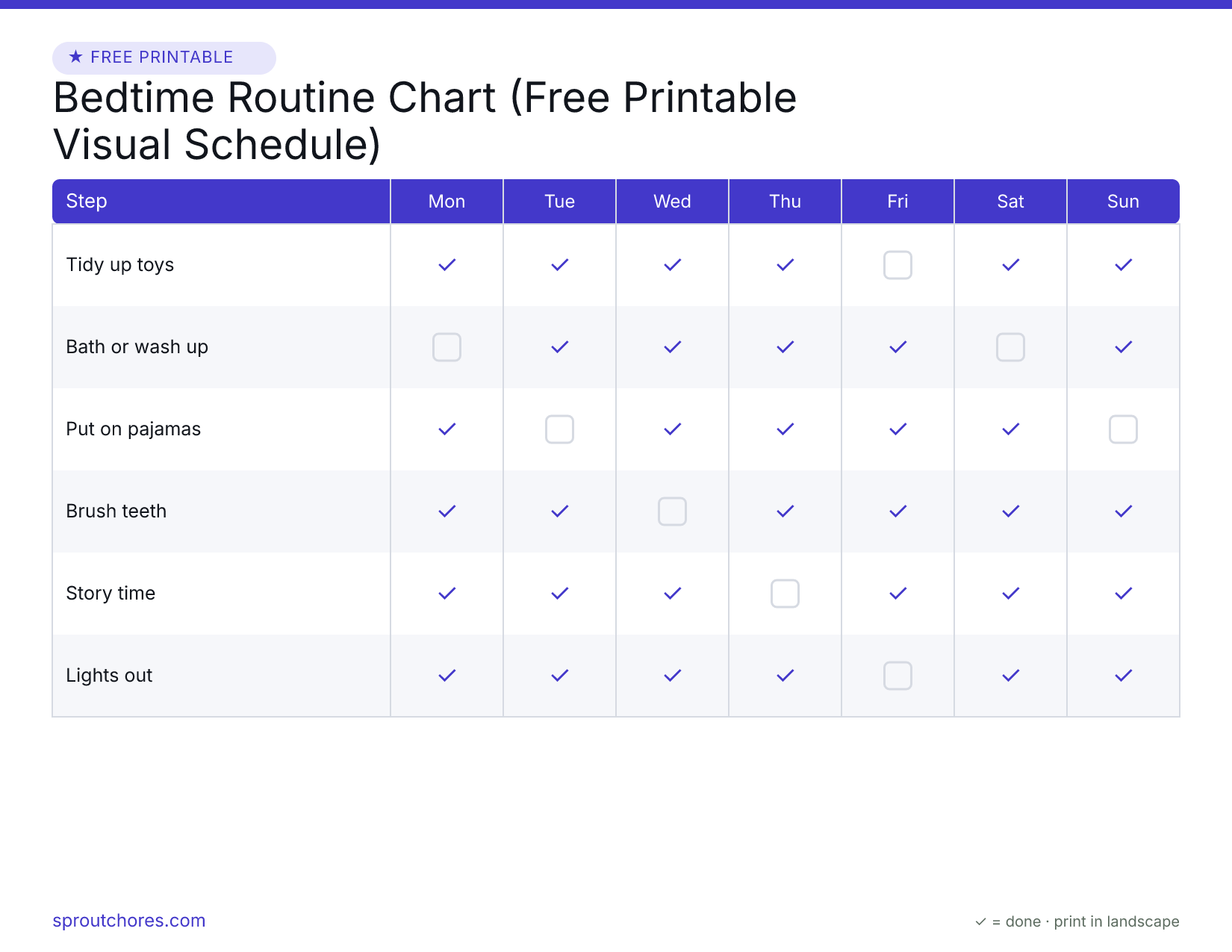
Some evenings the stretch between dinner and lights-out can feel like the longest hour of the day. The chart on this page is meant to shorten it. You build a short wind-down sequence in the maker above, drop in simple pictures so a child who isn't reading yet can still follow along, lay the steps out across the week, and print it for free. I'm Andrew, and at our place there are four kids spanning ages 9 to 18, plus the little ones we've welcomed through foster care over the years. If I had to point to the one thing that took the fight out of bedtime, it wouldn't be any clever trick. It was simply letting a child see, in pictures, the same handful of steps land in the same order every single night. When the path to sleep stops being a surprise, most of the pushback quietly drains away.
| Step | Mon | Tue | Wed | Thu | Fri | Sat | Sun | Remove |
|---|---|---|---|---|---|---|---|---|
| Tidy up toys | ||||||||
| Bath or wash up | ||||||||
| Put on pajamas | ||||||||
| Brush teeth | ||||||||
| Story time | ||||||||
| Lights out |
Tip: choose Landscape in the print dialog for the best fit.
Print in landscape for the best fit. A few reminders from our family to yours: do it together the first few times, keep the chart somewhere everyone can see it, and reward steady effort over a perfect job. — The SproutChores family
Want every age in one file? Get the free Age-by-Age Pack
Six printable charts (ages 4–10) plus reward and routine sheets, in one tidy PDF — free, straight to your inbox.
We email you new printables now and then — unsubscribe anytime. Privacy.
Something went wrong — please try again in a moment.
✓ Almost there — check your inbox!
We just emailed you a confirmation link. Click it to confirm, and your free Age-by-Age Chore Chart Pack lands in your inbox moments later.
Why a predictable wind-down does the heavy lifting
A child who knows what's coming has far less to brace against. When the evening unfolds the same way each night, sleep stops feeling like something dropped on a kid out of nowhere and starts feeling like the last, expected stop on a road they've walked many times. A printed bedtime routine chart holds that order steady for you, which matters most on the nights you're worn thin and tempted to improvise.
We saw how powerful this is during our hardest, most rewarding season as foster parents. A pair of young twins arrived with almost no rhythm to their days — they'd drift off wherever they happened to land, with little sense of when anything came next. Bedtime, unsurprisingly, was a battle. So we built a dependable shape to the whole evening and held it night after night. The resistance didn't vanish overnight, but once they could anticipate each step, the nightly standoff melted into something gentler. It taught us a lesson that shapes how we parent every kid in the house: a lot of what reads as defiance at bedtime is really a child who doesn't feel settled, and steadiness is what settles them. A calm body has to come before any cooperation does, and an unchanging routine is one of the simplest ways to get a wound-up little one there.
The pictures pull more weight than parents expect. A toddler who can't yet read a word still recognizes a small drawing of a bath or a bed, and that image quietly answers the question every tired child asks — "what now?" — so you're not the one repeating it for the fifth time.
A simple bedtime routine you can copy tonight
If you're staring at a blank chart wondering what to actually put on it, here's a plain sequence that works for most young kids — treat it as a starting point and trim it to fit your own. A dependable wind-down usually runs something like this: a small snack or drink if they need one, a warm bath, into pajamas, brush teeth, a last trip to the toilet, then one or two books in bed, and lights out. Five or six steps is the sweet spot; a longer list tends to sag in the middle.
The order matters more than the exact steps, and the rule of thumb is simple: move from active to calm. Anything stimulating — roughhousing, bright screens, a lively splash-around bath — belongs at the front, and the last couple of steps should be the quietest things you do all day, like a story in a dim room. You're walking a child down a gentle ramp toward sleep, not flipping a switch, so each step should feel a notch calmer than the one before it.
Keep the whole thing short. Most wind-downs land somewhere around twenty to thirty minutes once you're not fighting over them. If yours routinely stretches past an hour, that's usually a sign there are too many steps or the routine is starting too late — not that your child is being difficult. Build your version in the maker above, put a simple picture on each step, and lock the order so it's the same climb down every night.
How to use the chart at home
Build your steps in the maker above and keep the list lean — four or five is usually plenty for a young child, and a crowded chart just gets skipped. Print it, then give some thought to where it lives. A page buried on the side of the fridge is easy to walk past; the version that earns its keep is the one your child's eyes actually fall on at the moment it matters.
For our youngest kids, a single printed sheet was only the start. We'd snip the steps apart into individual picture tiles and post each one in the exact room where that part of the night happens, so the cue waits for the child right where the action is rather than back on the kitchen wall. A picture by the tub, a picture near the bed. The child glances at it, sees what's next, and moves along without a parent narrating every move. If your kid is a touch older and can read, the printed weekly chart on its own tends to be enough — they can run their finger down the row and pace themselves.
One more lever that has saved us countless meltdowns, and it costs nothing: warn before you transition. Springing "time for bed, right now" on a child mid-play almost guarantees a fight. We give a runway instead — a heads-up an hour out, another at fifteen minutes, a last one at five — so the shift to the routine never arrives as an ambush. Pair that with a chart they recognize and the handoff into bedtime gets noticeably smoother. And I'd gently reframe what the chart is for: in our home it's less a scoreboard for the kids and more a quiet check for us, a way to glance back over the week and notice whether the evenings are holding together or quietly unraveling. The willingness to wind down doesn't come from a sticker waiting at the end; it comes from this simply being how our nights go.
What a calm wind-down looks like, toddler through age 5
We've never believed in one rigid script for every child. The principle stays put — same steps, same order, every night — but how you run it bends to the kid in front of you.
Toddlers, roughly 2 to 3: keep it small and do it with them. At this age the steps are really self-care in disguise — climbing into pajamas, a quick wash, brushing teeth — and a toddler learns by copying, so moving through it shoulder to shoulder beats directing from the doorway. The picture tiles carry most of the load here, since the words mean nothing yet. A bedtime routine chart for toddlers works best as something they see, not something they read.
Three to four: a 3-year-old can start working down the sequence with a bit more independence, though don't expect it to run clean. They'll stall on a step or skip one entirely, and that's fine — you're laying a habit, not chasing a tidy result. This is a good stretch to let them point to or check off each step as they finish, which makes the progress feel real and theirs.
Four to five: most kids this age can own the routine with you nearby rather than hovering. The printed weekly version starts to shine for a 5-year-old, who can recognize the steps and keep their own pace through the wash, teeth, and story. One honest, bedtime-specific fix worth passing along: with one of our daughters, screens late in the evening were wrecking the whole wind-down. Once we drew a clean line and cut the screens after the late afternoon, bedtime sorted itself out almost on its own. If your evenings keep falling apart no matter how good the chart looks, the screen is the first thing I'd look at.
When bedtime keeps unraveling: the usual culprits
If you've got a clear chart and nights are still a battle, it's almost always one of a short list of things — and none of them mean the routine is broken.
The classic one is the endless stall: one more drink, one more hug, one more trip to the bathroom. The fix isn't to argue each request on its own; it's to fold the likely ones into the chart itself so they're already accounted for — a drink step, a last bathroom step — and then hold the line gently once the steps are done. When "one more thing" is already on the wall as a finished step, there's far less left to negotiate.
Getting out of bed again and again is the next most common. Boring consistency beats a big reaction here: walk them back with as few words and as little drama as you can manage, every single time. A child who gets a lively response — even an irritated one — has a reason to keep popping up; a calm, repetitive walk-back gives them nothing to push against.
Then there's the overtired trap, which catches a lot of parents off guard: a child who melts down, catches a second wind, or fights sleep hardest is often not undertired but overtired, and the answer is usually an earlier start to the wind-down, not a later one. If bedtime has crept later and later, pull the whole routine forward by fifteen or twenty minutes for a week and watch what changes.
And if the routine itself keeps shifting, that alone can be the culprit. A wind-down works precisely because it's the same climb every night, so it quietly comes undone when the steps change order, when weekends drift an hour past the school-night bedtime, or when one adult runs it differently than another. Before you change anything else, check whether the routine is actually consistent: same steps, same order, roughly the same time, run the same way whoever's on duty.
Frequently asked questions
- What age is a bedtime routine chart good for?
- It earns its keep from toddlerhood through the early school years, but how you lean on it shifts with age. For a 2- or 3-year-old who can't read, a picture-based chart carries the routine — and individual picture tiles posted in the room where each step happens work even better — while you move through most of it alongside them. By 4 or 5, kids can recognize the steps and pace themselves down the printed weekly chart with you nearby rather than directing every move.
- My toddler can't read yet — does a printable chart still work?
- That's exactly where the pictures pay off. A clear little image of a bath or a bed tells a pre-reader what's next without a single word. We took it a step further with our youngest: we cut the steps into separate picture tiles and put each one in the place it actually happens, so the cue shows up right where the child needs it instead of on a distant wall. The visual order becomes a quiet, hands-off reminder of what to do and when.
- Should I reward my child for finishing the bedtime routine?
- We keep bedtime clear of rewards. The chart isn't a prize machine — it's there to make the shape of the night visible and to help us, as parents, spot whether the evenings are holding steady. Cooperation grows out of the plain expectation that this is how our nights run, not from earning a treat at the end. Dangling a reward at bedtime tends to turn winding down into one more thing to bargain over, which is the last thing you want right before sleep.
- How do I get a free printable bedtime routine chart?
- Use the editable maker on this page: set your wind-down steps, add a simple picture to each so a young child can follow it, lay them out across the week, and print at home. There's no signup and nothing to pay. Start with just four or five steps for a little one so the routine feels doable rather than long, and keep the order the same night after night — that steadiness is what actually makes bedtime easier.
- What should I put on a bedtime routine chart?
- Keep it to the handful of steps that actually move your child from wound-up to asleep — usually five or six. A common sequence is a bath, pajamas, brushing teeth, a last trip to the bathroom, a book or two, then lights out. Order them from most active to calmest so the final step is the quietest, and put a simple picture beside each one so a child who can't read yet can still follow along. Resist the urge to pack in extras; a short chart your child can finish beats a long one they tune out.
- What time should my child go to bed?
- It varies by child, but as rough general guidance, toddlers and preschoolers tend to do well somewhere in the 7:00–8:00 pm range, and most early-grade-school kids land around 7:30–8:30, adjusted for when they have to wake up. A more useful signal than any clock is your own child: watch for the sleepy window — rubbing eyes, slowing down, getting clumsy or silly — and aim to have them in bed as it opens, because pushing past it often flips a tired child into a wired one. Every child's sleep needs differ, so treat these as starting points, not rules.
- Does a school-age child still need a bedtime routine chart?
- Often yes, just a lighter one. Once a child can read and manage the steps on their own, the printed weekly chart shifts from a picture guide into more of a checklist they run themselves — shower, lay out tomorrow's clothes, read, lights out. School-age kids benefit a lot from a steady bedtime because early wake-ups aren't negotiable, and a chart takes the nightly reminding off your plate and hands the responsibility to them. You can usually drop the picture tiles by this age and let the written list carry it.

About the author
More free printables
Get the free Age-by-Age Chore Chart Pack
Six printable charts (ages 4–10) plus reward and routine sheets, in one tidy PDF. We'll also send new printables and the occasional real parenting tip. The charts on this site are always free — no sign-up needed.
We email you new printables now and then — unsubscribe anytime. Privacy.
Something went wrong — please try again in a moment.
✓ Almost there — check your inbox!
We just emailed you a confirmation link. Click it to confirm, and your free Age-by-Age Chore Chart Pack lands in your inbox moments later.