Behavior Chart for a 5-Year-Old (Free Printable Good-Behavior Chart)
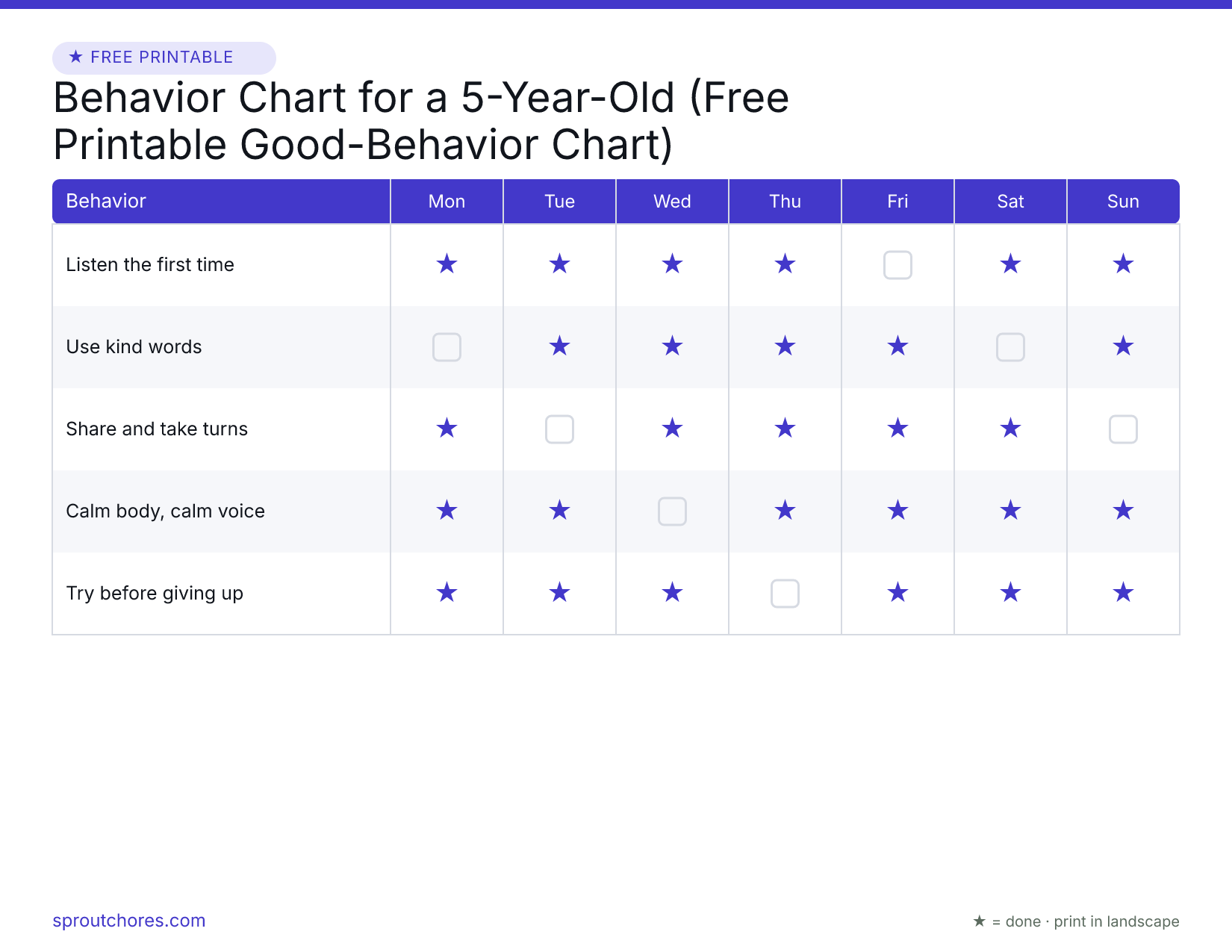
At four and five, a child is right on the edge of reading. Through the preschool and kindergarten years they know a handful of letters, but a clear picture still tells them far more than a word ever could, and that single fact shapes everything about a good behavior chart at this age. The one on this page is built around it: it runs on picture cues a pre-reader can decode at a glance, and it's meant to hold just one behavior, maybe two, instead of a long list. We're Andrew and the SproutChores family, raising four kids from 9 to 18 and fostering younger ones along the way, so we've had charts like this taped to the fridge for the better part of two decades. The honest thing we'd want you to hear before you print anything: this free printable behavior chart won't make your five-year-old behave, and it isn't meant to. Its real job is to give you, the parent, a quiet weekly read on how your child is doing, so you can catch a rough patch early and meet it with a steady hand rather than a big reaction. Build yours below, type in the one behavior you're focused on, print it with icons for the wall, then read on for how we keep it from turning into a sticker-for-being-good machine.
| Behavior | Mon | Tue | Wed | Thu | Fri | Sat | Sun | Remove |
|---|---|---|---|---|---|---|---|---|
| Listen the first time | ||||||||
| Use kind words | ||||||||
| Share and take turns | ||||||||
| Calm body, calm voice | ||||||||
| Try before giving up |
Tip: choose Landscape in the print dialog for the best fit.
Print in landscape for the best fit. A few reminders from our family to yours: do it together the first few times, keep the chart somewhere everyone can see it, and reward steady effort over a perfect job. — The SproutChores family
Want every age in one file? Get the free Age-by-Age Pack
Six printable charts (ages 4–10) plus reward and routine sheets, in one tidy PDF — free, straight to your inbox.
We email you new printables now and then — unsubscribe anytime. Privacy.
Something went wrong — please try again in a moment.
✓ Almost there — check your inbox!
We just emailed you a confirmation link. Click it to confirm, and your free Age-by-Age Chore Chart Pack lands in your inbox moments later.
Start with one behavior, two at the very most
The single most useful thing we can tell you about charting behavior at this age is to resist the urge to track everything at once. A five-year-old simply cannot hold a long list of expectations in their head. Their working memory is short, and a wall of demands reads to them as noise. So pick one behavior. If your child is doing well and you're feeling ambitious, stretch to two, but no further. One clear target a child can actually feel proud of finishing will always beat five they quietly tune out.
Make that behavior something you can both see and name plainly. "Be good" means nothing to a kindergartner, but "listen the first time I ask" or "keep gentle hands with your brother" is something you can point at, agree on, and celebrate the moment it happens. Choose the one thing that would genuinely smooth out your child's day right now, not the behavior some chart online happens to list. Every kid is wired a little differently, and the whole job here is to answer the question of what this particular child needs next.
This is also where a four-year-old and a five-year-old part ways. At four, expect to be right there beside them, coaching one simple behavior through with a lot of patience and even more grace. By five, with kindergarten teaching them that the day has a rhythm, a child can start to carry that one target a bit more on their own. Once it's genuinely automatic, retire it and quietly swap in the next thing you're working on.
Make the chart readable for a pre-reader
A chart only works for a pre-reader if the pictures do the talking. That's why the version here runs on icons rather than words: a small, clear image your child can decode in a second, without needing you to read the row aloud. When the cue is a picture they recognize on their own, the chart stops being your reminder and starts being theirs.
Where you hang it matters just as much as what's on it. Put it at your child's eye level, right where the behavior actually happens, not filed in a binder or stuck somewhere only adults look. Young kids respond to what's physically in front of them, which is one honest reason we've always leaned on paper taped to the wall over a tidy app. An app lives on a grown-up's phone, invisible to the very child it's supposed to guide, while a picture on the wall is impossible to walk past.
Then mark it together, in the moment, right after the good thing happens. Catching it live, with something like "you used such a gentle voice just now, let's put a star on it," is what welds the picture to the action in a young child's mind. Reconstructing the whole week on Sunday night does none of that. And resist the urge to take a star back after a hard afternoon. A chart that can run in reverse starts to feel like a penalty, and kids quietly stop trusting it. Let it record the wins, and handle the tough moments with a calm word instead.
What looks like misbehaving at five is often something else
Here's the shift that changed how we read our own kids: at five, a great deal of what looks like misbehaving isn't defiance at all. It's a small person who's tired, overstimulated, or who just got asked to drop something fun and switch gears with no warning. A chart can't fix that, and treating it as a discipline scoreboard usually makes it worse. What helps far more is a heads-up before a change is coming. Letting a child know that clean-up is a few minutes off gives them time to land the plane themselves instead of being yanked out of play, and that one habit has defused more standoffs in our house than any reward ever did.
When a five-year-old does tip over the edge, the order matters: help them settle first, talk about the behavior afterward. You can't reason with an overwhelmed little kid mid-meltdown, and a calm adult is the quickest path back to a calm child. We learned this most vividly while fostering young children who'd known almost no predictable structure. What first looked like acting out was, more often than not, a child who simply didn't know what was coming next, and a steady, repeating daily rhythm settled them in a way no prize could touch. Behavior, it turns out, grows out of feeling safe and feeling like you belong far more than out of earning a sticker.
So let the chart be a record, not a currency. We keep treats, screen time, and allowance deliberately walled off from it. The moment good behavior becomes something you buy and sell, the deeper message that this is our family and we look out for each other quietly slips away.
Knowing when to take it down
A behavior chart is scaffolding, not a permanent fixture. It comes down once the thing you built with it can stand on its own. The signal is usually a happy one: your child stops caring about the chart because the behavior has gone quiet and automatic. When a habit no longer needs the star, the habit has won. You don't need an announcement. Just let that behavior slip off the chart, hand the row to whatever's still a work in progress, and eventually let the whole thing fade.
Make peace early with how slowly this moves. Change in a young child is nearly invisible day to day. You only see it when you hold today up against a year ago. Our youngest now gathers every trash can in the house on his own, unprompted, and that didn't arrive in one gold-star week. It grew out of years of the same calm expectations, repeated until they were simply part of who he is. Your five-year-old's progress is unfolding on that same slow, real timeline.
Two last cautions. Don't pull the chart the instant one good week shows up. Give the habit time to truly set. And don't read the inevitable wobble, a holiday, a stretch of illness, a chaotic few days, as proof it all failed. The systems that survive real family life aren't the flawless ones. They're the ones you can dust off and restart on a Monday without any drama, and that restartability, more than any perfect streak, is what keeps a chart useful long enough to do its job.
Frequently asked questions
- How many behaviors should a behavior chart for a 5-year-old have?
- One, or two at the very most. At five a child's working memory is short, so a single clear target they can actually hold onto and feel proud of finishing beats a long list they simply tune out. Make it concrete and easy to picture, something like listening the first time or keeping gentle hands, rather than a vague "be good." Once that behavior is reliable and automatic, retire it and swap in the next thing you're working on.
- Do behavior charts actually work for 5-year-olds?
- It depends on what you're asking it to do. As a machine for bribing a five-year-old into good behavior, not really, and not for long. As a quiet weekly read for you, the parent, and a gentle picture cue for your child, it works well. In our experience the behavior itself changes because of a steady daily rhythm and a child feeling like they belong here, not because of the stars. We saw that most clearly while fostering kids who'd had little structure: predictability settled them far more than any reward could.
- What's the difference between a behavior chart for a 4-year-old and a 5-year-old?
- Mostly how much you expect and how much you help. A four-year-old needs you right alongside them, coaching one simple behavior with heavy picture cues and a lot of patience. A five-year-old, especially once kindergarten has taught them the day has a rhythm, can carry that one target a little more independently and is starting to grasp what it means to be part of the household, so you can occasionally stretch to two behaviors and expect a touch more consistency. The picture-based approach stays the same; the bar just inches up.
- Should I give my 5-year-old a prize for a good week on the chart?
- We'd keep big prizes off the chart. A small, occasional treat for a genuinely good stretch is fine, but paying out a reward per star quietly teaches a child that behaving well is something you do to get paid, which is a hard lesson to unwind later. Keep screen time and allowance on their own separate tracks entirely. The most durable motivation we've seen doesn't come from prizes at all; it comes from a child feeling like a valued, contributing part of the family, with the chart just helping that habit take hold.

About the author
More free printables
Get the free Age-by-Age Chore Chart Pack
Six printable charts (ages 4–10) plus reward and routine sheets, in one tidy PDF. We'll also send new printables and the occasional real parenting tip. The charts on this site are always free — no sign-up needed.
We email you new printables now and then — unsubscribe anytime. Privacy.
Something went wrong — please try again in a moment.
✓ Almost there — check your inbox!
We just emailed you a confirmation link. Click it to confirm, and your free Age-by-Age Chore Chart Pack lands in your inbox moments later.