Behavior Chart for the Classroom (Free Printable Clip & Color-Level Chart for Teachers)
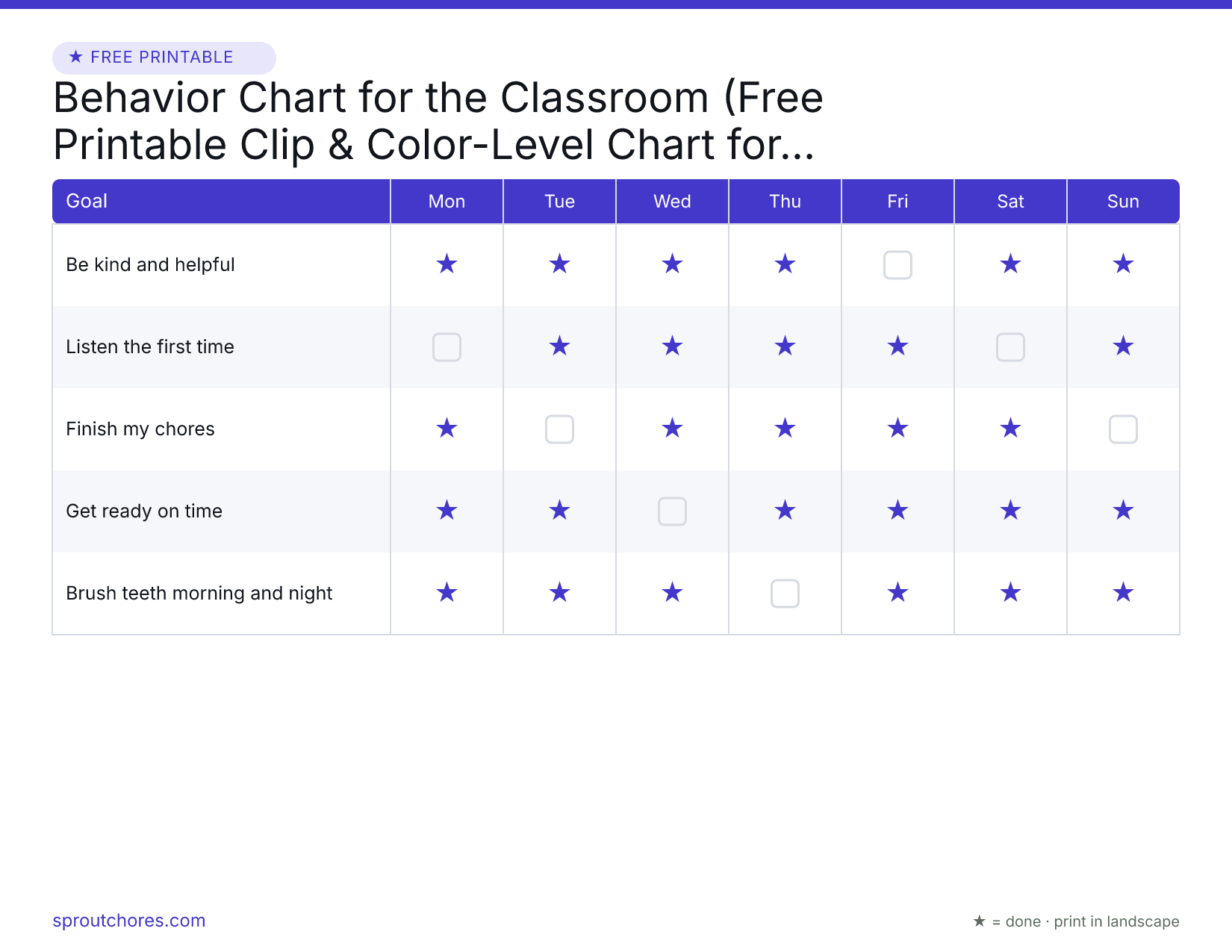
If you teach, you already know what a behavior chart for the classroom is supposed to do: give the room a shared, visible language for how the day is going, so a quiet redirect can happen without you raising your voice over thirty heads. The editable chart on this page builds exactly that kind of tool. Set up your own color bands or clip levels, add the goals you actually want to reinforce, and print it for the wall or the document camera. We're Andrew and my wife, raising four kids between 9 and 18 and fostering alongside that, and my wife spent years in a classroom before she came home to run our homeschool, so this lives close to the bone for us. Here's the honest thing we'd ask you to hold onto while you build yours. A chart on the wall is mostly a read-out for the adult in the room, a fast way to see who's thriving and who's quietly drifting, not a machine that manufactures good behavior on its own. The deeper pull toward cooperation comes from a child feeling like they belong in the room and are needed there, the same way it works at home. There's also a real catch with the clip-up, clip-down design that we'll be straight about below, because a chart that turns a hard morning into a public scoreboard can do more harm than the behavior it's tracking. Build your chart first, then read on for how to run it so it helps a class without singling anyone out, and how to know when to set it aside.
| Goal | Mon | Tue | Wed | Thu | Fri | Sat | Sun | Remove |
|---|---|---|---|---|---|---|---|---|
| Be kind and helpful | ||||||||
| Listen the first time | ||||||||
| Finish my chores | ||||||||
| Get ready on time | ||||||||
| Brush teeth morning and night |
Tip: choose Landscape in the print dialog for the best fit.
Print in landscape for the best fit. A few reminders from our family to yours: do it together the first few times, keep the chart somewhere everyone can see it, and reward steady effort over a perfect job. — The SproutChores family
Want every age in one file? Get the free Age-by-Age Pack
Six printable charts (ages 4–10) plus reward and routine sheets, in one tidy PDF — free, straight to your inbox.
We email you new printables now and then — unsubscribe anytime. Privacy.
Something went wrong — please try again in a moment.
✓ Almost there — check your inbox!
We just emailed you a confirmation link. Click it to confirm, and your free Age-by-Age Chore Chart Pack lands in your inbox moments later.
Running a clip chart without turning a hard day into a public display
The honest weakness of a clip-up, clip-down chart is that it broadcasts. When a child's clip slides down for the whole class to see, you've handed every other student a label to attach to that kid, and you've handed the kid a story about themselves they didn't choose. That's the part we'd ask you to handle with real care. If you use levels at all, we'd lean hard toward celebrating upward movement and keeping the harder conversations quiet and one-to-one, a low word at the desk rather than a clip dragged down in front of everyone. The reason isn't softness; it's that a child who feels exposed and cornered isn't in a state to learn anything from the moment anyway. We saw this in its rawest form while fostering young children who'd arrived with almost no steady structure: what looked like defiance was usually a kid who simply didn't feel safe yet, and no consequence landed until that settled. A dysregulated child, in the heat of it, will reach for whatever feels least awful right now and will often pin the bad feeling on whoever's nearest, which in a classroom is you. So the order matters. Help the child come back to even keel first, then have the conversation, because nothing said in the storm actually gets recorded properly. A few practical guardrails keep a classroom chart honest. Aim it at a small number of behaviors you can point to plainly, since a wall of vague expectations gets tuned out by the room and by you. Give advance notice the way you'd want it yourself, a quiet heads-up that we're cleaning up in five minutes lands far better than a cold command, and we've watched that single move dissolve more conflict than any chart ever did. And resist the urge to clip a child down for the kind of thing they can't consciously control in the moment. Some kids genuinely cannot answer the question of why they zoned out or forgot the thing again, because there was no decision behind it; pressing them on it just becomes one more thing to survive rather than a lesson. Used gently, the chart becomes a calm signal in the room. Used as a scoreboard of shame, it teaches kids to fear the wall.
Why the chart is your tool, not the class's motivation engine
It's tempting to expect the chart to do the motivating, to assume that once the colors and rewards are up, the room will police itself. In our experience that's backwards. The chart's real value is that it lets the adult see patterns at a glance: which student is on a quiet slide this week, which one only struggles right after a transition, which one is steady as a rock. That information is gold, because it tells you where to lean in early instead of waiting for a blow-up. But the thing that actually moves a child is the felt sense that this is a place where everyone contributes and is counted on, not the square on a chart. What surprises most teachers is how differently kids respond to the very same chart. In our own house the contrast is almost comic: our 11-year-old adores a chart and will happily design her own and chase every mark on it, while her 9-year-old brother could not care less, the colors slide right past him. For a kid like him the chart isn't a motivator at all; it's purely something the adult reads, while the real nudging happens in real time, a heads-up that the next task is coming, then a cue when it's time. A class is thirty versions of that range sitting in one room. The chart will reach some of them and bounce right off others, and that's not a flaw in the chart, it's just children being wired differently. So watch which students it's actually reaching and don't assume the one it slides past is choosing not to care. The matching tip we'd offer from years of trial and error: the principle of building good habits holds for every child, but how you reach a given kid changes from one to the next. Read your room, keep the chart as the steady backdrop, and do the personal work where the chart can't.
Using a reward layer well, then easing the chart back out
Plenty of classroom charts bolt a reward onto the top color band, and a reward layer can genuinely help when it's pointed at one specific habit a class is trying to build, lining up quietly, transitioning without chaos, cleaning up the room. The trouble starts when the prize becomes the whole reason kids do anything, because then you've quietly taught the room to expect a payout for ordinary belonging, and that's a hard lesson to walk back later. So we'd treat any reward as a short-term boost for a single new habit while it's forming, kept clearly apart from the things that are simply expected of everyone in the room. Small and frequent beats big and rare every time; at home our workhorse for years was a dollar-store treasure chest a kid could pick from when a stretch of work was done well and with a decent attitude, cheap enough that we never had to ration it or argue over it. In a classroom the same logic favors a little extra free-read time or letting the class pick the read-aloud over a high-stakes prize that turns into something to bargain over. And keep the reward lane walled off from the things that carry their own logic, the way we keep screen time and discipline on separate tracks from any chart at home. The real point, though, is that a behavior chart is scaffolding, not furniture. The signal to ease it out is a happy one: the routine has gone quiet and automatic, and the class barely glances at the wall anymore. When a habit stops needing the chart, the habit has won. None of this moves on a tidy schedule, and the systems that last in real rooms aren't the flawless ones, they're the ones you can dust off and restart in a few minutes after a fire drill or a substitute week knocks everything sideways. Real change in children is almost invisible day to day; you only see it when you compare the room in October against the room in March. Let the chart carry a habit for a season, then let it fade, because the thing that makes good behavior stick is the same thing the chart is quietly pointing toward, a child feeling like a needed part of the group.
Frequently asked questions
- Are classroom clip charts bad for kids?
- They're not automatically harmful, but the public, clip-up-clip-down design carries a real risk worth naming: when a child's clip slides down for the whole class to see, it can shame a kid in front of peers right when they're least able to learn from it. We'd lean toward celebrating upward movement openly and keeping any harder conversation quiet and one-to-one. From our years parenting and fostering, a child who feels exposed and cornered isn't in a state to take anything in anyway, so help them settle first and talk after. Used gently as a calm signal rather than a scoreboard, a chart can support a room; used to single kids out, it tends to teach fear of the wall instead of better behavior.
- How many behaviors should a classroom behavior chart track?
- Keep it short, just a handful of behaviors you can point to plainly. A wall of vague expectations like be good gets tuned out by the whole room, while specific, visible targets such as line up quietly or clean up your space give both you and the students something concrete to agree on. Pick behaviors that are a genuine but reachable stretch for the class you actually have, and start a touch easier than feels necessary. An easy-to-meet chart gets used all week; an overloaded one is ignored by Thursday, and you can always raise the bar once the early wins start stacking up.
- Should classroom good behavior come with rewards or prizes?
- A reward layer can help as a short-term boost while a class builds one specific new habit, but we'd keep it small, frequent, and low-drama rather than a big prize that becomes something to bargain over. Reserve it for the one or two things you're actively trying to build right now, and keep the everyday expectations of the room unrewarded, since rewarding everything quietly teaches kids to expect a payout for ordinary belonging. In practice an extra few minutes of free reading or letting the class pick the read-aloud works better than high-stakes prizes. The motivation that actually lasts comes from children feeling like needed members of the group, so let any reward fade once the habit holds on its own.
About the author
More free printables
Get the free Age-by-Age Chore Chart Pack
Six printable charts (ages 4–10) plus reward and routine sheets, in one tidy PDF. We'll also send new printables and the occasional real parenting tip. The charts on this site are always free — no sign-up needed.
We email you new printables now and then — unsubscribe anytime. Privacy.
Something went wrong — please try again in a moment.
✓ Almost there — check your inbox!
We just emailed you a confirmation link. Click it to confirm, and your free Age-by-Age Chore Chart Pack lands in your inbox moments later.