Behavior Chart for Kids at Home (Free Printable Good-Behavior Tracker)
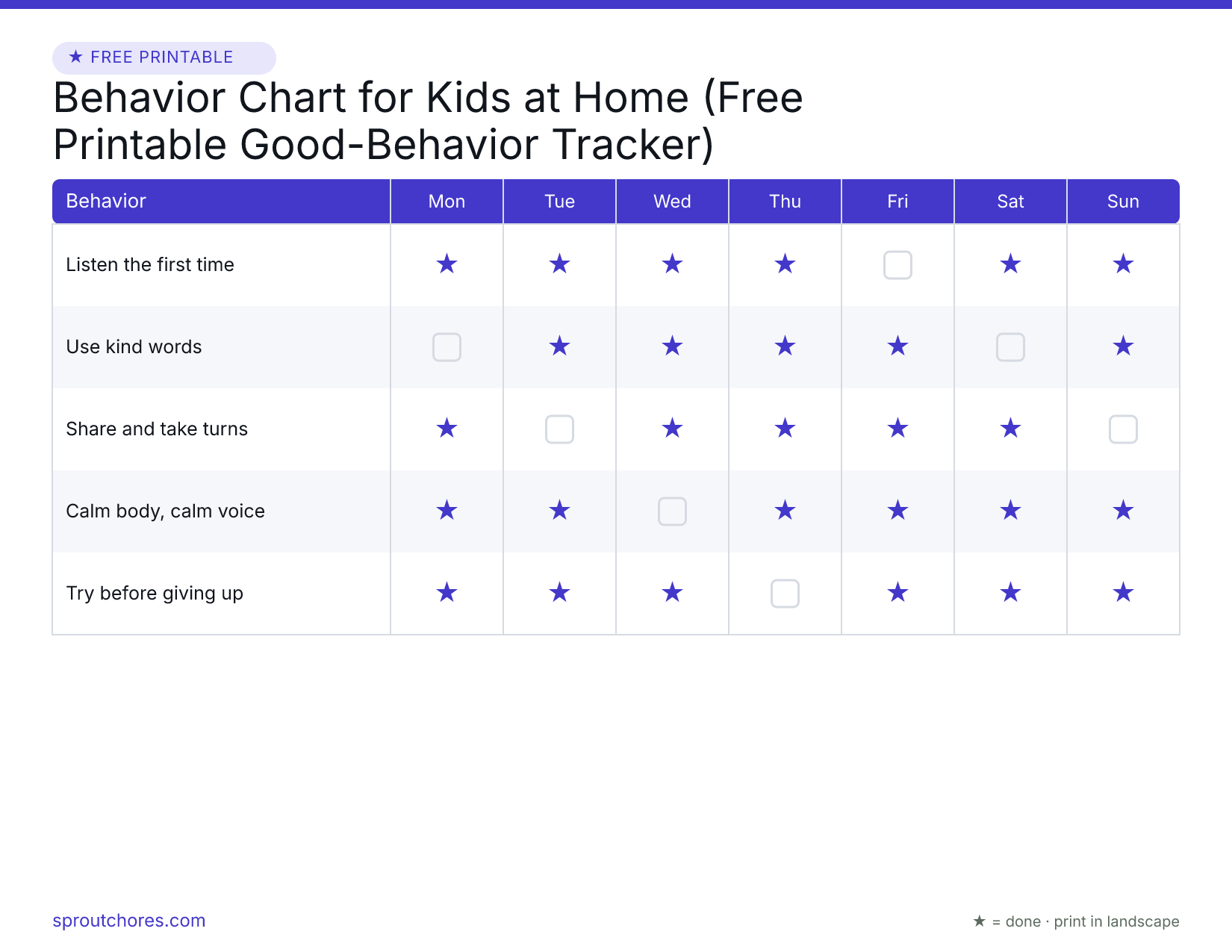
A behavior chart for kids is, at heart, a very simple thing: a few habits running down one side, the days of the week across the top, and a small smiley to earn each day one goes well. The chart on this page is yours to shape. Type in the behaviors you actually want to encourage, print it for the fridge or a bedroom wall, and let your child watch a good week fill in. Before you start, though, here's the one idea we'd ask you to keep in the back of your mind. We're Andrew and our wife, raising four kids between the ages of 9 and 18, and foster parents on top of that, so we've lived with charts like this for years. What we've come around to is that the chart is mostly for you, the parent. A row of smileys won't make a child want to behave, and it shouldn't have to. The real pull comes from a child knowing this is a home where everyone pitches in and looks out for each other. The chart's quieter, more useful job is to show you, week by week, how each kid is really doing, so you can notice a rough patch early and lean in before it grows. Used that way, a printable behavior tracker earns its place on the fridge. Build yours below, then read on for how we make it work without it turning into a sticker economy.
| Behavior | Mon | Tue | Wed | Thu | Fri | Sat | Sun | Remove |
|---|---|---|---|---|---|---|---|---|
| Listen the first time | ||||||||
| Use kind words | ||||||||
| Share and take turns | ||||||||
| Calm body, calm voice | ||||||||
| Try before giving up |
Tip: choose Landscape in the print dialog for the best fit.
Print in landscape for the best fit. A few reminders from our family to yours: do it together the first few times, keep the chart somewhere everyone can see it, and reward steady effort over a perfect job. — The SproutChores family
Want every age in one file? Get the free Age-by-Age Pack
Six printable charts (ages 4–10) plus reward and routine sheets, in one tidy PDF — free, straight to your inbox.
We email you new printables now and then — unsubscribe anytime. Privacy.
Something went wrong — please try again in a moment.
✓ Almost there — check your inbox!
We just emailed you a confirmation link. Click it to confirm, and your free Age-by-Age Chore Chart Pack lands in your inbox moments later.
How to use a behavior chart at home without it becoming a bribe
Hang it where your child genuinely lives — at their eye level, on the fridge door or the wall beside their bed, not tucked inside a binder. With younger kids especially, that visibility is most of the point: the chart sits in their everyday line of sight and gently cues what's expected next. Then mark it in the moment rather than reconstructing the week on Sunday night. Catching a behavior as it happens — "you got dressed before I even asked, that's a smiley" — is what makes the chart feel alive instead of like paperwork. We'd steer you away from one tempting habit, though: erasing a smiley after a bad afternoon. A tracker that can run backwards starts to feel like a penalty, and kids quietly stop believing in it. Let it record the good days, and handle the hard ones with a calm conversation instead. And keep the chart walled off from the things that already carry their own logic in our house. Screen-time limits, for us, are about protecting sleep and focus — one of our daughters slept far better once evenings went screen-free, so that boundary stands on its own, not as a prize you buy with good behavior. Money is its own track too: any allowance our kids earn rides on steady effort and a decent attitude over time, never paid out a smiley at a time. When the chart stays a simple record rather than a vending machine, it does its real work and stops feeding the daily negotiation.
Choosing 3 to 5 behaviors worth tracking
The fastest way to make a behavior chart fail is to cram it full. Pick three to five behaviors, no more — a short, focused list a child can actually hold in their head and feel proud of finishing. When the chart turns into a wall of demands, kids tune it out, and so do you. Aim for behaviors you can see and name plainly. "Be good" is a fog; "put your shoes away when you come in" or "speak kindly when you're frustrated" is something both of you can point at and agree on. We've found it helps to choose behaviors that are genuinely a stretch for that particular child right now, rather than copying someone else's list. Every kid is wired differently — the principle of building good habits holds across all of them, but what you put on the chart should answer the question of what would make this child's day go a little smoother. For one of ours, the answer was as concrete as managing the transition out of a fun activity; gentle warnings as the clock ran down did more than any sticker. It's also worth keeping the bar honest to your child's age. A four-year-old's chart should lean on self-care and simple routines you'll often still help with, while an older child can carry behaviors that ask for real self-management. Start a touch easier than you think you need to. An easy chart gets used all week; an ambitious one is abandoned by Thursday, and you can always raise the bar as the wins start stacking up.
When and how to phase the chart out
A behavior chart is scaffolding, not furniture — it's meant to come down once the building underneath can stand on its own. The signal to start phasing it out is usually a happy one: the behavior has gone quiet and automatic, and your child barely glances at the chart anymore. When a habit stops needing the smiley, that habit is winning. You don't need a ceremony or an announcement. We tend to just let a behavior drift off the chart once it's reliable, freeing up a row for whatever's still a work in progress, and eventually the whole chart fades when there's nothing left that needs tracking. None of this moves on a tidy schedule, and it's worth making peace with that early. Real change in kids is almost invisible day to day; you only see it when you compare now against a year ago. Our youngest son now hauls every bag of trash in the house on his own, no reminder from anyone — and that didn't arrive in a triumphant week of stars. It grew out of years of the same quiet expectations, repeated until they became simply who he is. Two cautions as you wind a chart down. Don't yank it the instant a single good week shows up; let the habit actually set. And don't treat the inevitable rough patch — a holiday, an illness, a chaotic stretch — as proof the whole thing failed. The systems that last in real homes aren't the flawless ones; they're the ones that are easy to dust off and restart after life knocks them sideways. We learned that vividly while fostering: when we took in children who'd known almost no predictable rhythm, what first looked like defiance was usually a kid who simply didn't know what was coming next. A steady, repeated routine settled them far more than any reward could, because what they truly needed was to feel safe and to belong. That's the same thing your chart is quietly pointing toward — and once a child has it, the chart has done its job.
Frequently asked questions
- What is a behavior chart for kids actually for?
- It's most useful as a tracking tool for you, the parent, rather than a reward machine for your child. A glance at the week tells you which behaviors are clicking and which one your kid is quietly struggling with, so you can step in early or ease off. In our house the motivation for good behavior never comes from the smileys themselves — it comes from the expectation that everyone in the family contributes and looks out for each other. The chart simply makes a child's progress visible to the adults guiding them.
- How many behaviors should a kids' behavior chart track at home?
- Keep it to three to five behaviors. A short, specific list is something a child can actually remember and feel good about completing, while a long one turns into background noise that everyone ignores. Choose behaviors you can see and describe plainly — "put toys away before dinner" beats "be good" — and pick ones that are a real but reachable stretch for your particular child right now. Start a little easier than feels necessary; an easy chart gets used all week, and you can raise the bar once the early wins build momentum.
- Should I give my child a prize for filling in the behavior chart?
- We'd keep big prizes off the chart. When every smiley buys a reward, cooperation starts to feel like a transaction and the prize quietly becomes the whole point, which is a hard pattern to undo later. If you offer anything, make it a small, occasional treat for a good stretch of effort rather than a payout per square, and keep screen time and allowance on separate tracks entirely. The most durable motivation we've seen comes from a child feeling like a contributing part of the household, with the chart just helping that habit take hold.
- When should I stop using a behavior chart?
- Phase it out when the behavior has become automatic and your child barely notices the chart anymore — that fading interest usually means the habit has stuck, which was the goal all along. There's no need for an announcement; just let that behavior drop off the chart and free up the row for something still in progress. Don't pull the chart after a single good week, and don't treat a rough patch during a holiday or busy stretch as failure. The best systems are simply easy to restart, so dust it off and pick back up where you left off.

About the author
More free printables
Get the free Age-by-Age Chore Chart Pack
Six printable charts (ages 4–10) plus reward and routine sheets, in one tidy PDF. We'll also send new printables and the occasional real parenting tip. The charts on this site are always free — no sign-up needed.
We email you new printables now and then — unsubscribe anytime. Privacy.
Something went wrong — please try again in a moment.
✓ Almost there — check your inbox!
We just emailed you a confirmation link. Click it to confirm, and your free Age-by-Age Chore Chart Pack lands in your inbox moments later.