Chore Chart for ADHD Adults: A Free Printable You Can Actually Stick To
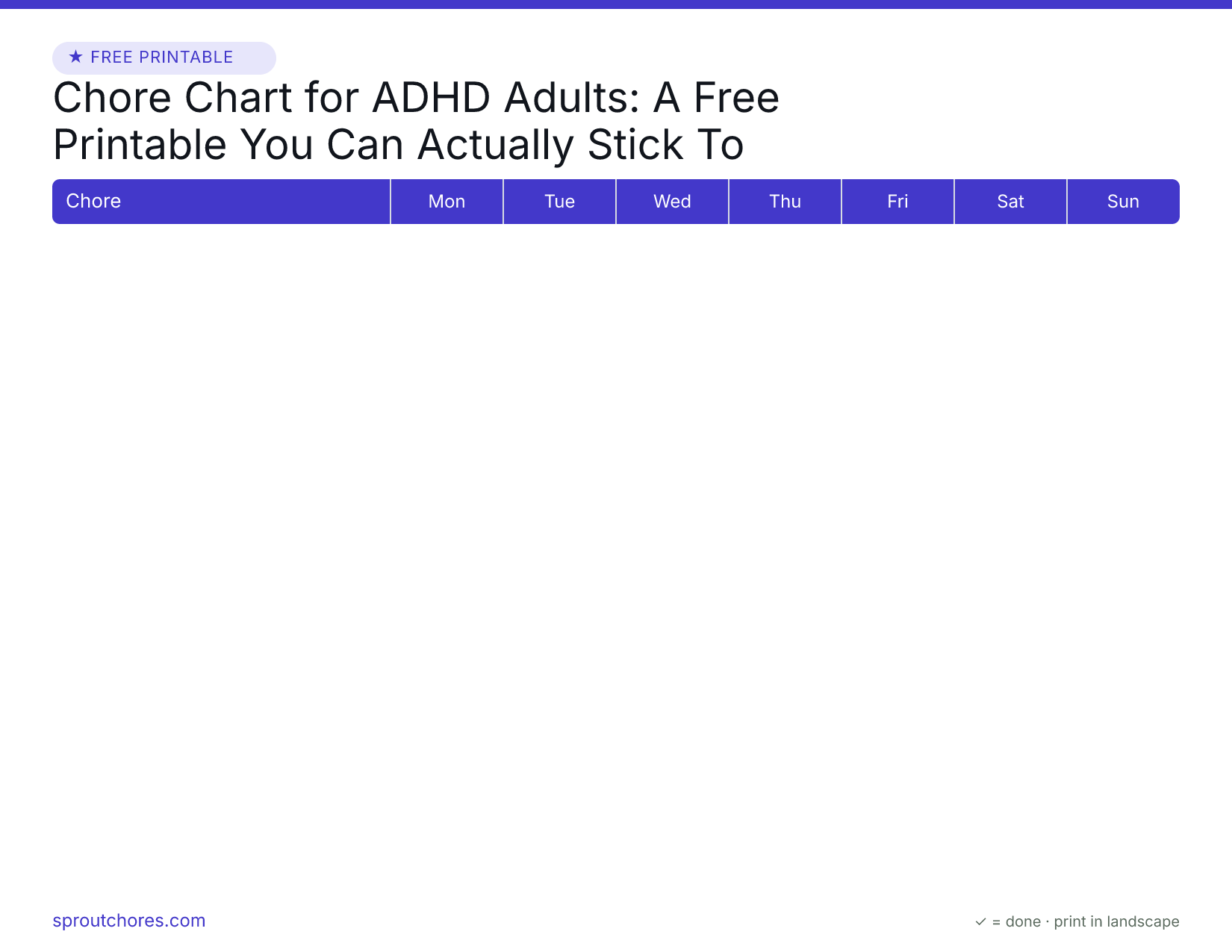
If a tidy color-coded planner has ever made you feel worse instead of more capable, you are in the right place. I am Andrew, a dad of four and a foster parent, and I am also someone whose own attention works exactly the way a lot of adults reading this will recognize. I lean inattentive. I will sit down to start something, drift off into a tab I opened twenty minutes ago, and have to physically reel my brain back to the desk. So this is not a chart handed down by someone who has it all figured out. It is the kind of plain, low-pressure tool I have leaned on myself. The generator below makes a blank, editable chart: you fill in your own tasks across the week, and you choose how full it gets. There are no childish stickers, no cartoon brooms, and no fixed list telling you what your life should look like. Just a frame you can bend around how your attention actually behaves.

| Chore | Mon | Tue | Wed | Thu | Fri | Sat | Sun | Remove |
|---|
Tip: choose Landscape in the print dialog for the best fit.
Print in landscape for the best fit. A few reminders from our family to yours: do it together the first few times, keep the chart somewhere everyone can see it, and reward steady effort over a perfect job. — The SproutChores family
Want every age in one file? Get the free Age-by-Age Pack
Six printable charts (ages 4–10) plus reward and routine sheets, in one tidy PDF — free, straight to your inbox.
We email you new printables now and then — unsubscribe anytime. Privacy.
Something went wrong — please try again in a moment.
✓ Almost there — check your inbox!
We just emailed you a confirmation link. Click it to confirm, and your free Age-by-Age Chore Chart Pack lands in your inbox moments later.
Why an adult ADHD chart needs to be nearly empty
The fastest way to abandon a chore chart is to fill it with twenty tidy rows on day one. A wall of tasks reads as one giant undifferentiated blob, and a brain wired this way tends to respond to that blob by quietly deciding not to look at it again. That is why this generator caps the number of rows low and skips the decorative clutter. The goal is a page so sparse it never feels like a confrontation.
The other reason to keep it light is honesty about what charts can and cannot do. In our house, I think of a chart as a tracking tool, not a motivator. For an adult, that means the page is there to show you where you actually are this week, not to nag you into being someone else. A short, finishable list that you genuinely complete teaches your brain that this thing is safe to open. A bloated, half-checked one teaches the opposite. Start with three or four things you can realistically close out, leave the rest of the grid blank on purpose, and let the chart earn your trust before you ask more of it.
Break the big jobs into pieces you can finish today
Here is the move that changed the most for me. A task with no visible end, like "deep clean the kitchen" or "sort the paperwork," hits my brain as a vague threat, and the instinct is to look away from it entirely. The fix is to never write the giant version on the chart at all. Write the smallest slice that has a clear finish line.
Not "clean the kitchen" but "clear and wipe the counters." Not "do the laundry" but "move the wash to the dryer." Each row should be something you can point at and say it is unambiguously done. I work this out on my early-morning walks: I take whatever is looming and chop it into chunks small enough that I can actually measure when each one is finished. A useful side effect is that you finally learn how long things really take, which kills a lot of the dread.
Then give yourself explicit permission to feel finished. When a block is done, it is done, and you are allowed to stop and register that as a win rather than immediately steamrolling into the next worry. That small, deliberate sense of completion is doing more work than any reward sticker ever could, and an editable chart lets you size each block down to whatever your brain will actually start.
Build the system around your real attention, not the ideal version of you
A chart works best when it sits inside a few habits that take the pressure off your memory and your willpower. A handful that have held up for me:
Clear the field first. Before a focused block, I get the physical and digital space down to one thing. A clean surface, and on the computer, close everything except the single task and sometimes restart the machine so there is nothing tempting to jump to. A brain that cannot see the distraction has a much easier time staying put. The chart is part of that cleared field, which is exactly why it should not be visually loud.
Externalize everything. If it lives only in your head, assume it will evaporate. The chart is one place to offload; a calendar entry is another. The point is that the page remembers so you do not have to, which frees up the attention you were spending just trying not to forget.
Work with your own clock. I am sharp in the early morning and fading by evening, so I aim my hardest tasks early and stop pretending I will rally at night. Someone else peaks after dark. When you fill in the chart, slot the demanding rows into your actual good hours instead of fighting your own rhythm. And when a layout stops working, do not declare the whole thing a failure. The best systems are the ones that are easy to restart after a bad week, so just reprint a fresh, mostly-empty page and pick it back up. That recoverability matters far more than any single perfect streak.
Frequently asked questions
- Why doesn't this chart have icons or pictures?
- Because it is built for adults, not as a scaled-up kids' chart. Cartoon icons and reward stickers can read as patronizing, and they add visual noise that a distractible brain does not need. This page is deliberately plain and low-density: a small number of editable rows, no decoration, and room to leave most of the grid blank. The idea is a frame quiet enough that opening it never feels like a confrontation, which for a lot of us is the whole battle.
- How many chores should I put on an ADHD chart?
- Fewer than you think. The generator keeps the task count low on purpose. A long list tends to register as one overwhelming blob that the brain quietly avoids, so start with three or four things you can genuinely finish, and break any big job into its smallest finishable slice. "Wipe the counters" beats "clean the kitchen." A short list you actually complete teaches your brain the chart is safe to use; a bloated one you abandon teaches the opposite. You can always add more once the habit holds.
- What if the chart stops working after a week or two?
- That is normal, and it is not a verdict on you. Most systems fall apart not because they were bad but because they were not built to survive a busy week, a trip, or a rough patch. The fix is to treat the chart as something you restart rather than something you perfect. When it slips, do not throw out the whole approach. Print a fresh, mostly-empty page and begin again with a couple of easy wins. Recoverability matters far more than any unbroken streak.
- Is this medical advice for managing ADHD?
- No. Everything here comes from our family's own lived experience with how attention works for us, not from a clinic. I am writing as a parent and an adult who navigates this day to day, sharing tools that have helped in our house, framed as tendencies and personal experience rather than diagnoses. It is not treatment guidance, and it says nothing for or against medication, which is a personal decision. If you have questions about diagnosis or treatment, please talk with a qualified professional.

About the author
More free printables
Get the free Age-by-Age Chore Chart Pack
Six printable charts (ages 4–10) plus reward and routine sheets, in one tidy PDF. We'll also send new printables and the occasional real parenting tip. The charts on this site are always free — no sign-up needed.
We email you new printables now and then — unsubscribe anytime. Privacy.
Something went wrong — please try again in a moment.
✓ Almost there — check your inbox!
We just emailed you a confirmation link. Click it to confirm, and your free Age-by-Age Chore Chart Pack lands in your inbox moments later.