Visual Chore Chart for an Autistic Child (Free Printable Picture Chart)
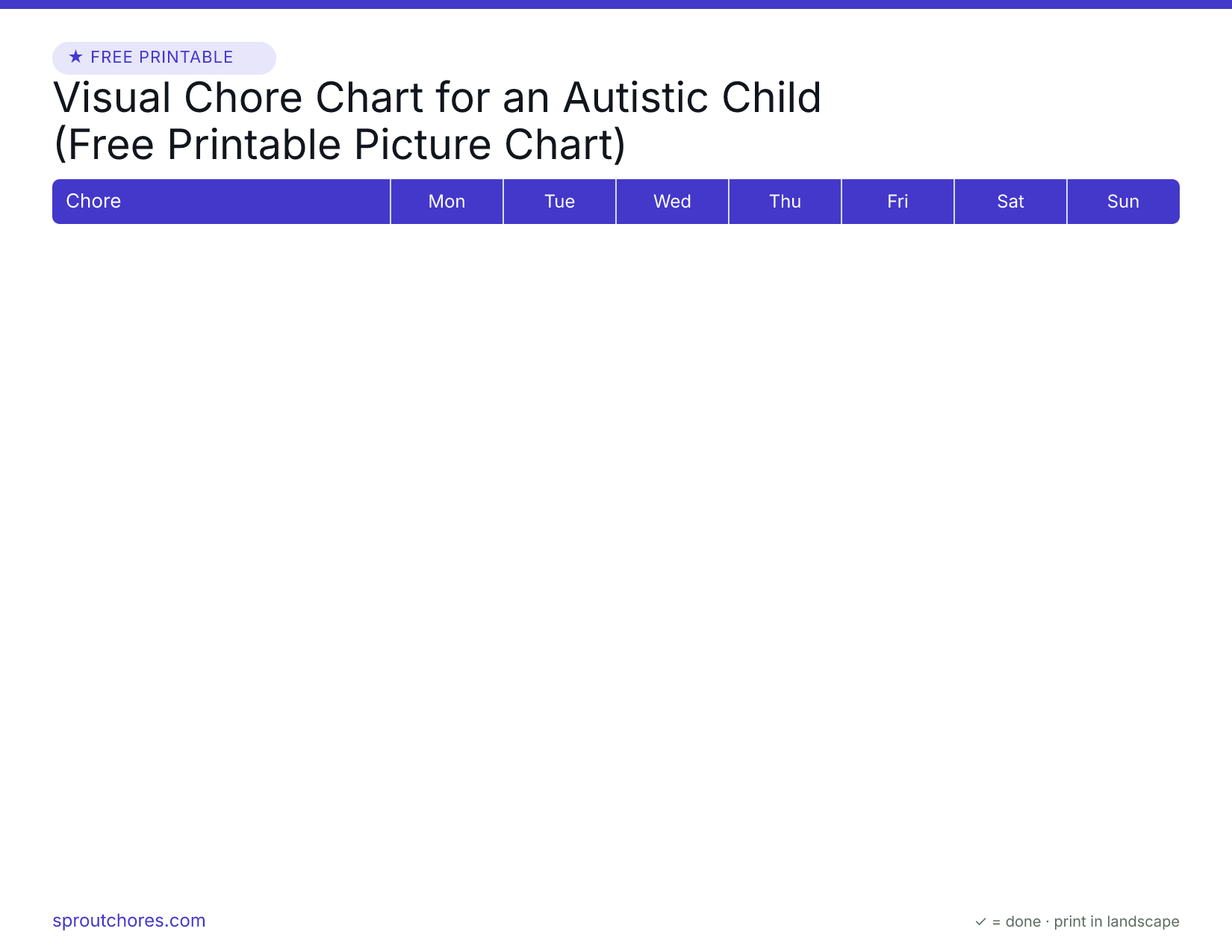
I want to be straight with you before you print anything, because it will save you some frustration. I'm Andrew, writing for the SproutChores family — my wife and I are raising four kids between nine and eighteen, and for about half a year we fostered boy-girl twins who had just turned three, both on the spectrum (one diagnosed, the other suspected). Here is the honest part: at that age, a chart on the wall taught those two almost nothing on its own. What steadied them was a day that unfolded the same way every single time, so they could feel what came next in their bones. That is the truth most printable pages skip, and it's the truth that makes the tool above actually worth using. The chart maker here is fully blank — you pin your own pictures to your own short list of jobs and print it, no account and no email. For a very young or largely non-speaking child, its first real job isn't to instruct your child at all; it's to keep the grown-ups running the same routine the same way, posted where anyone stepping in can follow it. Further down I'll cover older autistic kids too, where a visual chart genuinely does more of the lifting, and I'll lean on reputable research there rather than just our kitchen-table story. One firm note up front: everything here is our family's lived experience, not a diagnosis and not medical advice. Every child is different, and anything clinical belongs with a professional you trust.
| Chore | Mon | Tue | Wed | Thu | Fri | Sat | Sun | Remove |
|---|
Tip: choose Landscape in the print dialog for the best fit.
Print in landscape for the best fit. A few reminders from our family to yours: do it together the first few times, keep the chart somewhere everyone can see it, and reward steady effort over a perfect job. — The SproutChores family
Want every age in one file? Get the free Age-by-Age Pack
Six printable charts (ages 4–10) plus reward and routine sheets, in one tidy PDF — free, straight to your inbox.
We email you new printables now and then — unsubscribe anytime. Privacy.
Something went wrong — please try again in a moment.
✓ Almost there — check your inbox!
We just emailed you a confirmation link. Click it to confirm, and your free Age-by-Age Chore Chart Pack lands in your inbox moments later.
For a young or non-speaking child, the routine does the teaching — the chart keeps the adults consistent
With our twins, I learned fast that words alone didn't carry instructions the way I expected. Ask one of them to "say please" and you'd get the tail end of your own sentence echoed back, with no bridge to the idea underneath it. So a chart meant to *tell* a very young child what to do, in that season, was asking for a skill they simply didn't have yet. What worked instead was a fixed pattern they could anticipate. Dinner led to the last show of the night, which led to the tub, then books, then teeth, then bed — and once they trusted that order, they'd actually start calling out for the next step because they knew it was coming and it felt safe. The sequence did the work the chart couldn't.
So here's the reframe that changes how you'll use the tool above. For a child this young, don't build the chart as a set of orders for your child to read and obey. Build it as a script for the adults. Pin your family's picture routine on the fridge so that any grown-up in the house can run the day the exact same way, and so a hand-off never turns into a scramble — one parent can step out and the other picks up the sequence without missing a beat. That consistency is the whole point. The predictability isn't really for the child in the sense of following a list; it's the thing that lets *you* stay steady, and your steadiness is what the child leans on.
And give it time. In our house it took somewhere between a couple of weeks and a full month before a daily rhythm even seemed to register, and longer still before it settled. It feels endless while you're in it, and then one day it's simply easier. Research backs the broader idea that predictable, structured routines and visual supports help autistic children — Autism Speaks and other reputable groups describe visual schedules and structured routines as widely used supports (autismspeaks.org). But mirror that against the honest timeline: the structure is a slow-burn foundation, not a switch you flip.
"First this, then that": making the next step visible is the chart's real job
One way to use the tool above that tends to pay off across ages is to let it show the *next* thing rather than the whole day at once. That's the idea behind a "first, then" setup, which turns up repeatedly in the visual supports autism organizations recommend (autismspeaks.org): instead of a long list, you show just two things — first we do this, then we do that. First teeth, then a book. It narrows the world down to one step a child can manage, plus a plain reason to finish it. It's especially handy in the minutes right before a change of activity, which is often where a young child needs the most support. On the printable above you can keep the full weekly grid for your own planning and still zoom in to a single first/then pair when you need it.
Small rhythms make the bigger ones easier to carry. Each morning with the twins we'd name the kind of day ahead — a home day, a visit day, a going-out day — so what was coming next wasn't a mystery to them. It meant nothing in the first days; by a few weeks in, it clearly did. Expect that same pattern from any visual support here: it works by slow accumulation rather than in a single afternoon, and the quiet payoff is a day with fewer surprises waiting inside it.
As with everything on this page, that's what we've lived rather than medical guidance — every child is different, and anything clinical belongs with a professional who knows yours.
Older autistic kids: where a visual chart earns its place
As a child grows and starts connecting a picture to an action to a result, a visual chart shifts from being mostly a caregiver tool toward doing real work for the child. This is where the printable above starts to look like what most people picture when they imagine a chore chart. I'll be careful here and separate what I've lived from what's better answered by research, because our own firsthand window is with much younger kids.
What the research consistently points to — and what fits everything we've seen — is that visual, predictable supports tend to help. Visual schedules and step-by-step picture sequences are among the most commonly recommended supports for autistic learners; you'll find them described across autism organizations and educational resources such as Autism Speaks (autismspeaks.org) and the National Autistic Society (autism.org.uk). The common thread is that seeing the steps laid out reduces the mental load of holding a sequence in your head and softens the friction of shifting from one activity to the next. That's why, on the tool above, I'd nudge you toward a picture for each job rather than words alone, even for an older child — and toward breaking one job into its small steps if a single icon isn't enough.
A couple of things from our own experience carry over regardless of age. First, transitions are often the hard part, not the task itself — the jolt of stopping one thing to start another is what tips a moment sideways. A chart that makes the next step visible ahead of time gives a child a running start at that shift, which is worth more than any reward pinned to finishing. Second, every child on the spectrum is genuinely different; a support that clicks for one may do nothing for another. So treat the chart as a starting point you adjust, not a prescription. If a picture routine isn't landing, that's information, not failure — shorten it, change the images, or move where it lives, and try again.
How to build a chart that actually fits your child (and your house)
Because the generator above starts empty, you get to write in the handful of things that matter for *your* child instead of inheriting a stranger's list. That freedom is the whole advantage, so use it. Start from the child in front of you and work backward to the chart, never the other way around. A job that's a fine fit for one kid can be genuinely out of reach for another — one of our twins had a condition that left her physically weak, so something as ordinary as getting dressed was real, effortful work for her, not a two-minute task. If I'd graded her against a generic chart, I'd have missed the point entirely.
A few things we'd steer you toward as you fill in the grid:
- Keep it short. A couple of steps a child can actually complete beats a crowded sheet that becomes wallpaper. For a young child, a self-care sequence they see the same way each day is plenty.
- Put a picture on everything, and hang the chart where the work happens rather than in one master spot by the door. A morning routine belongs where they get dressed; a kitchen step belongs in the kitchen. When the reminder sits right where the action is, it cues the next move on its own instead of leaving you to repeat yourself all day.
- Build in slack for regulation. This one's easy to skip and costly to skip. Don't schedule the day so tightly that there's no room to help a child settle. If a ten-minute drive matters, leave far earlier than you'd think you need to, so a rough morning has somewhere to go. On the spectrum especially, a young child often can't self-regulate yet, so part of the plan is *your* plan bending to make space for theirs.
And here's the stance that runs through everything we do: the chart is a tracking tool for you, the parent — a way to see how your child is doing and decide when to lean in — not a machine for motivating them. We keep rewards, allowance, and screen time in their own separate lane, never priced out job by job. Motivation, in our house, comes from the plain expectation that everyone belongs to the family and pitches in, and for a young autistic child it comes from a day that feels safe and predictable. The chart supports that. It was never meant to be the engine. We saw this most clearly while fostering: for kids who'd never had a household they could count on, a simple, dependable rhythm did more good than any prize riding on top of it — what first looked like defiance was usually just not knowing what came next.
Frequently asked questions
- Do chore charts actually work for autistic children?
- It depends heavily on the child's age and stage, and I'll be honest about it. For a very young or largely non-speaking child, a chart on the wall won't teach your child much by itself — what does the teaching is a predictable daily routine they can anticipate and feel safe inside. At that stage the chart's real value is keeping the adults consistent, so anyone in the house can run the day the same way. For older autistic kids who connect a picture to an action, a visual chart does more of the actual work, and reputable autism organizations describe visual schedules and picture sequences as commonly used supports (autismspeaks.org, autism.org.uk). Either way, treat it as a starting point you adjust to your child. This is our family's lived experience, not medical advice — every child is different, so lean on a professional you trust for anything clinical.
- What kind of chart is best for a non-verbal or pre-verbal autistic child?
- In our experience with young twins on the spectrum, the most useful thing wasn't a chart the child reads — it was a picture routine posted for the grown-ups, so the day ran the same way every time no matter who was on duty. So build a short, all-pictures sequence and hang it where each step happens: the morning steps where they get dressed, the bathroom steps in the bathroom. Keep it to just a few images, use the same order every single day, and give the routine real time to sink in — for us it took weeks before it even registered. The consistency you provide is what the child leans on, far more than any single icon on the wall. If communication or development questions come up, those are worth raising with a professional.
- How long before a routine or chart starts helping an autistic child?
- Slower than you'll want, honestly. With our fostered twins it took somewhere between a couple of weeks and a month before a daily pattern even seemed to register, and longer before it truly settled in. It can feel like nothing is working right up until the moment it quietly starts to. Two things helped us stay the course: running the exact same sequence every day whether it was a busy day or a lazy one, and building slack into the schedule so a rough morning had room to breathe instead of colliding with the clock. Progress on the spectrum tends to look like steady, uneven improvement rather than a breakthrough — the hard moments don't vanish, but over time they come less often and are easier to move through. This is our own experience, not a clinical timeline; every child is different.
- What chores are appropriate for an autistic child?
- Start from your child, not from a list — that's the whole reason the chart above is blank. Match each job to what this child can genuinely do right now, and break it into small, visible steps when a single picture isn't enough. Keep in mind that a task that's trivial for one kid can be real, effortful work for another, so "right for this child" matters far more than "right for this age." Good early candidates tend to be short self-care and tidy-up steps done at the same point every day, so the routine and the chore reinforce each other. Hold the list short and treat it as a starting point you adjust — and for anything specific to your child's needs, the professionals who know them are the best guide.
- Should I use rewards or stickers on the chart for an autistic child?
- In our house the chart is a tracking tool, not a prize machine — a way for the adults to see how things are going and stay consistent, not a system for buying cooperation one job at a time. We keep rewards, allowance, and screen time in their own lane rather than pricing them onto tasks. For a young autistic child especially, the thing that actually builds cooperation isn't a sticker at the end; it's a day that feels safe and predictable, where the next step is always knowable. Stickers are fine if your child simply enjoys them, but lean on the routine and your own steady presence to do the real work — the reward isn't what makes the chart effective.
- How do I get my autistic child to actually follow the chart?
- Gently, and slower than you'd like — the aim is cooperation that grows, not compliance you force. Three things helped us most. First, make the next step visible right before it happens instead of relying on your child to hold the whole plan in their head; a simple "first this, then that" cue at the moment of a transition does more than any full-day list. Second, give it weeks rather than days — it's normal for nothing to seem to change and then, gradually, for it to. Third, build slack into the day: if you have to be out the door by a set time, back the whole morning up so a hard moment isn't racing the clock. And when a step still won't land, treat it as a signal to adjust rather than a defeat — shorten the chart, change the pictures, or move where it lives. This is our experience, not a clinical method, and every child is different.

About the author
More free printables
Get the free Age-by-Age Chore Chart Pack
Six printable charts (ages 4–10) plus reward and routine sheets, in one tidy PDF. We'll also send new printables and the occasional real parenting tip. The charts on this site are always free — no sign-up needed.
We email you new printables now and then — unsubscribe anytime. Privacy.
Something went wrong — please try again in a moment.
✓ Almost there — check your inbox!
We just emailed you a confirmation link. Click it to confirm, and your free Age-by-Age Chore Chart Pack lands in your inbox moments later.