Chore Chart for ADHD Kids (Free Printable Visual Chart + Generator)
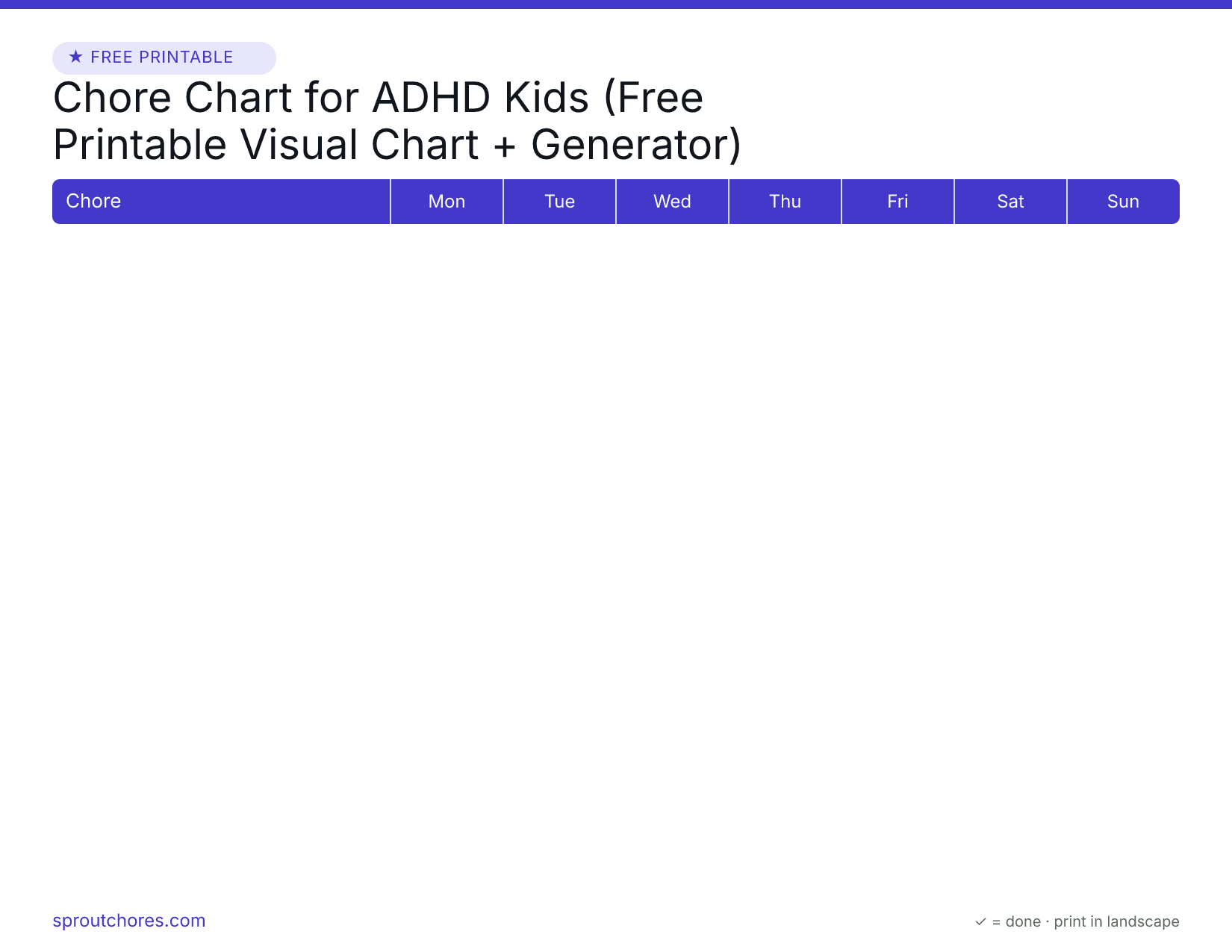
If you have a kid whose brain runs fast in a hundred directions, you already know the standard chore chart doesn't fit them. You make a tidy grid, you tape it up, and within a few days it's wallpaper. I'm Andrew, and our SproutChores house has four kids, ages 9 to 18, plus the children we've fostered along the way. Two of ours are wired this way, and so am I, so a chart that works for an attention-wired child isn't a guess for us, it's something we've had to figure out the hard way at our own kitchen table. One honest note up front: everything on this page is what we've lived, not a diagnosis and not medical advice. If anything around medication ever comes up, that belongs with a professional you trust, not a chore-chart page. What I can hand you is the chart maker above, where you fill in your own short list of jobs across the week and pin a picture to each one, plus the part most printables skip: how to use it so it actually holds for a kid whose attention won't sit still. The big idea, and we'll come back to it, is that this chart is far more useful to you than it will ever be to your child.

| Chore | Mon | Tue | Wed | Thu | Fri | Sat | Sun | Remove |
|---|
Tip: choose Landscape in the print dialog for the best fit.
Print in landscape for the best fit. A few reminders from our family to yours: do it together the first few times, keep the chart somewhere everyone can see it, and reward steady effort over a perfect job. — The SproutChores family
Want every age in one file? Get the free Age-by-Age Pack
Six printable charts (ages 4–10) plus reward and routine sheets, in one tidy PDF — free, straight to your inbox.
We email you new printables now and then — unsubscribe anytime. Privacy.
Something went wrong — please try again in a moment.
✓ Almost there — check your inbox!
We just emailed you a confirmation link. Click it to confirm, and your free Age-by-Age Chore Chart Pack lands in your inbox moments later.
Keep it short and make it a picture, because a wall of tasks just disappears
The quickest way to lose an attention-wired kid is to hand them a full grid. The second a list starts to look like a stack of demands, their brain treats the whole thing as something to flinch away from, and it quietly slides off their radar entirely. So when you build your chart above, resist the urge to load it up. A handful of jobs your child can actually see to the end beats a crowded sheet every time. Then lean on the pictures. A small image sitting right where the job happens carries more than any neatly printed word, especially for a younger child or one who isn't reading fluently yet.
Here's something that surprised even me. Our nine-year-old shows these tendencies strongly, and a written chart does basically nothing for him. For a long time I read that as him tuning us out. It isn't. He genuinely cannot hold a string of tasks in order in his head at this stage, so a list he's expected to run on his own is asking for a skill he doesn't have yet. What we do instead is cue him in the moment: a quiet heads-up that a job is coming soon, then the actual prompt when it's time. That advance warning, by the way, has settled more standoffs in our house than any reward ever did, springing a task on a kid mid-play almost guarantees a fight, while a little runway lets them shift gears on their own.
And brace for this, because it'll save you some heartache: even a good chart often won't land cleanly on the first try with these kids. A flop isn't a verdict on the whole idea. It's just the tool telling you to adjust. Shorten the list, swap the pictures, move where it lives, and try again.
This chart is a tool for you, not a motivator for your child
I want to say this plainly, because it goes against most of the advice out there. For an attention-wired kid, the chart is not the thing that makes them want to do their jobs. It's a tracking tool for you, the parent, a way to glance over and read how your child is doing and decide when to step in. The motivation has to come from somewhere sturdier than a sheet of paper, and in our house that somewhere is the plain, unargued expectation that everyone here pitches in because we're a family. Nobody gets paid by the task. We do keep an allowance going for the younger kids, but it's tied to the whole picture over time, how steady they've been, how they've gone about it, not priced out chore by chore. Rewards and screen time live in their own lane entirely, separate from the chart, so chores never turn into a transaction your kid learns to haggle over.
The flip side of all this is worth holding onto. The very wiring that makes a boring list feel impossible is the same wiring that powers an almost unreal kind of focus when the subject is right. Our son will go all-in on one thing for weeks, squids, then space, then building something out of Legos with more careful detail than I could manage, and the depth he reaches is genuinely something. The chart isn't there to fight that fire. It's there to quietly carry the unglamorous stuff in the background while that real drive grows up on its own schedule. So when the chart isn't lighting your kid up, that's not a failure of the chart. It was never supposed to be the engine.
Meet the kid you actually have, and don't rescue too fast
There is no single version of this that works for every child, and I'd be selling you something false if I pretended otherwise. Same house, opposite wiring: our nine-year-old couldn't care less about a chart, while one of our daughters genuinely lights up building her own and checking the boxes off. If we'd forced one method on both, we'd have broken the thing that was working for one of them. So take the chart above as a sensible starting point, then bend it toward the specific kid in front of you. With a younger child who leans this way, plan on being the engine for a few more years. You prompt, you walk alongside, you carry the sequencing they can't carry yet, and that's normal, not something gone wrong.
One harder truth from our experience: kids wired this way tend to steer toward whatever feels least unpleasant in the moment, which usually isn't the job they're supposed to do. The instinct, especially for an organized parent, is to swoop in and catch them every time they let something drop. Be careful with that. If a kid learns that not doing a thing reliably summons a rescue, they'll keep right on not doing it. The lesson that actually sticks comes from letting a missed job land as a real, ordinary consequence, the natural kind, shaped like the real world rather than like a parent who's annoyed. That last part matters enormously. We learned it most clearly during our season as foster parents and with our own teen: you cannot reason with a child who's worked up, the body has already decided, and in that state a kid will often pin the bad feeling on whoever's closest, usually the parent trying to help. So the order has to be calm first, conversation second. The chart, and everything around it, only works once the kid is settled enough to actually take it in.
Frequently asked questions
- What makes a chore chart work for an ADHD kid?
- In our experience, three things. Keep the list short, because a packed grid overwhelms an attention-wired kid and gets ignored within days. Make it visual, since a small picture at the spot a job happens lands far better than printed words. And hold onto the fact that the chart is mostly for you, not your child, it's a way to track how they're doing, not a magic motivator. For younger kids who lean this way, expect to prompt them one task at a time rather than handing over a list to manage solo, that's developmentally normal, not a failure. This is lived family experience, not medical advice.
- My child with ADHD tendencies completely ignores the chart. What now?
- That's incredibly common and it doesn't mean the chart failed. For our youngest, a written chart simply doesn't register, he can't hold a sequence of steps in his head yet, so instead of expecting him to run a list, we cue him one job at a time with a little advance notice, then the actual prompt when it's time. Try shortening the list, swapping in clearer pictures, moving the chart to where his eyes actually land, or stepping in as the prompter for now. And remember the motivation was never meant to come from the chart, it comes from the steady expectation that everyone in the family pitches in.
- Should I pay or reward my ADHD child for doing chores?
- We don't pay per task for any of our kids, and an attention-wired child tends to shrug at sticker-style rewards anyway. The motivation in our house comes from the expectation that everyone contributes because we're a family. We do keep an allowance for the younger ones, but it's gated on the bigger picture over time, the steadiness and the attitude, never priced chore by chore. We also keep screens and rewards in a separate lane so chores don't become a transaction. For these kids especially, calm structure and predictable prompts do far more for follow-through than any prize dangled on the chart.

About the author
More free printables
Get the free Age-by-Age Chore Chart Pack
Six printable charts (ages 4–10) plus reward and routine sheets, in one tidy PDF. We'll also send new printables and the occasional real parenting tip. The charts on this site are always free — no sign-up needed.
We email you new printables now and then — unsubscribe anytime. Privacy.
Something went wrong — please try again in a moment.
✓ Almost there — check your inbox!
We just emailed you a confirmation link. Click it to confirm, and your free Age-by-Age Chore Chart Pack lands in your inbox moments later.