Chore Chart for a Family of 7
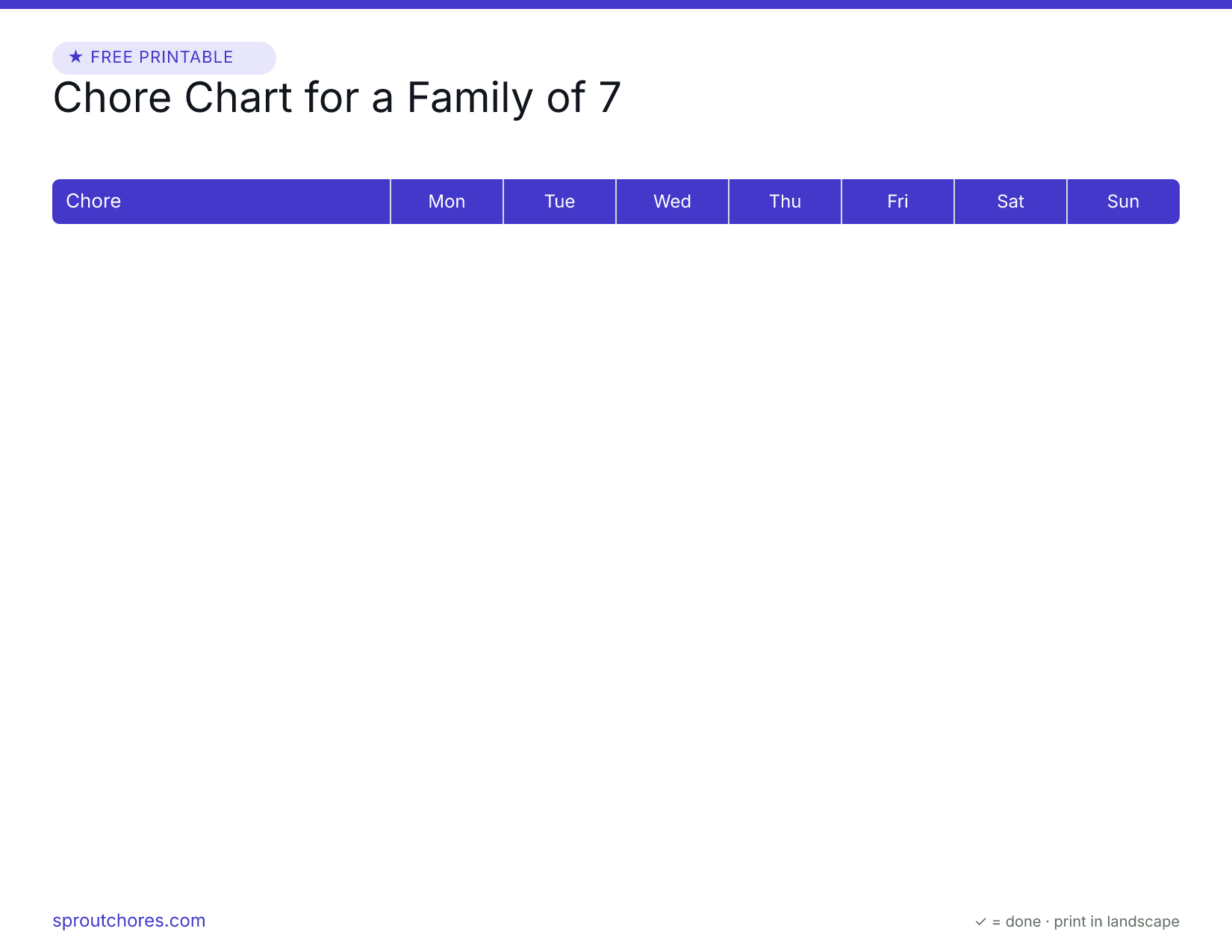
When our own household is at full strength it runs as six — two parents and four kids spanning a nine-year-old up to an eighteen-year-old — but during the years we fostered, our count climbed into the sevens and eights, so a chore chart for a family of 7 is something we've actually lived, not just sketched. A big household is exactly where most printable charts quietly give up: they're sized for a tidy two-parents-two-kids grid, and by the time you're feeding seven people they've run out of room. The chart below is different. It's a blank, editable grid — you name the seven people, you name the jobs, and you decide who does what. What we can add is the part no template prints: how you actually spread a real workload across seven people of very different ages, how to keep your most dependable kid from silently inheriting every miserable job, and why this works best as a way for the parents to keep track of the whole house rather than a sticker board built to bribe anyone.
| Chore | Mon | Tue | Wed | Thu | Fri | Sat | Sun | Remove |
|---|
Tip: choose Landscape in the print dialog for the best fit.
Print in landscape for the best fit. A few reminders from our family to yours: do it together the first few times, keep the chart somewhere everyone can see it, and reward steady effort over a perfect job. — The SproutChores family
Want every age in one file? Get the free Age-by-Age Pack
Six printable charts (ages 4–10) plus reward and routine sheets, in one tidy PDF — free, straight to your inbox.
We email you new printables now and then — unsubscribe anytime. Privacy.
Something went wrong — please try again in a moment.
✓ Almost there — check your inbox!
We just emailed you a confirmation link. Click it to confirm, and your free Age-by-Age Chore Chart Pack lands in your inbox moments later.
One shared list breaks down at seven people — give everyone their own column
The oldest mistake in a big family is a single chore list for the family of 7 taped to the fridge — dishes, trash, vacuum, laundry — a list that technically belongs to everyone and therefore lands on no one. That failure gets worse, not better, as the household grows: the more names that could be attached to a job, the easier it is for each person to assume somebody else has it covered. So the chart is built the other way around. Every person gets their own column with their name at the top and their own jobs beneath it, and the columns are kept compact on purpose so all seven fit on one readable page instead of spilling onto a second sheet nobody checks. You're not filling in our chore list for family of 7; you're filling in yours. Print it, and each person can see at a glance exactly what's theirs today — no shared list to disappear behind.
A family of 7 usually spans a wide age range — match the work to the person
Seven-person households are almost never made of kids the same age. You're typically stretched from a toddler to a teenager, or you're a blended family, a multigenerational one, or — as we were — a home whose count jumped when foster children arrived. That range is the whole reason a uniform list won't do. The youngest belong on anchor tasks: caring for themselves and keeping their own space, where the point isn't a spotless result but building the muscle of pitching in. The older kids carry the load-bearing work — cooking, dishes, yard, helping with repairs — and can be expected to do it well without being chased around the house. We don't treat any of it as a shortcut to a clean house; we treat it as rehearsal for the day each of them will run a home of their own, and that reframe changes what you're willing to put up with while they're still learning. Measure each kid against where they personally started, not against a sibling. In one house you can easily have an eleven-year-old who's delighted to design and run her own chart, a younger one who still needs each task named out loud in the moment, and a teen for whom the family grid has stopped working entirely — all correct at the same time.
Rotate the jobs nobody wants so your most dependable kid isn't taxed for it
Here's the specific tax a big family levies without meaning to: the more capable a kid is, the more the hard jobs drift their way, because they'll actually get done — and that kid notices, even if they never say so. Your steadiest eldest slowly becomes the household's unofficial shift supervisor, and quiet resentment follows. The fix is a rotation pool. Take the genuinely unloved jobs — scrubbing bathrooms, hauling all the trash, the after-dinner kitchen — and let them shift down the family week by week, so no single person owns the worst of it forever. Keep the little kids' anchor tasks fixed (a six-year-old isn't rotating onto the stove), and rotate only among the kids who can truly handle those jobs. Fairness in a large family chore chart was never about everyone doing identical work; it's a right-sized load for each person plus an even share of the jobs everybody dreads.
Build a big family chore chart that survives a chaotic week — and that any adult can run
Two truths hold in every busy house, and they bite hardest in a big one. First, the chart is mostly for you. With seven people moving through a single day, you can't keep everyone's progress in your head, so the chart's real job is to give you a fast read on who's keeping up and who needs a nudge — a read-out for the parents, not a bribe board for the kids. We keep the real motivation off of it entirely: the work gets done because this is everyone's home and the load belongs to all of us, not because a sticker is waiting at the finish. Rewards and screen time stay in their own separate lane, and while allowance exists in our house, it tracks the overall pattern — follow-through, reliability, and the attitude someone brings — rather than a set price per task.
Second, build it to be knocked down and stood right back up. A big household throws off a lot of real life — a sick week, a travel weekend, a holiday that flattens every routine — and the classic way one of these systems collapses is that a parent builds the flawless version, one messy week tips it over, and the whole family concludes it was never going to work. It didn't fail; it simply wasn't built to restart. So favor a chart you can abandon for a week and pick back up over an elaborate one you're afraid to break, keep it on paper and stuck up somewhere the whole family files past, and lean on advance notice — 'we'll run the laundry and reset the living room in an hour' lands far better than barking 'do it now.' And a big house needs one thing a small one can skip: a posted routine any adult can run. When more than two grown-ups are in the rotation — a grandparent, an older teen minding the little ones, or a co-parent stepping in as we did during our fostering years — a written pattern lets the day carry on without a negotiation. More than we ever expected, that same predictability is also what helped unsettled kids relax and start trusting that things would unfold the way they always had.
Frequently asked questions
- How do you make a chore chart for a family of 7?
- Give each of the seven people their own column instead of writing one shared list. Down each column, add jobs that fit that person's stage — self-care and their own space for the youngest, real household jobs like dishes, cooking, and yard work for the older kids. Drop the jobs everyone dreads into a weekly rotation so they're shared fairly, and leave a few age-appropriate tasks fixed. Then print it, post it where the whole family walks past it, and use it mainly to track who's keeping up. Because the chart is a blank, editable grid, you're filling in your own family's names and jobs rather than following a fixed chore list for family of 7.
- How do you divide chores fairly across such a wide range of ages?
- In a big family, fair doesn't mean identical. Two habits carry most of the weight. First, match each job to the person's stage so no one is set up to fail and no one is left bored — anchor tasks for the littles, load-bearing work for the olders. Second, rotate the jobs nobody wants — bathrooms, trash, the after-dinner kitchen — so your steadiest kid doesn't end up owning them just for being dependable. And remember that teenagers often do better on a job-style arrangement, with tasks asked for ahead of time, than on the same grid as their younger siblings.
- Does this chart work for a family of 8 or a bigger household?
- Yes. It's built with a column per person and keeps its shape as the count climbs, so a chore chart for a family of 8 — or a blended, multigenerational, or foster household that suddenly grows — works the same way. Add a column for each extra person, hand them age-appropriate jobs, and stretch the rotation pool wider so the hardest jobs keep moving. We've run our own house at six normally and at seven or eight during our fostering years, and a per-person big family chore chart holds up as long as everyone has their own column and the worst jobs never settle permanently on one person.

About the author
More free printables
Get the free Age-by-Age Chore Chart Pack
Six printable charts (ages 4–10) plus reward and routine sheets, in one tidy PDF. We'll also send new printables and the occasional real parenting tip. The charts on this site are always free — no sign-up needed.
We email you new printables now and then — unsubscribe anytime. Privacy.
Something went wrong — please try again in a moment.
✓ Almost there — check your inbox!
We just emailed you a confirmation link. Click it to confirm, and your free Age-by-Age Chore Chart Pack lands in your inbox moments later.