Chore Chart for Stay-at-Home Moms
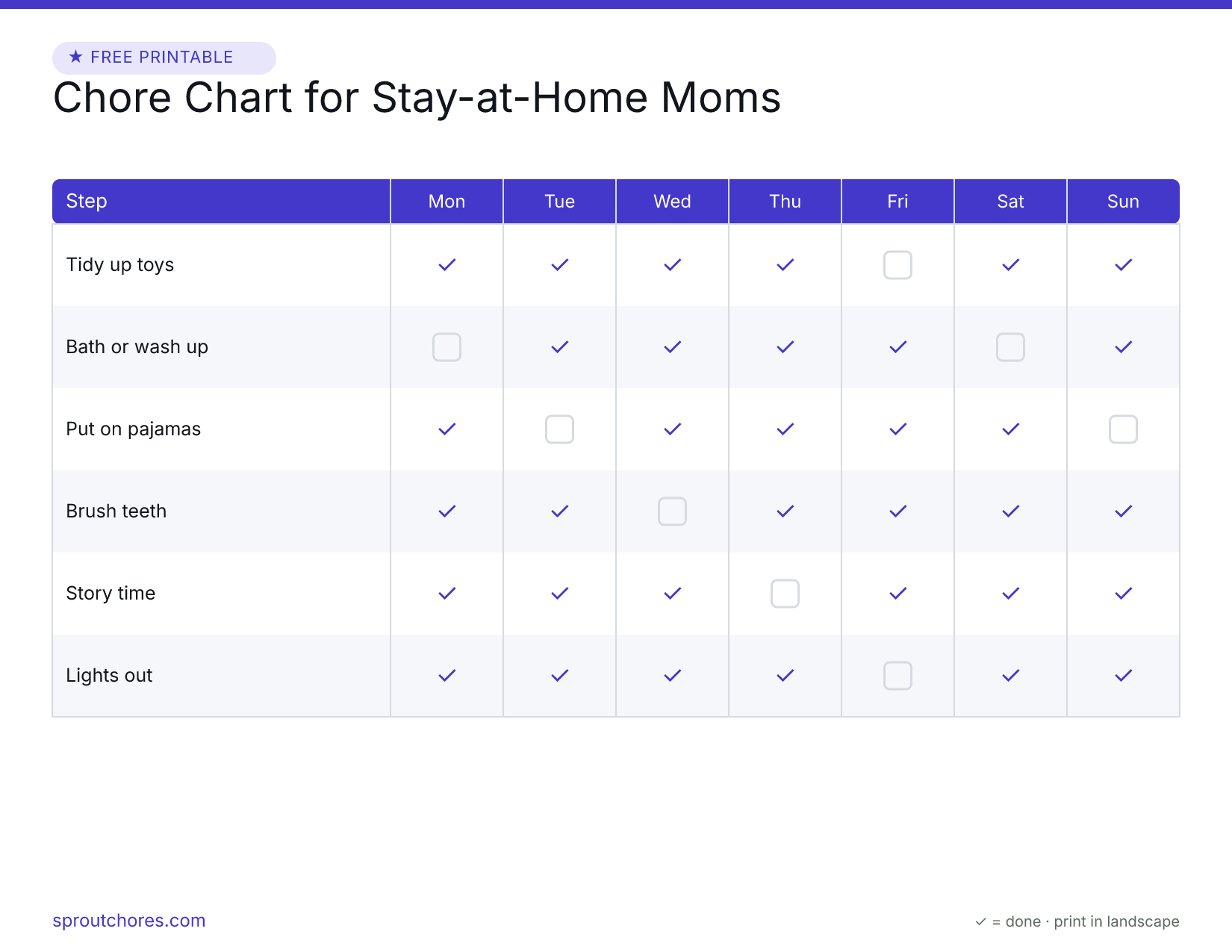
If you run the house all day, you already know the real problem isn't a shortage of chores to do — it's that the whole schedule lives in your head and never switches off. A chore chart for a stay-at-home mom isn't a kid's sticker grid pointed at you; it's a daily home rhythm you can actually see, so the mental load of remembering everything stops being one more thing you carry alone. I'm Andrew — my wife is home with our four kids, running our house and our homeschool, and over the years we've watched a simple, visible rhythm do more for a sane day than any productivity trick ever did. The chart below lets you build your own in about a minute: sketch the shape of a typical day and week — the cleaning passes, the meals, the school and errand windows, and real downtime — then print it or keep it editable and put it somewhere you'll genuinely look. Think of it less as a SAHM cleaning schedule to obey and more as a plan for the day the rest of the family can see too, because running a home was never meant to be a one-person job. Below the tool you'll find what makes a rhythm like this survive the first hard week, how to fit it to your own energy, and the honest reframe that finally made ours stick.
| Step | Mon | Tue | Wed | Thu | Fri | Sat | Sun | Remove |
|---|---|---|---|---|---|---|---|---|
| Tidy up toys | ||||||||
| Bath or wash up | ||||||||
| Put on pajamas | ||||||||
| Brush teeth | ||||||||
| Story time | ||||||||
| Lights out |
Tip: choose Landscape in the print dialog for the best fit.
Print in landscape for the best fit. A few reminders from our family to yours: do it together the first few times, keep the chart somewhere everyone can see it, and reward steady effort over a perfect job. — The SproutChores family
Want every age in one file? Get the free Age-by-Age Pack
Six printable charts (ages 4–10) plus reward and routine sheets, in one tidy PDF — free, straight to your inbox.
We email you new printables now and then — unsubscribe anytime. Privacy.
Something went wrong — please try again in a moment.
✓ Almost there — check your inbox!
We just emailed you a confirmation link. Click it to confirm, and your free Age-by-Age Chore Chart Pack lands in your inbox moments later.
A daily rhythm beats an hour-by-hour schedule
When people search for a stay-at-home mom schedule, they usually picture a color-coded timetable with a task pinned to every fifteen minutes. Those look wonderful and almost never survive a teething toddler, a sick day, or a week when the car needs the shop. The version that lasts is looser: a repeatable rhythm — rough blocks for the parts of the day that recur, like a cleaning pass, meal prep, school or errands, and genuine downtime — instead of a minute-by-minute script.
Building for flexibility isn't lowered standards; it's recovery. The systems that fell apart in our house were always the perfectly detailed ones, because the moment real life knocked over a single domino the whole thing felt 'ruined' and got abandoned. What we rely on now is a rhythm you can walk away from entirely for a week and simply resume when things settle — no guilt, no redesign. A daily chore list for a stay-at-home mom should be exactly that easy to pick back up.
One small lever helps enormously with everyone else in the house: naming what's coming before it lands. 'In a bit we're going to reset the living room' meets far less resistance than an out-of-nowhere order — and the chart does that work quietly, because the shape of the day is already on the wall for the whole family to see.
The chart is for you — not a list to feel guilty about
It's easy to turn a home chart into a scoreboard you can only lose against, and we'd push back on that hard. In our family a chart was never meant to motivate anyone with stars or prizes; its real job is to get the running list out of one person's head and somewhere you can all see it. For the parent quietly holding the entire schedule of a household, that alone is the point — you stop gripping every thread at once.
We learned how much a predictable pattern steadies a home during the seasons we fostered young children who'd arrived with almost no structure. What surprised us was who it helped most: not only the kids, but the adults. A dependable rhythm is what gave us evenings we could count on and the ability to hand the day off cleanly — one of us could say 'I need to step out, can you take it from here?' and the other could pick up without a briefing, because the plan wasn't locked inside one person's memory.
So treat this as a tracking tool and a shared plan, not a leverage device or a productivity gauntlet. Keep the reward stuff out of it — a smoother, calmer home is the payoff. Keeping the place running was never supposed to rest on one set of shoulders, and the chart mostly just makes the shared part visible.
Fit the rhythm to your own wiring, not someone else's
The best schedule is the one built around the person actually running it. I'm up before dawn and do my clearest thinking on a long early walk; my wife runs at the opposite end of the clock. Neither is right — the mistake is forcing your day into a shape that fights your natural energy. If you come alive in the morning, stack the heavier resets and the focused work there and leave the evening loose; if you're slow to start, protect the early hours and let the productive block land later. Build the rhythm around when you genuinely function.
The other quiet drain is the churn of a dozen half-remembered tasks circling in the background. The fix that reliably works for us is boring and effective: get every one of them out of your head and onto the page. A backlog you can see is far lighter than the same backlog looping silently, and writing it down lets you be honest about what truly has to happen today versus what can move to a 'later' list and stop taking up room right now.
And give yourself the grace we try to give the kids: start from the day you actually have, not the idealized one you wish you had. The goal isn't a flawless week — it's a steady one, and steady wins over perfect every single time.
Weaving the kids' routines into your day
A big share of a stay-at-home parent's rhythm is really shepherding smaller humans through theirs, so it helps to build their routines right into your chart instead of treating them as interruptions. In our house the running order is simple and consistent: schoolwork gets done first, then the day's chores, and then a lot of genuinely free time. We're firm that it isn't our job to fill every minute for them — we make sure there's plenty to reach for, and their free time is theirs to own. That structure steadies the adult running the day as much as it steadies them.
With very young kids you can hand off a surprising amount of the narrating. For our littlest ones we've leaned on simple picture cues placed right where each step happens, so a child can glance at the reminder and see what's next without you calling out every move. It turns their part of the routine into something they can begin to run themselves, which frees you up to keep the rest of the day moving.
Keep a copy of the whole rhythm somewhere central, too. When someone's sick or you get pulled away, an editable chart on the fridge means another adult can step in and keep the day on its rails without a play-by-play from you.
Frequently asked questions
- What does a realistic stay-at-home mom daily routine look like?
- Less like a rigid timetable than most templates suggest. What holds up over time is a repeatable rhythm — rough blocks for the things that recur every day (a cleaning pass, meals, school or errands, and real downtime) that you can shuffle when life demands it. The specifics should match your kids' ages and your own energy, not a stranger's idea of a perfect day. The chart above lets you sketch your own blocks across the week and adjust them as your season changes, rather than locking you into an hour-by-hour script you'll abandon the first rough morning.
- How do I make a chore chart for a stay-at-home mom that actually sticks?
- Keep it visible, keep it shared, and keep it easy to restart. Post it where you can't miss it, build it so a rough week is just a fresh start instead of proof it 'failed,' and let the rest of the household see it so the load is obviously shared. Fit it to when you actually function — morning person or night owl — and get your mental backlog out of your head and onto the page. You can build one in about a minute with the generator above, print it, or keep it editable so it changes as your family does.
- If I'm home all day, isn't the housework all my job?
- We don't see it that way. Being the parent at home means you carry the rhythm of the house, but keeping a home running is a job the whole family shares — partner and kids included. Handing children real, age-appropriate responsibilities isn't offloading; it's how they build the competence they'll need as adults, and it keeps the whole thing from resting on one person. A chart helps here because it turns 'everyone pitches in' from a hopeful phrase into something visible the family has actually agreed to.

About the author
More free printables
Get the free Age-by-Age Chore Chart Pack
Six printable charts (ages 4–10) plus reward and routine sheets, in one tidy PDF. We'll also send new printables and the occasional real parenting tip. The charts on this site are always free — no sign-up needed.
We email you new printables now and then — unsubscribe anytime. Privacy.
Something went wrong — please try again in a moment.
✓ Almost there — check your inbox!
We just emailed you a confirmation link. Click it to confirm, and your free Age-by-Age Chore Chart Pack lands in your inbox moments later.